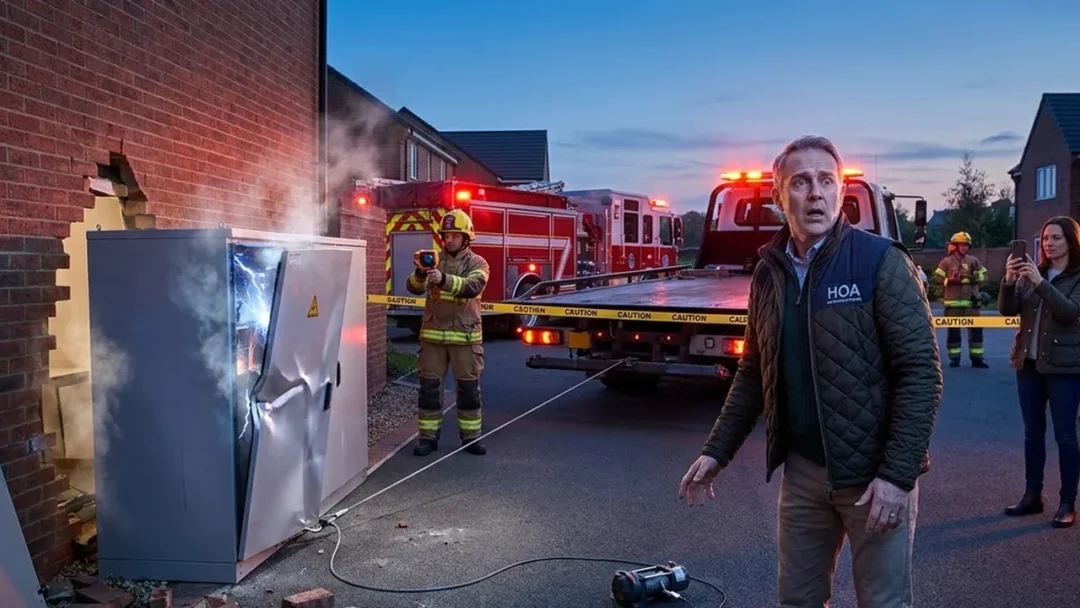
The Torqued Home Battery And The Evacuated Suburban Tow Truck
CHAPTER 1: THE WINCH CABLE AT FALCON CREST
The dry, searing heat of northern Maricopa County radiated off the exposed aggregate driveway at 114 Falcon Crest Reserve. Built against the rugged foothills of the McDowell Mountains in Scottsdale, Arizona, the master-planned development was an enclave of contemporary desert-modern villas. Low-slung roofs of dark bronze steel, sandy earth-toned stucco, and red-brick architectural veneer accent walls were engineered to blend harmoniously into the saguaro-studded landscape. Here, environmental efficiency was heavily promoted in sales brochures, yet daily life was policed by an aggressively pedantic Homeowners Association board that treated any visible deviation from suburban symmetry as a personal insult.
Sean Mitchell stood behind a bright yellow plastic chain strung across his side garage apron. At forty-four, Sean was a senior electrical systems architect for an aerospace defense contractor in Tempe. He had spent his professional career designing fail-safe power distribution systems for commercial avionics, and he treated high-voltage electrical installations with the profound, meticulous respect they demanded. Mounted securely to the red-brick veneer wall of his garage was a state-of-the-art silver Tesla Powerwall 3 home energy storage system. The sleek, brushed-aluminum cabinet stood four feet tall, weighing nearly three hundred pounds, and housed a high-capacity lithium-iron-phosphate battery bank capable of outputting thirteen point five kilowatt-hours of backup power.
Affixed prominently to the face of the cabinet was a durable polycarbonate inspection placard, stamped with the official gold seal of the City of Scottsdale: “CAUTION: ENERGIZED DC VOLTAGE 400V — CITY OF SCOTTSDALE BUILDING PERMIT #E-9921.” To the right of the unit, a heavy-duty rotary emergency rapid-shutdown switch stood illuminated with a steady green LED, signaling that the system was synchronized and live-connected to the municipal electrical grid. Sean had spent three months navigating city planning commissions, structural load calculations, and fire marshal reviews to guarantee that the installation exceeded all National Electrical Code standards.
The serene desert stillness was shattered by the harsh, metallic clatter of a heavy commercial tow truck backing rapidly up the incline.
The vehicle was a customized Ford F-550 Super Duty flatbed wrecker, finished in high-gloss black with chrome exhaust stacks and equipped with an industrial hydraulic wheel-lift and a twelve-thousand-pound planetary recovery winch. Painted on the cab doors in bold gold lettering was the business name: VANCE RECOVERY & TOWING LLC. The truck reversed with aggressive jerks, its dual rear mud tires crushing Sean’s decorative desert landscaping stones before coming to a stop barely four feet from the brick wall.
The driver’s door swung open with a heavy mechanical clunk. Warren Vance stepped down onto the driveway, slamming the heavy cab door behind him. At fifty-two, Warren was the vice-president of the Falcon Crest Homeowners Association and the principal owner of the repossession towing company. Dressed in grease-streaked work jeans, steel-toed cowboy boots, and an unbuttoned canvas work shirt exposing a heavy gold chain, Warren carried himself with the swagger of a man who believed that physical possession was ten-tenths of the law.
For six weeks, Warren had waged a personal vendetta against Sean’s solar installation. He had issued three separate five-hundred-dollar fines claiming the battery enclosure clashed with the neighborhood’s Tuscan-desert aesthetic palette, had threatened to have Sean’s solar contractor arrested for parking on the street, and had repeatedly asserted that no municipal building permit could supersede the CC&Rs of Falcon Crest.
Warren marched around the back of his flatbed, dragging a twenty-foot length of half-inch alloy steel recovery chain across the pavement. The links clanged loudly against the stones.
“Mitchell!” Warren barked, his voice coarse and arrogant. “Your thirty-day grace period expired at noon today. The board voted in executive session yesterday evening to enforce aesthetic compliance through direct abatement. This silver eyesore is coming off the wall.”
Sean remained behind the yellow safety line, his phone held in both hands, recording in high-definition video. “Warren, step back from that wall. You are trespassing on private property, and you are approaching an energized four-hundred-volt electrical service cabinet. That system was permitted, inspected, and approved under Arizona Revised Statutes section thirty-three-four-thirty-nine, which protects residential solar and energy storage installations from HOA bans.”
Warren laughed, a harsh, dismissive bark that showed his yellowed teeth. “I don’t give a damn about state statutes, Mitchell. Our subdivision covenants were recorded in 2004, long before you tech nerds started bolting lithium bombs to the outside of your houses. Falcon Crest rules outrank city hall permits on my watch. If you don’t unbolt it, my winch will.”
Warren stepped up to the battery cabinet, threw the heavy steel chain around the aluminum casing, and snapped a forged steel grab hook through the links, cinching the metal tightly against the fragile cooling fins. He unhooked the braided steel winch cable from the truck’s rear stanchion, locked the thirty-ton recovery clevis to the chain, and reached into his pocket for a magnetic wireless winch remote.
With a smug, mocking sneer, Warren held up the remote control, resting his thumb directly on the red power toggle.
The conflict between architectural aesthetics and clean energy modernism had been simmering in Falcon Crest Reserve for nearly two years. Established during the high-growth boom of the early two-thousands, the subdivision had adopted restrictive covenants designed to enforce a rigid vision of desert-southwest uniformity. Every home was required to adhere to a thirty-page architectural manual specifying acceptable exterior paints—shades with names like Desert Silt, Saguaro Bark, and Mesa Sand. But Arizona’s brutal summer temperatures, routinely topping one hundred and fifteen degrees, had caused residential electricity bills to soar past eight hundred dollars a month. Clean-energy technology had rapidly evolved from an eccentric hobby into an essential household survival strategy.
Sean Mitchell had anticipated resistance from the board. When he submitted his architectural review application six months earlier, he had included comprehensive three-dimensional CAD renderings, manufacturer specifications, sound-decibel acoustic ratings, and a certified letter from the Scottsdale Fire Marshal verifying that the proposed lithium-iron-phosphate chemistry was non-volatile and fully contained. But Warren Vance had personal reasons for his obstruction. As the owner of an aggressive commercial repossession agency, Warren viewed neighborhood management as an extension of his towing empire. He chaired the architectural enforcement subcommittee with an iron fist, issuing fines for unapproved garden hoses, towing delivery trucks parked more than ten minutes on residential curbs, and boasting at annual meetings that no state bureaucrat could dilute the power of a private covenant.