The Loaf Marked With a Cross
Part I — The Hand That Reached
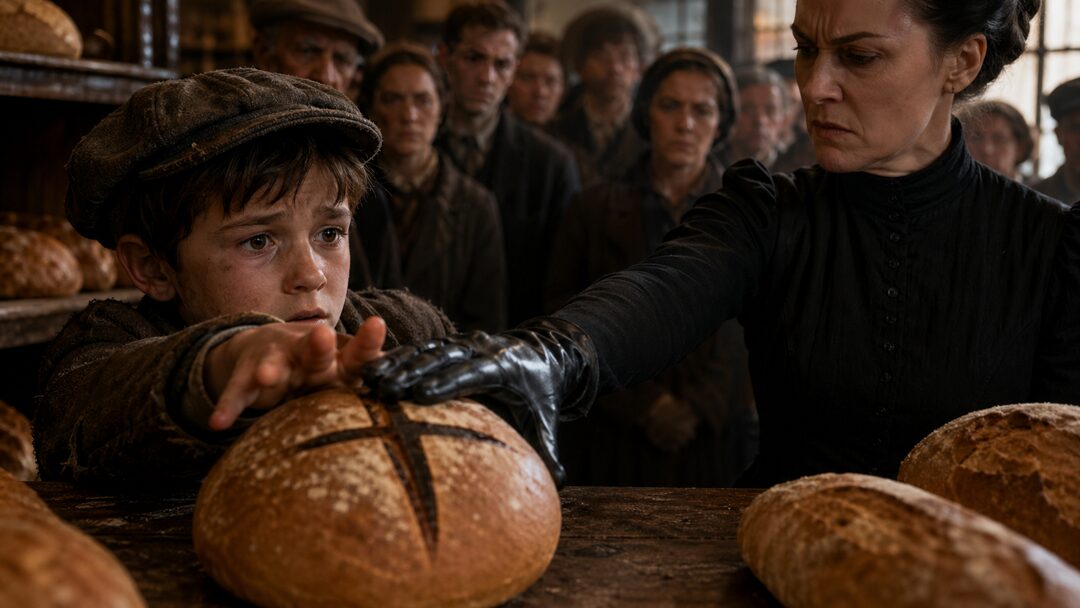
Tommy Carter’s fingers were almost around the loaf when his aunt struck his hand away.
The sound was small. Just skin against skin. But the bakery went quiet as if someone had broken glass.
The loaf rocked once on the wooden counter. It was round and brown and warmer than anything Tommy had touched in two days. Across its crust, cut deep and black from the oven, was a cross.
Not a church cross. Not a pretty one.
A rough mark, made by someone who knew exactly where to put the knife.
Tommy reached again.
Mrs. Evelyn Carter caught his wrist this time.
“Thomas.”
She never called him Tommy in front of people.
Her gloved fingers closed around his arm hard enough to pinch the bone. She lifted the loaf with her other hand and held it above him, out of reach, as if he were a dog nosing at a table.
A woman in the line sucked in a breath. A man near the door looked away. No one stepped forward.
No one ever stepped forward when Mrs. Carter had arranged herself into righteousness.
“You embarrass me,” she said, her voice clean and low, “even when I feed you.”
Tommy’s face burned hotter than the bread.
He had not meant to cut the line. He had not meant to make anyone look at him. He had waited outside Miller’s Bakery since before sunrise, hunched in his patched brown coat, cap pulled low, hands tucked under his arms until his fingers stopped aching from the cold.
But then he saw it.
The round loaf.
The cross.
His mother had been right.
For three weeks, he had carried her words inside him like a coal wrapped in paper.
If they turn you away, go to Miller’s on charity morning. Take the round loaf with the cross. Not any loaf. That one. And don’t let Evelyn see it first.
He had not known what she meant.
He still did not.
But Clara Reed had gripped his hand with the last strength left in her fevered body and made him repeat it until the nurse told her to rest.
“Say it,” she had whispered.
“The round loaf,” Tommy had said.
“With?”
“The cross.”
“And?”
“Don’t let Aunt Evelyn see it first.”
His mother had smiled then. Not happy. Not safe. Just relieved enough to stop fighting her own breath.
Now Aunt Evelyn had seen it first.
And everyone was watching.
The bakery was full of people who smelled of wet wool, coal smoke, old hunger, and pride worn thin. Men with hollow cheeks. Women with baskets. Children who watched the counter with quiet animal focus. Behind them, the morning windows were gray with frost.
Mrs. Carter stood behind the charity table as if it were a judge’s bench.
Dark dress buttoned to the throat. Polished shoes. Gloves. Hair pinned so tightly it looked painful. She had the kind of face people trusted when they needed rules more than mercy.
“She was stealing from the line,” someone muttered.
“He,” another voice corrected.
Tommy wished he could disappear under the counter.
“I wasn’t,” he said.
It came out too soft.
Mrs. Carter bent toward him, smiling without warmth.
“What was that?”
Tommy swallowed. His throat hurt. His stomach hurt worse.
“My mother told me to take that one.”
The words made her fingers tighten.
For a moment, only Tommy felt it. The squeeze. The warning.
Then Mrs. Carter straightened and gave a careful laugh to the room.
“Children make stories when they are ashamed.”
The crowd relaxed a little. That was what people wanted: an explanation that put the shame back where it belonged, on the small boy with dirty cuffs.
Tommy stared at the loaf.
The cross seemed darker now.
From behind the counter, an old man stopped tying a sack of flour.
Samuel Miller had been moving slowly all morning, like a man whose joints remembered every winter. Flour sat in the creases of his hands and along one eyebrow. His sleeves were rolled to the elbow. His apron was dusted white, but his eyes were dark and awake.
He looked at Tommy first.
Then at the loaf.
Then at the cross cut into its crust.
His face changed so little most people missed it.
Mrs. Carter did not.
“No need to trouble yourself, Mr. Miller,” she said. “The boy is mine to correct.”
Mr. Miller wiped his hands once on his apron.
“I’d like to see that loaf.”
The line shifted.
Mrs. Carter’s smile held.
“It is bread,” she said.
“Yes,” Mr. Miller said. “That is why I know when something is wrong with it.”
Tommy stopped breathing.
Mrs. Carter drew the loaf closer to her chest.
For the first time since Tommy had reached for it, she looked afraid.
Part II — Charity With Teeth
Mrs. Carter had taken Tommy in six days after his mother died.
She had not cried at the ward. Not where anyone could see. She signed the paper, collected Clara’s little bundle of things, and told the nurse, “My sister always did leave others to tidy what she could not bear to finish.”
Tommy had been standing right beside her.
He remembered the bundle: one blue ribbon, a comb with missing teeth, a handkerchief smelling faintly of lavender soap, and nothing else.
No ring. No photograph. No letter.
Nothing that said Clara Reed had once belonged to anyone but poverty.
At Mrs. Carter’s house, Tommy slept in the back room off the kitchen, where coal dust drifted under the door and the blankets smelled of onions. Every morning, he folded his cot before she came down.
“You are not a guest,” she told him the first day. “You are family, which is harder. Family must not make me sorry I showed mercy.”
Mercy had rules.
He did not ask for seconds.
He did not speak of his mother at table.
He did not say “Mama” in front of Mrs. Carter’s church friends.
He did not cry loudly.
And when Mrs. Carter stood at the charity table on Wednesdays, giving away bread from Miller’s Bakery to families poorer than herself, Tommy stood behind her carrying baskets and learned that hunger had ranks.
There were people deserving of bread.
There were people grateful for bread.
And then there was Tommy, who was fed only because Mrs. Carter could not bear the scandal of refusing him.
That morning, she had brought him to the bakery early to help stack loaves. She had told him to keep his hands folded.
Then the back door opened, and Mr. Miller came out with a tray.
Six long loaves.
Four square loaves.
One round loaf.
A cross burned into the top.
Tommy’s heart had slammed so hard he thought everyone heard it.
He waited until Mrs. Carter turned to speak with the minister’s wife. Then he slipped forward.
One step.
Two.
The smell of the bread rose into him like a memory of being loved.
Then came the strike.
Now the same bread rested in Mrs. Carter’s arms like a stolen child.
Mr. Miller came around the counter.
The crowd made room for him, not because he commanded it, but because people trusted old tradesmen with quiet hands. He had fed most of the street at one time or another, even when they paid late, even when they paid in buttons, mending, or promises.
Mrs. Carter did not move.
“Mr. Miller,” she said, “you are making a scene out of a boy’s bad manners.”
“The scene was already made.”
A whisper crossed the room.
Mrs. Carter’s mouth tightened.
Tommy watched Mr. Miller’s hands. They were large, cracked, and powdered with flour. Not soft hands. Not gentleman’s hands. But when he reached for the loaf, he did it as if asking permission from the bread itself.
Mrs. Carter held it back.
“I said no.”
Mr. Miller looked at her then.
Not with anger.
With recognition.
Tommy had seen men angry at Mrs. Carter before. Coal men unpaid. Renters ashamed. A drunk outside church after she refused his wife a parcel. Anger never touched her. She stepped around it like mud.
But recognition made her blink.
“You marked this,” Mr. Miller said quietly.
“I did no such thing.”
“No,” he said. “You didn’t.”
The crowd leaned closer without seeming to.
Mrs. Carter laughed once.
“I suppose now the bread has a history?”
“Everything has a history if someone tries hard enough to bury it.”
The sentence landed low and heavy.
Tommy felt his aunt’s fingers dig into his shoulder.
She had shifted without his noticing. One hand still held the loaf. The other clamped him in place, as if he might run off with the truth by himself.
A woman near the window said, “Let him look, Evelyn.”
Mrs. Carter turned on her with a kind smile.
“Mrs. Bell, when you have taken in your dead sister’s child and fed him from your own cupboard, you may advise me on generosity.”
Mrs. Bell lowered her eyes.
That was how Aunt Evelyn won. She did not shout. She made other people feel vulgar for noticing pain.
Tommy whispered, “Please.”
Mrs. Carter looked down.
It was worse than if she had slapped him again.
“Please what?”
He wanted to say, Please don’t take it. Please don’t make me go home. Please don’t make Mama wrong.
But the line was listening.
So he said only, “That one.”
Mrs. Carter lifted her chin toward the crowd.
“You see? Not bread. That bread. Greed becomes particular when it is indulged.”
Mr. Miller held out his hand.
“Then let us see what greed chose.”
Her glove creaked around the loaf.
For a second, Tommy thought she would refuse again.
Then someone in the back said, “If it’s only bread, let Miller break it.”
The room changed.
Not much.
Enough.
Mrs. Carter felt it. Her power had always lived in public agreement. Now public curiosity tugged against her.
She smiled as if granting a favor.
“Very well,” she said. “But when there is nothing inside it but air, Thomas will apologize to everyone in this room.”
She placed the loaf in Mr. Miller’s hands.
Tommy saw the old baker flinch.
Not from the weight.
From the cross.
Part III — The Mark in the Crust
Mr. Miller set the loaf on the counter.
He did not cut it immediately.
He pressed his thumb near the cross and held it there. His face went still in a way that made the bakery feel smaller.
Mrs. Carter saw it.
“Is the bread speaking to you, Samuel?”
His name, in her mouth, sounded like an insult dressed for church.
Mr. Miller did not answer.
Tommy had never heard anyone call him Samuel. Not like that. Not as if the name belonged to a younger man who had once stood somewhere foolish with his heart open.
Mrs. Carter leaned in.
“Or is this another one of your charities? You always did have a weakness for women who made other people pay for their mistakes.”
A rough murmur went through the line.
Tommy did not understand all the words, but he understood how people reacted to his mother’s name even when no one said it. A small shame passed from face to face. Some looked at him. Some looked at Mrs. Carter. Some looked at the floor.
Mr. Miller’s hand remained on the bread.
“Do not bring Clara into this.”
Mrs. Carter’s eyes sharpened.
“So we are allowed to remember her now?”
The room held its breath.
Tommy’s mother had been dead three weeks. But from the way the adults stood, he understood that Clara Reed had been buried long before the hospital took her.
A picture came back to him: his mother’s hand on his cheek, dry and hot, her blue ribbon tied around her wrist because her hair had fallen too thin to hold it.
“Listen to me,” she had said.
“I am listening.”
“No, Tommy. Listen like you do when you are afraid.”
He had nodded because he was afraid all the time then.
“If your aunt says I left you nothing, she is wrong.”
“You have to get better.”
“I left you something she cannot keep if you are brave enough.”
He had cried then. Quietly, because the woman in the next bed was asleep.
His mother had pulled him close.
“Go to Miller’s on charity morning. Take the round loaf. The one with the cross. Not the pretty bread. Not the biggest. The marked one.”
“Why?”
Her eyes had filled, not with tears exactly, but with time.
“Because some doors only open after someone is gone.”
Now Mr. Miller lifted the loaf and turned it over.
The bottom crust looked ordinary, darker at the edges. He tapped it once. Twice.
His jaw tightened.
“There’s a hollow.”
Mrs. Carter moved fast.
“Give it to me.”
Mr. Miller stepped back.
The crowd stirred again.
“No,” he said.
She smiled, but it had lost its shine.
“You forget yourself.”
“I did that once,” he said. “Not today.”
Mrs. Carter went pale around the mouth.
Tommy felt the words before he understood them.
There had been a story once. Not one told to children. A story that lived in cut-off sentences, in closed doors, in the way his mother stopped singing when Mrs. Carter entered a room.
His mother had grown up in the same house as Evelyn. Clara was the younger sister. The pretty one, people said when they thought Tommy could not hear. The foolish one. The one who laughed with flour on her sleeve outside Miller’s Bakery when she should have been looking higher than a baker.
Evelyn had married Mr. Carter, a man with a clean collar and a dry cough and a family name that still opened doors after the money ran thin. Clara had left town for a while. When she came back, she had Tommy and no husband worth naming.
Evelyn told everyone she had taken her sister in.
She never said what she charged for shelter.
Silence.
Gratitude.
The right to correct Clara in front of guests.
The right to call love a mistake and sacrifice a burden.
Now all those years seemed to gather around the loaf.
Mr. Miller reached for the bread knife.
Mrs. Carter said, “Samuel.”
Not sharp this time.
Soft.
That was what frightened Tommy most.
Mr. Miller paused.
For a breath, the bakery was not full of hungry people. It was full of the past.
Mrs. Carter lowered her voice, but everyone heard.
“Some things are kinder unopened.”
Mr. Miller looked at Tommy.
Then at the loaf.
“No,” he said. “Some things are only kinder to the person who closed them.”
He cut into the crust.
Part IV — What Fell Out
The knife made a dry crack through the top of the loaf.
Tommy heard someone behind him whisper a prayer.
Mr. Miller did not slice all the way through. He worked the crust carefully, thumbs pressing along the cross, finding a seam no one else would have seen. A wedge of bread loosened. Steam escaped, faint and sour-sweet.
Then something white showed beneath the crumb.
Paper.
Mrs. Carter made a sound too small to be a word.
Mr. Miller stopped.
For one second, no one moved.
Then he opened the loaf with both hands.
A folded note slid out onto the counter.
Beside it fell a small silver ring.
It struck the wood and spun once.
The sound was tiny.
It might as well have been a bell.
Tommy stared at it.
He had never seen the ring before. It was plain, narrow, and darkened from heat, but it caught the bakery light along one edge.
Mrs. Carter reached for it.
Mr. Miller’s hand came down over the ring.
“Don’t.”
She froze.
A man near the sacks of flour said, “Read it.”
Mrs. Carter turned so quickly he stepped back.
“This is indecent,” she said. “A dead woman’s private madness is not entertainment.”
Mr. Miller unfolded the paper.
His hands shook once. Then stilled.
Tommy could not read well enough from where he stood. He saw lines of tight writing, slanted hard, as if his mother had written while fighting for breath.
Mr. Miller read silently at first.
The longer he read, the more the room changed around him.
His shoulders sank.
His face emptied.
When he looked up, he did not look at Mrs. Carter.
He looked at Tommy.
And Tommy, who had been hungry his whole life without always knowing it, suddenly wanted to run.
Mrs. Carter spoke first.
“Clara was fevered.”
Mr. Miller’s voice came out rough.
“She was clear enough.”
“She was always dramatic. Need looked noble on her. It was her one talent.”
Mr. Miller looked down at the page again.
The line waited.
Someone coughed. No one told him to hurry.
He read aloud, not all of it. Only the parts that seemed to cut him open.
“Samuel, if this reaches you, it is because my son remembered better than the adults around him deserved.”
Tommy’s eyes blurred.
Mrs. Carter whispered, “Stop.”
Mr. Miller did not.
“I let another man’s name stand where yours should have been. I was afraid. Evelyn said your letters stopped because you had married in Barrow. She said you were ashamed of me. I believed her because I was tired and because I had already been taught that wanting you was a kind of disgrace.”
The crowd made a low, living sound.
Mrs. Carter stood perfectly still.
Mr. Miller’s mouth moved, but no sound came. He swallowed and continued.
“She knew, Samuel. She knew before Tommy was born. She took your letters. She took mine. When I came back with the child, she took us in and called it mercy. She made me pay for bread with silence.”
Mrs. Carter’s face had gone white except for two red spots high on her cheeks.
“That is enough.”
But no one moved to help her.
For the first time in Tommy’s life, Aunt Evelyn said a command and the room did not obey.
Mr. Miller read the last lines more softly.
“If I am gone when this is found, do not let her teach him he was a burden. He was loved before he had a name. Tell him that. Tell him I tried. Tell him the bread is his.”
The paper trembled.
Mr. Miller lowered it.
No one spoke.
Tommy looked at Mrs. Carter.
She looked smaller. Not weak. Never that. But reduced somehow, as if the dark dress and gloves and polished shoes had been built around a person who could not survive being seen.
Then she laughed.
One clean, dreadful laugh.
“A beautiful performance,” she said. “Clara always did know how to turn ruin into theater.”
Mr. Miller folded the note halfway, then stopped, as if afraid to hide even a corner of it.
“You told me she wanted nothing to do with me.”
Mrs. Carter’s eyes flashed.
“And you believed me.”
The words hit harder because they were true.
Mr. Miller flinched.
Mrs. Carter turned to the crowd.
“There. You have your scandal. A baker and a dead girl and a child who has learned to beg with props. Shall we pass the basket now? Shall we applaud?”
No one did.
She looked at Tommy.
“Come.”
Tommy did not move.
Her voice dropped.
“Thomas.”
He stayed where he was.
His knees shook so badly he felt them knocking inside his trousers.
Mrs. Carter’s face hardened.
“You will not stand there and shame me with her lies.”
Mr. Miller said, “They’re not lies.”
She turned on him.
“Ask him where he was when she coughed blood into a washbasin.”
That silenced him.
Mrs. Carter saw the wound and pressed.
“Ask him who held the basin. Ask him who paid the nurse. Ask him who kept that boy from the street when his mother’s romance had become nothing but a hospital bill.”
Mr. Miller shut his eyes.
Tommy looked from one adult to the other.
His aunt had taken his mother’s letters.
Mr. Miller had believed silence.
His mother had waited until death to tell him where to find the truth.
Every adult in the room had a reason.
None of the reasons were a home.
Part V — The Apology
Mrs. Carter held out her hand.
“Come here.”
Tommy stared at it.
He knew that hand.
That hand had tied his scarf too tightly in winter and smoothed his hair before church. It had measured flour for charity bread and pinched his ear when he forgot to say thank you. It had closed bedroom doors on Clara’s coughing.
It had struck him away from the loaf.
“You have caused enough spectacle,” she said. “You will apologize to Mr. Miller and to every person in this room. Then we will go home.”
Home.
The word had never sounded so thin.
Mr. Miller turned toward Tommy. His face was wet, though no tear had fallen.
“Tommy,” he said.
The name broke something open and did not fix it.
Mrs. Carter snapped, “His name is Thomas.”
Mr. Miller did not look at her.
“Tommy,” he said again, “you can come with me.”
There it was.
The rescue.
The thing some part of Tommy had been waiting for without knowing it.
A man with his mother’s note in his hand. A ring on the counter. A loaf split open. A name he had never been allowed to ask about.
Mr. Miller took one step closer.
“If your mother—if Clara—” His voice failed. He tried again. “I should have come. I should have looked harder. I should have known.”
Mrs. Carter smiled without mercy.
“Should have. The easiest words in the English language.”
Mr. Miller accepted it like a blow.
“Yes,” he said. “They are.”
The answer stole some of her power.
Tommy looked at him differently then.
Not as a hero.
As a man who knew he had failed.
That frightened Tommy less.
Mrs. Carter seized the loaf from the counter. Not the note. Not the ring. The bread.
She held it out to Tommy.
The room watched her change tactics the way a room watches weather turn.
“Here,” she said. “Take it.”
Tommy did not reach.
She softened her voice.
“You were hungry. I understand that. I was embarrassed and perhaps I was severe. Take the bread. Apologize for the rest. We will put this ugly business away.”
The loaf sat in her hands, open where Mr. Miller had broken it, the hollow exposed.
Tommy looked at the place where the note had been.
“Say your mother was confused,” Mrs. Carter said.
Tommy’s stomach turned.
“Say it,” she pressed, “and this ends.”
Mr. Miller’s hand curled around the note.
“No.”
Mrs. Carter ignored him.
“She was ill, Thomas. She wrote things she did not understand. Adults say many things when death is near. You are a child. You cannot carry her shame.”
Tommy heard his mother’s voice under hers.
Listen like you do when you are afraid.
He was afraid now.
More afraid than when Aunt Evelyn first struck his hand. More afraid than in the hospital ward. More afraid than when the coffin lid closed and no one let him put the blue ribbon inside.
Because this was the moment his mother had left him.
Not the bread.
Not the ring.
The choice.
Mrs. Carter pushed the loaf closer.
“Take it properly.”
Properly meant from her.
Properly meant as a gift.
Properly meant with his eyes lowered, the note denied, the ring forgotten, his mother made feverish and foolish again.
Mr. Miller said softly, “Tommy, you don’t have to—”
“I know.”
It was the first clear thing Tommy had said all morning.
The room heard it.
He stepped forward.
Mrs. Carter’s expression flickered in relief.
Then Tommy did not take the bread from her hands.
He reached past her, to the counter, and picked up the silver ring.
Mrs. Carter’s breath stopped.
Tommy closed his fist around it. It was warm from the loaf.
Then he took the note from Mr. Miller.
The old baker gave it at once. No tug. No claim.
Last, Tommy turned to Mrs. Carter and held out his hands for the bread.
For one moment, she almost refused.
But the crowd was watching.
She placed the loaf into his palms.
This time, no one struck him.
The bread was heavier than he expected. Its crust scratched his skin. Crumbs fell onto his coat.
He carried it to the center of the room, where a smaller child stood beside her mother, staring at the broken loaf with open hunger.
Tommy pulled the bread apart.
The crust resisted. Then gave.
He handed half to the little girl.
Her mother began to protest, then covered her mouth.
Tommy kept the other half against his chest with the note and ring.
Mrs. Carter whispered, “Thomas, do not be foolish.”
He looked at her.
His voice was not loud.
It did not need to be.
“My mother said this was mine.”
The sentence moved through the bakery like a door opening.
Mrs. Carter’s hand rose, then fell.
No one offered her a word to stand on.
For years, she had taught the town how to see Tommy: as burden, charity, mistake, evidence of Clara’s weakness.
Now he stood with bread in his arms and his mother’s note against his heart, and the town had to see him as something else.
Not rescued.
Not forgiven.
Not explained.
Claimed.
Part VI — The Ring Across the Counter
Mrs. Carter left without her basket.
That was what people remembered later.
Not the note. Not at first. Not even the ring.
They remembered Evelyn Carter walking out of Miller’s Bakery with her gloves still on and her basket still under the charity table, empty as a mouth after a lie has been pulled from it.
No one stopped her.
No one comforted her.
No one jeered.
That would have been easier for her. Noise could be condemned. Silence had to be survived.
At the door, she turned once.
Tommy thought she might call him again.
Thomas.
The name she used when she wanted him small.
But she only looked at the bread in his arms, then at the faces turned away from her, and stepped into the gray morning.
The bell above the door rang after she was gone.
The line did not move for a long time.
Then Mr. Miller cleared his throat.
“There’s bread,” he said.
His voice was rough, but it did its work.
People remembered their hunger.
Loaves passed from counter to hand. Coins appeared where there were coins. Names were marked where there were no coins. Mrs. Bell took two square loaves and touched Tommy’s shoulder as she passed, then seemed to think better of speaking.
The little girl ate her half too fast until her mother told her to slow down.
Tommy did not eat yet.
He sat on a flour sack near the back wall with the note folded in his lap and the ring hidden in his fist. He watched Mr. Miller serve the rest of the line.
The old baker did not look at him too often.
Tommy was grateful for that.
Too much looking felt like being taken.
At last the bakery emptied. The morning light had climbed higher, turning the flour dust gold. The counter was scratched and crumb-covered. The hollowed loaf lay beside Tommy, missing its secret and half its body.
Mr. Miller locked the door.
Then he stood behind the counter as if it were the only thing holding him up.
“I won’t ask you to call me anything,” he said.
Tommy looked down at the note.
His mother’s handwriting leaned across the page, thin but stubborn.
He was loved before he had a name.
The words hurt in a place hunger could not reach.
Mr. Miller came no closer.
“I would like,” he said, “if you allow it, to walk with you to your mother’s grave. Not today if you don’t want. Not ever if you don’t want. But I would like to hear about her last days from someone who loved her.”
Tommy ran his thumb over the ring.
A part of him wanted to punish the man.
Where were you?
The question sat between them because Mrs. Carter had put it there, but she had not invented it.
Mr. Miller looked at the floor.
“I should have come,” he said. “Even if I believed her. I should have come once just to be certain.”
Tommy waited for him to explain.
He did not.
That helped.
Outside, a cart rolled over the stones. Somewhere down the street, Mrs. Carter would be entering a house where every object still obeyed her. The folded cot. The kitchen door. The rules waiting in the air.
Tommy wondered if she would expect him by supper.
He wondered if he would go.
He lifted the bread and took one bite.
It was plain bread. Coarse at the edge where the hollow had dried. A little smoky from the oven. Nothing magical.
Still, he chewed slowly.
His mother had found a way to feed him after death.
Not enough to fill his stomach forever.
Enough to stop the lie.
Mr. Miller turned away and wiped the same clean patch of counter twice.
Tommy watched his shoulders.
They were broad, but bowed now, like the rafters over the oven.
He could have said father.
He did not.
He could have asked why his mother waited.
He did not.
Some questions were too large for a boy with bread in his mouth and a dead woman’s handwriting on his knee.
Instead, Tommy opened his fist.
The ring lay in his palm, silver and scarred from heat.
He stood, crossed the bakery, and placed it on the counter between them.
Mr. Miller looked at it but did not touch it.
Tommy pushed it closer.
Not all the way.
Just enough.
Mr. Miller understood. His face changed the way it had when he first saw the cross on the loaf—quietly, terribly, as if a life could break without making noise.
“Thank you,” he said.
Tommy picked up the note before the old man could look at it again.
Then he sat back down and took another bite of bread.
For a while, neither of them spoke.
The bakery smelled of flour, ashes, and something still warm enough to share.