The Fermented Fish Emulsion Sprinkler And The Obstructed Speed Trap
CHAPTER 1: THE RADAR ON ORCHARD RIDGE
The dry late-summer breeze rolled down from the foothills of the Cascade Range, sweeping across the vast apple orchards and vineyard slopes of Yakima County, Washington. In this high-desert agricultural basin, nourished by federal irrigation canals diverted from the Yakima River, generations of orchardists had transformed volcanic ash and sagebrush into the premier fruit-growing capital of North America. The air was laden with the sweet, ripening aroma of Gala and Honeycrisp apples hanging heavy on trellised branches, intertwined with the earthy fragrance of sun-baked irrigation ditches and freshly cut alfalfa. Orchard Ridge Road was a smooth, two-lane ribbon of newly paved black asphalt that stretched for three straight, unobstructed miles between rolling fruit blocks and residential estate parcels. Because of its wide shoulders and long downhill grade, the road had become a notorious weekend speedway for an organized local street-racing syndicate whose modified Japanese and European coupes frequently terrorized the neighborhood at speeds exceeding one hundred miles per hour.
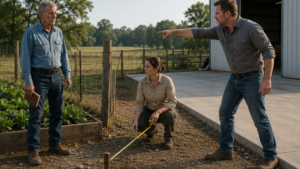
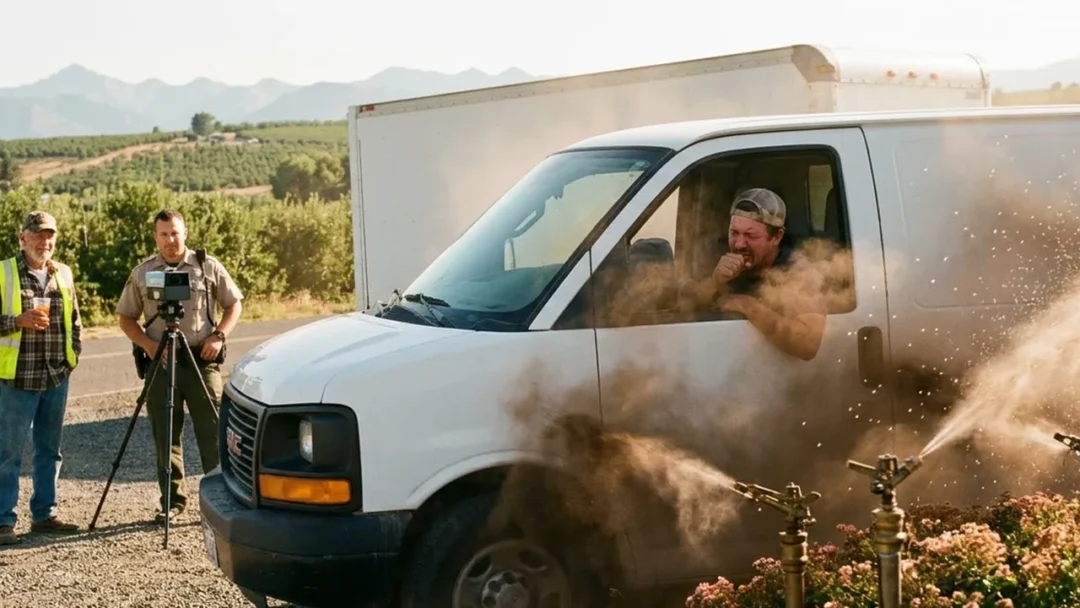
At half-past two on a bright Tuesday afternoon, seventy-six-year-old Arthur Campbell sat comfortably and calmly in a folding dark-green canvas camp chair at the edge of his wide gravel driveway apron. Dressed in a soft flannel work shirt, heavy canvas trousers, and a high-visibility lime-green volunteer safety vest, Arthur held an insulated tumbler of iced mint tea. For forty-eight years, Arthur had owned and operated a two-hundred-acre commercial Honeycrisp apple orchard before transitioning into semi-retirement. In Yakima County, fruit growing was not merely an occupation; it was a grueling, high-stakes battle against spring frosts, codling moths, and summer scorch. Arthur had spent decades climbing wooden ladders in pre-dawn freezing mists, firing smudge pots to save blooming buds, and engineering drip irrigation lines from mountain snowmelt. He knew every microclimate in the valley, the precise cubic-feet-per-minute output of every water pump along the canal, and the unbending laws of fluid dynamics. To a man who had outsmarted three severe droughts and forty hailstorms, an arrogant twenty-something kid in a commercial truck was nothing more than a minor mechanical problem awaiting a practical field solution. Today, his crowning glory was his front boundary: a five-hundred-foot, six-foot-tall living hedge of Grandiflora and hybrid tea roses, carefully grafted onto cold-hardy rootstocks and nurtured with meticulous precision throughout the arid growing season, whose velvety crimson and apricot blooms required rigorous horticultural discipline to maintain against the alkaline Washington soils.
Beside Arthur’s chair stood Officer Dan Cooper of the Yakima County Sheriff’s Office Traffic Division. Cooper was armed with the latest lidar technology because Orchard Ridge had become a priority enforcement zone. Over the preceding six months, the sheriff’s office had documented over thirty separate incidents of street racing, including hit-and-run property damage, mailbox destruction, and near-misses with farm combines moving between orchard blocks. The community had demanded action, and Cooper had volunteered to spend his afternoons working the checkpoint, determined to restore safety and peace to the rural families who had farmed these hills for a century. Cooper was a steady, professional deputy of forty-five, wearing dark tactical sunglasses and a crisp tan uniform. Mounted on a heavy aluminum tripod at the edge of the asphalt was a state-of-the-art LTI 20/20 TruSpeed laser lidar unit—a precision electro-optical speed enforcement instrument equipped with an internal heads-up display capable of clocking vehicles up to two thousand feet away.
“Valley is quiet right now, Arthur,” Officer Cooper observed, squinting through the sight glass toward the distant heat shimmer rising from the asphalt. Cooper took pride in his work as a traffic specialist. In his twenty years on patrol, he had handled fatal head-on collisions, rollover crashes on mountain passes, and grief-stricken parents standing in hospital emergency rooms. To him, speed enforcement in an agricultural community was not about ticket quotas or municipal revenue; it was about keeping teenage tractor drivers alive on narrow country roads and preventing street-racing syndicates from treating farm corridors like their private raceway. “Word usually gets out on their group chats the minute my cruiser parks on the ridge. But the dispatch center received six separate reckless driving complaints yesterday alone. Three modified sports cars ran a school bus off the shoulder near the packing shed on Monday.”
“They’ll be through here before three o’clock, Dan,” Arthur replied quietly, taking a slow sip of his iced tea. “Those boys treat this ridge like their private drag strip. They gather down at the gravel staging pit on Old River Road, wait until the commercial orchard trucks finish their afternoon haul, and then they run side-by-side time trials up the crest.”
Right on cue, the high-pitched, resonant wail of an uncapped turbocharger exhaust echoed from the valley floor two miles to the west.
Arthur and Officer Cooper looked down the straightaway. But it was not a low-slung sports car that rounded the orchard bend.
It was a massive, sixteen-foot commercial refrigerated box-van painted in glaring white enamel, sporting chrome wheel simulators and an enormous, loud refrigeration compressor unit mounted above the cab. The massive van accelerated aggressively up the steep hill, thick black diesel smoke puffing from its tall elevated stack.
Instead of slowing down as it approached the marked patrol cruiser and the lidar tripod, the box-van veered sharply onto the gravel shoulder. The sheer physical mass of the commercial vehicle was intimidating. It stood twelve feet tall, its tandem rear tires kicking up a cloud of chalky dust that drifted across the ditch. Tyler had deliberately loaded two thousand pounds of concrete ballast blocks in the cargo bay. He had spent days planning this operation with his fellow street racers, calculating that by anchoring the heavy refrigerated van on the narrow shoulder, he could exploit administrative loopholes in county parking enforcement while creating an impenetrable optical blind spot for the lidar. He viewed traffic safety laws not as community protections, but as personal inconveniences to be dismantled with mechanical arrogance and legal posturing. to give the vehicle unyielding stability, ensuring that a standard municipal police tow truck with a light boom could not hoist the axle without specialized heavy-duty recovery equipment. The heavy tires threw crushed limestone against the curb, and with an aggressive hiss of air brakes, the massive white vehicle reversed sharply, backing straight up toward the radar station.
The heavy steel rear step bumper stopped exactly three inches from the fragile optical glass lens of the lidar tripod.
Curiosity Lock: The driver’s door flew open, and a young man wearing a backwards baseball cap and designer sunglasses hopped down onto the gravel, twirling a set of commercial van keys on his index finger with an insufferable smirk.