The Archimedes Ironwood Lever And The Lost Armored Transport Discovery
CHAPTER 2: THE ARCHIMEDES FULCRUM
Vince Brock stared at the silver-bearded mountain hermit in utter disbelief. He looked at the massive fourteen-foot ironwood log, then at the old man’s worn oilskin duster, and let out a harsh, mocking laugh that cut through the thunder.
“Well, look who crawled out of the rhododendrons!” Vince mocked, shaking rainwater from his sleeves. “Amos Calloway, the mountain ghost! Put the firewood down, old man! Did you hit your head on a cliff? My eight-ton commercial hydraulic recovery winch just snapped a steel cable rated for sixteen thousand pounds! You think you’re going to rescue a four-ton tractor with a tree branch? You’ll rupture every disc in your eighty-year-old spine!”
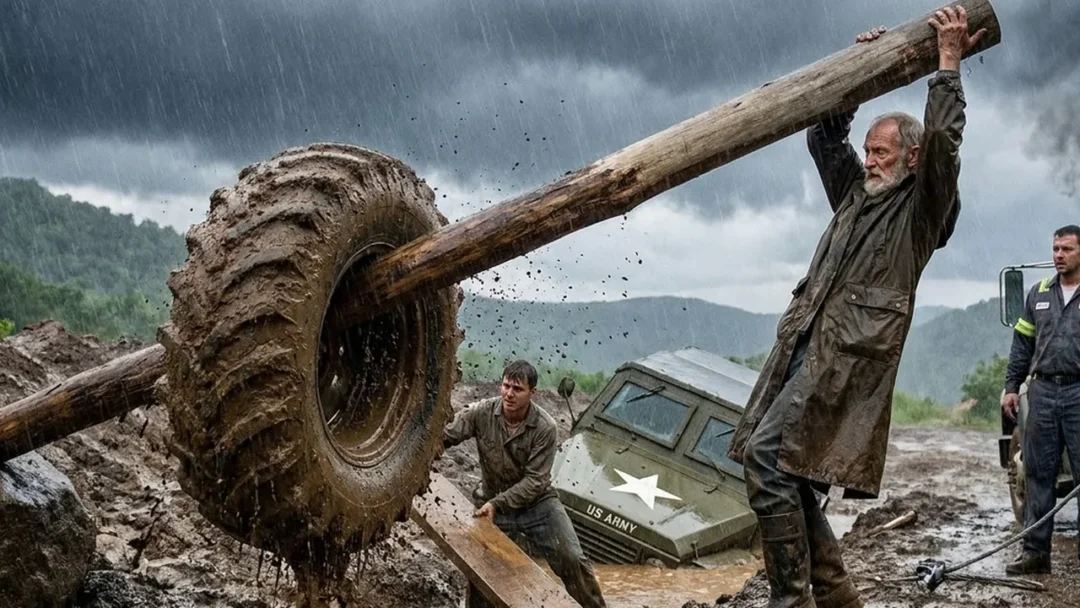
Amos Calloway did not look at Vince Brock. He did not blink against the driving sheets of mountain rain. He walked past the idling wrecker, stepped down into the knee-deep mud hole beside the tractor’s sunken drive wheel, and lowered the heavy ironwood timber onto the gravel shoulder with a dull, ground-shaking thud.
The timber was a masterpiece of natural forestry. Mountain ironwood, also known in the Appalachians as hop hornbeam, possesses the highest modulus of rupture and compressive strength of any hardwood species native to the eastern United States. With a Janka hardness rating exceeding nineteen hundred pounds, green ironwood fibers possess extraordinary longitudinal tensile strength, capable of flexing under immense tonnages without fracturing along its growth rings.
Amos knelt in the rushing red-clay water, completely indifferent to the freezing mud that soaked through his work pants. He laid his bare, scarred palms against the tractor’s rear axle housing, feeling beneath the slurry where the iron rim was wedged against the granite ledge.
His assessment took ten seconds.
“The tire isn’t stuck on mud, Toby,” Amos said, his voice deep, gravelly, and unhurried. “The tire dropped into a localized sub-surface cavity. The lower sidewall is pinched against a vertical shelf of iron-hard stone. Every time that wrecker pulled forward, it was wedging the steel rim deeper into a mechanical vise. You can pull with fifty tons of horizontal force and you will only shear the tractor in half.”
Amos stood up, his grey eyes scanning the washed-out road cut above the ditch.
Ten feet up the steep bank, half-buried in the wet gravel and shale, rested a wedge-shaped boulder of solid Blue Ridge granite, measuring roughly two feet across and weighing at least one hundred pounds.
Amos did not ask for a shovel. He stepped up the loose shale bank, drove the iron-chiseled tip of his walking staff beneath the granite boulder, and pried it loose with a single, controlled heave. As the heavy rock rolled down into the ditch, Amos intercepted it with his boot, bent his knees into a disciplined deep deadlift, and hoisted the one-hundred-pound granite boulder in his bare arms.
He carried the stone into the mud pit and slammed it down six inches from the sunken tractor wheel, bedding the rock deep into the clay until it rested solidly against the underlying bedrock.
“There is your fulcrum,” Amos said simply.
The geometry was classical, elegant, and ancient.
Amos took the fourteen-foot ironwood log. The short end of the timber—fitted with an antique hand-forged iron band around its butt to prevent splitting—was shoved eighteen inches deep beneath the tractor’s heavy cast-iron axle trumpet housing, resting squarely over the crest of the granite boulder.
The remaining twelve and a half feet of the massive ironwood timber projected upward and outward into the road at a thirty-five-degree angle, forming a textbook first-class lever with a mechanical advantage ratio of nearly nine to one.
Amos pointed at a stack of rough-sawn two-inch-thick white oak planks resting on Toby’s trailer bed.
“Toby,” Amos commanded, his voice ringing with absolute authority. “Grab the two thickest oak planks. Stand right beside the rim. The moment you hear the mud suck air, drive those planks beneath the tire treads. Don’t hesitate.”
Vince Brock stood on the road shoulder, crossing his arms and shaking his head in loud, derisive scorn. “You’re out of your mind, Calloway! Archimedes lived in Greece, not on a muddy Virginia logging road! You can’t lift three thousand pounds of axle weight with your arms!”
Amos Calloway stepped to the high, outer end of the fourteen-foot timber. He looked down at the sunken tractor, his jaw setting like a block of Blue Ridge granite.
“Give me a place to stand,” Amos quoted softly, his eyes flashing beneath his silver brow, “and I will move the earth.”
The mechanical principles governing first-class levers were first mathematically formulated by Archimedes of Syracuse in the third century Before Christ in his foundational treatise On the Equilibrium of Planes. The fundamental law of the lever establishes that the ratio of the load force to the applied effort is inversely proportional to the ratio of their respective distances from the fulcrum: F1 * D1 = F2 * D2. In the case of Amos Calloway’s field-expedient rigging, the short arm of the lever extending from the granite fulcrum to the tractor’s axle trumpet measured precisely sixteen inches, while the long effort arm extending to the outer tip measured one hundred and fifty-two inches, yielding an effective mechanical advantage ratio of nine point five to one. Furthermore, because ironwood possesses an exceptionally high modulus of elasticity—exceeding two million pounds per square inch—the beam stores elastic strain energy during the initial deflection, releasing that stored potential energy dynamically at the instant the vacuum seal ruptures.