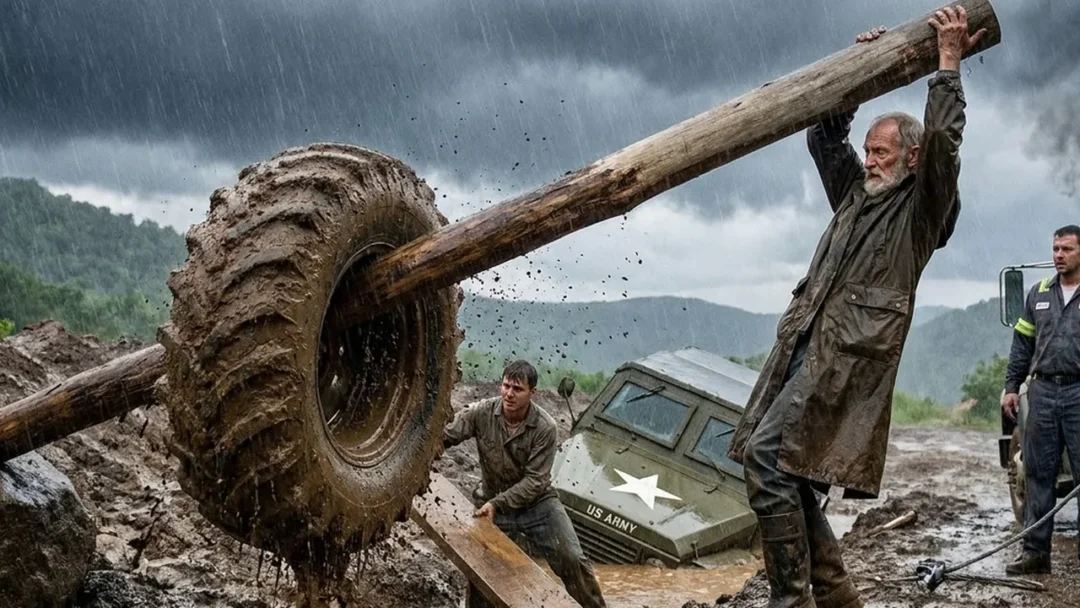
The Archimedes Ironwood Lever And The Lost Armored Transport Discovery
CHAPTER 3: THE POP OF THE VACUUM
The torrential rain seemed to redouble its fury, sweeping across the exposed crest of Devil’s Elbow in howling grey gusts. The wind whipped the heavy branches of the mountain hemlocks, filling the air with the roaring roar of a thousand cascading waterfalls.
Amos Calloway did not hesitate.
He planted his heavy logging boots firmly on the high tail-end of the fourteen-foot ironwood beam, nine feet above the churning red mud of the road. His long oilskin duster whipped behind him in the mountain gale like a tattered battle flag. He reached up, clamped his bare, calloused hands around the rough bark of the timber, and dropped his full one-hundred-and-eighty-pound body weight into the lever.
The initial resistance was immense. The tractor’s left rear corner weighed approximately twenty-four hundred pounds in static dead weight, and the vacuum adhesion of the thick, colloidal clay exerted an additional three thousand pounds of downward hydraulic suction.
For two seconds, the ironwood log groaned under the astronomical bending moment.
The dense green fibers along the bottom face of the fourteen-foot beam stretched under thousands of pounds of tensile stress, bowing downward in a graceful, taut arc like an ancient English longbow. Vince Brock leaned forward, a triumphant smirk ready on his lips, fully expecting the heavy timber to splinter in half and send the old hermit crashing headfirst into the shale ditch.
Then Amos engaged his legs.
Using the iron-banded fulcrum over the granite boulder as a pivot point, Amos did not merely hang; he drove downward with explosive, piston-like leg-press torque, his vastus lateralis and gluteal muscles locking into an unyielding bridge of kinetic power. The nine-to-one mechanical leverage multiplied his dynamic effort into over twenty-five hundred pounds of direct, vertical upward breakout force applied to the tractor’s axle trumpet.
The ironwood beam held. Not a single fiber split.
Deep beneath the surface of the mud pit, the physics of atmospheric pressure were violently overturned.
SCHLUCK-POP!
The sound was not subtle. It was an explosive, wet, concussive vacuum rupture that sounded like an artillery shell plunging into a deep marsh.
Air rushed violently into the void beneath the sunken tire, breaking the hydraulic suction seal with a fountain of bubbling grey water and red clay. Under the relentless upward thrust of the Archimedes lever, the massive four-hundred-pound agricultural tire lifted cleanly out of the abyss.
One inch. Three inches. Five inches.
The tractor’s rear axle rose majestically above the jagged rock shelf, completely suspended in mid-air upon the tip of Amos’s ironwood beam. Amos held the lever down with steady, unyielding pressure, his boots locked, his breath flowing in deep, calm nasal cycles, holding the multi-ton machine suspended as steadily as a clock weight.
“Now, Toby!” Amos roared over the storm. “Planks! Under the tread!”
Toby Miller did not freeze.
With adrenaline coursing through his veins, Toby lunged into the mud pit, carrying two three-foot-long, two-inch-thick rough-sawn white oak planks. He slammed the first plank deep into the cavity beneath the suspended tire, followed instantaneously by the second plank, creating a solid, elevated wooden bridge that spanned the entire sinkhole.
“Planks set! Planks are locked!” Toby screamed, scrambling clear of the wheel well.
Amos slowly, deliberately eased his weight off the lever.
The heavy ironwood beam rose, and the massive tractor tire settled firmly down onto the oak planks with a solid, satisfying thud that was music to Toby’s ears. The axle was six inches clear of the mud. The drive tire had solid traction.
Toby scrambled into the tractor cab, pumped the diesel primer, and hit the heavy starter switch.
The three-cylinder John Deere diesel engine coughed once, belched a cloud of warm black smoke into the rain, and roared to life with a healthy, rhythmic chug. Toby engaged the differential lock, eased the clutch out, and the tractor rolled smoothly forward across the oak planks onto the solid gravel road, towing the forty hives safely out of the quagmire.
Vince Brock stood on the shoulder with his mouth hanging open, his arms dropping limp at his sides. He stared at the tractor idling safely on the high road, then at the fourteen-foot ironwood log resting on the boulder, and finally at Amos Calloway, who was calmly stepping down from the bank without a single tremor in his limbs.
“He… he lifted that axle by hand…” Vince stammered, his voice choked with humiliated shock. “He broke sixteen thousand pounds of clay vacuum with a tree trunk…”
Amos did not answer the tow-truck driver. He walked back to the edge of the drained mud pit, his eyes narrowing as he looked down into the depression where the tire had been wedged.
With the heavy tractor removed, the swirling torrent of rainwater was rapidly washing away the thick slurry of red clay from the bottom of the sinkhole.
And as the water drained through a deep fissure in the rock, the beam of Vince’s wrecker lights struck something that did not belong in an Appalachian ditch.
Rising out of the washed-out shale was a flat, horizontal plate of four-inch-thick armored steel, coated in faded olive-drab military paint. And painted across the center of the steel plate, weathered by seventy years beneath the earth but still distinctly visible beneath the rushing water, was a five-pointed white military star.
Amos Calloway froze. His grey eyes widened in sudden, profound recognition.
“Toby,” Amos said softly, his voice cutting through the falling rain with chilling clarity. “Turn off the engine. That was never a sinkhole.”
The historical context of the nineteen-fifty-two Blue Ridge disaster was intimately linked to the intense military construction boom of the early Cold War. Following the escalation of hostilities on the Korean Peninsula, the Department of the Army had expanded the mountain training installations at Camp Shenandoah, constructing classified underground communications bunkers and radar relay stations across the remote ridges of western Virginia. Convoy Four had been tasked with delivering the monthly military payroll and classified cryptographic codebooks to the regional communications battalion during a severe late-autumn weather depression that had dumped over twelve inches of rain across the Shenandoah Valley in less than twenty-four hours. When the unstable limestone overhang at Devil’s Elbow collapsed, an estimated forty thousand tons of mud, fractured granite, and timber had sheared off the upper ridge, burying the road under forty feet of debris in less than fifteen seconds.
The tactical recovery procedures taught by the US Army Corps of Engineers during the second World War emphasized the use of natural rigging expedients over motorized winches in remote theater operations. In muddy jungle terrain or deep European mud where heavy recovery wreckers were immobilized, combat engineers were trained to construct ‘deadman’ anchors, shear-legs, and improvised lever systems using local hardwood timber. An eight-inch green ironwood trunk possessed a higher safety factor against sudden catastrophic shear failure than standard three-inch structural steel tubing, which would buckle under asymmetric lateral bending. Amos’s seamless execution of the Archimedes lift was not an improvised accident; it was the distilled combat engineering doctrine of a generation that had built airfields in the mud of the Pacific and bridged the roaring Rhine under enemy fire.