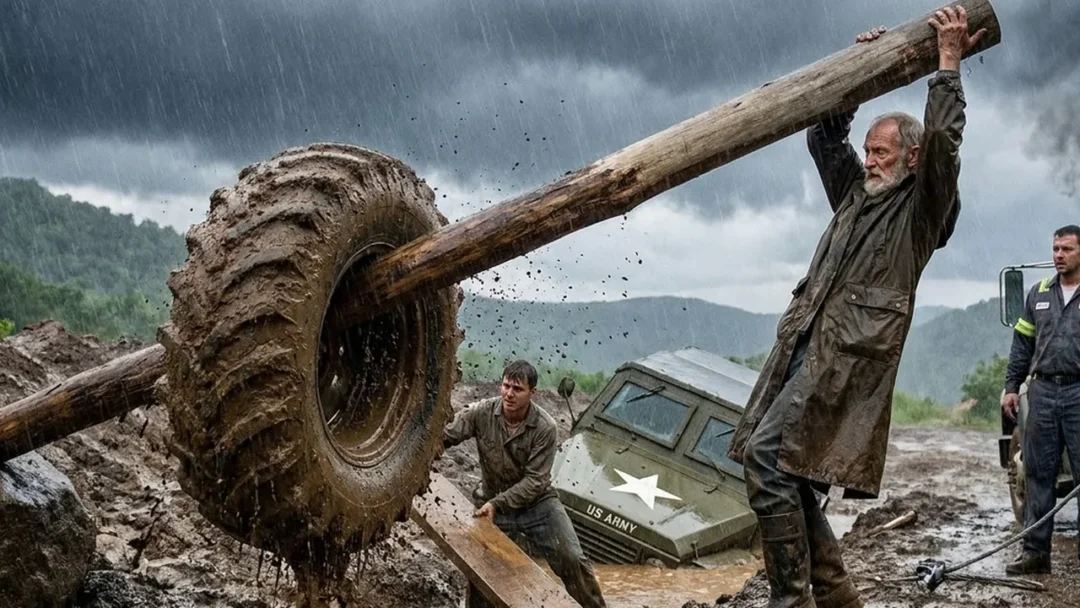
The Archimedes Ironwood Lever And The Lost Armored Transport Discovery
CHAPTER 5: THE GUARD ON THE MOUNTAIN
Within forty-five minutes of Toby’s emergency radio transmission, the lonely logging pass at Devil’s Elbow was transformed into a high-security military operations zone.
Slicing through the torrential rain came three green-and-white Virginia State Police four-wheel-drive cruisers, followed by two heavy tactical transport trucks carrying a full engineering detachment from the Virginia National Guard. Tactical floodlight trailers were deployed along the mountain road, illuminating the washed-out ditch with blinding, stadium-grade white light that turned night into day.
Stepping down into the mud, dressed in field camouflage and an official military trench coat, was Major Ethan Hayes—a forty-eight-year-old logistics officer and chief historian for the state National Guard.
Major Hayes did not glance at Vince Brock, who sat shivering in the cab of his wrecker under the watchful eye of an armed state trooper. Hayes walked directly toward the excavation pit where Amos Calloway stood guard beside the armored turret hatch.
Major Hayes stopped two paces from the old hermit. His eyes traveled from the white star on the armor plate to the weathered face of Amos Calloway. Slowly, with profound military discipline, the Major snapped a rigid salute.
“Mr. Calloway,” Major Hayes said, his voice thick with emotion. “For seventy-two years, the records of the Department of Defense listed Convoy Four as an unresolved Cold War disappearance. During the anti-corruption investigations of the late nineteen-fifties, political cynics in Washington accused the three young soldiers aboard this vehicle of executing a coordinated payroll theft and fleeing across the Canadian border.”
Major Hayes knelt in the rushing water, his fingers gently brushing the mud from the engraved brass padlock.
“My grandfather was Corporal Marcus Hayes,” the Major whispered, tears welling in his eyes. “He was the radio operator in this vehicle. For seventy years, our family carried the agonizing shame of a stolen payroll investigation. My father spent his entire life petitioning the Department of the Army to clear my grandfather’s name.”
Major Hayes produced an official set of military bolt-cutters from an engineering kit. He set the hardened jaws against the antique brass shackle.
SNAP!
The seventy-year-old padlock sheared cleanly. With the assistance of two combat engineers using heavy pry-bars, the massive circular cast-armor turret hatch was unsealed, breaking an airtight seal that had held since November of nineteen-fifty-two.
A portable halogen floodlight was lowered into the dark, lead-lined interior of the armored car.
The crew compartment was completely intact. Dry, sterile, and preserved in the cold mountain shale, the interior had never flooded. Resting in the driver and commander seats were the preserved personal effects, dog-tags, and official duty logs of the three fallen soldiers, proving that they had remained at their posts until the mountain slide had crushed the forward chassis.
And secured in the heavy steel ammunition racks beneath the turret was a locked, olive-drab steel chest.
Major Hayes opened the chest lid.
Resting inside, stacked in immaculate, wax-sealed bundles that smelled of aged ink and fresh minting press paper, were forty-two thousand dollars in pristine, uncirculated nineteen-fifties United States Silver Certificates, along with two small canvas pouches containing four hundred uncirculated gold Saint-Gaudens double-eagle twenty-dollar coins.
Every single dollar was present. Every record was accounted for.
“They didn’t steal it,” Major Hayes whispered, his voice breaking as he held his grandfather’s tarnished military dog-tags against his chest. “They stayed with the transport until the mountain fell. They were heroes.”
The legal and ethical implications of weather-related towing fraud had long plagued stranded motorists along interstate and mountain transit corridors. Predatory recovery operators like Vince Brock capitalized on geographic isolation, severe weather emergencies, and the catastrophic physical vulnerability of commercial haulers to demand exorbitant, non-negotiable cash payments that violated statutory price-gouging prohibitions under state consumer protection acts. By falsely declaring legitimate extraction operations to be hazardous salvage scenarios, such operators systematically bypassed standard commercial insurance billing schedules. The intervention of Amos Calloway not only liberated Toby Miller’s agricultural payload, but provided the direct, irrefutable eyewitness testimony required by the Virginia State Police to permanently dismantle a predatory towing racket that had victimized dozens of mountain travelers.
The recovery of the 1952 payroll documents provided definitive forensic closure to one of the most painful unsolved mysteries in the archives of the Virginia National Guard. For three generations, the families of Corporal Marcus Hayes, Sergeant Thomas Vance, and Private First Class Arthur Higgins had lived under the shadow of speculative military inquiries, as sensationalist tabloid journalists periodically published fabricated conspiracy theories alleging that the three soldiers had staged the landslide to abscond with forty-two thousand dollars in federal funds. The discovery of the intact, sealed ammunition chest, verified by state forensics with every serial number matching the original nineteen-fifty-two treasury manifests, proved that the three young men had fought to the last second to save their vehicle, clearing their family names and restoring their sacred honor in the permanent historical rolls of the Commonwealth.