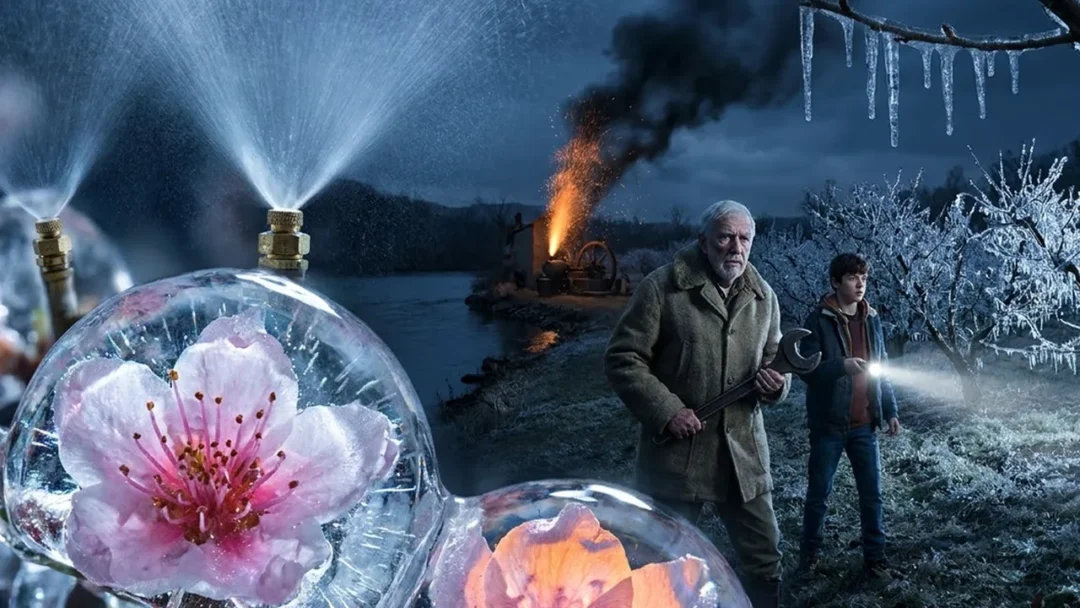
The Black Frost Midnight And The Blooming Peach Orchard Lanterns
CHAPTER 6: EIGHT MINUTES TO SUNRISE
When Toby reached the concrete apron of the pumphouse, the stench of scorched diesel fuel, hot engine oil, and electrical insulation burned his nostrils.
Inside the corrugated metal shed, Arthur was already at work, discharging a dry-chemical fire extinguisher onto the smoking manifold of the six-cylinder Detroit Diesel pump. White chemical powder billowed into the freezing air, smothering the orange flames that had licked up the exhaust wrap.
“What happened, Grandpa?!” Toby yelled, coughing as he grabbed a secondary chemical canister.
The phenomenon of frazil ice was one of the most treacherous hazards known to cold-water hydraulic engineers. Unlike surface sheet ice that formed under quiescent, still conditions, frazil crystals were tiny, discoid needles of ice that nucleated throughout super-cooled, turbulent water when stream velocity prevented surface stratification. As these sticky microscopic needles tumbled through the intake flume, they adhered instantaneously to any metal surface they contacted, bridging across the steel intake mesh and forming an impervious, frozen barrier in less than sixty seconds.
Arthur tossed the empty extinguisher aside, shining his heavy industrial flashlight into the dark pump pit below the concrete floor. “Frazil ice in the creek! The water temperature in Cedar Creek dropped to thirty-one point eight degrees. In turbulent, moving water, ice doesn’t form a surface sheet; it forms millions of microscopic, needle-sharp frazil crystals suspended in the current. Those crystals got sucked against our intake screen, clogged the mesh in ten seconds, and starved the pump impeller!”
Arthur pointed his beam at the shattered casing of the main cast-iron centrifugal pump. The iron housing was split wide open from the flange to the discharge collar, a six-inch jagged fissure bleeding steaming water onto the concrete.
“When the pump cavitated, the back-pressure shock wave blew the casing,” Arthur said, his voice grim and taut as a wire. “The main pump is dead iron. It’s finished.”
Toby looked at his wristwatch. The glowing hands read 2:54 AM.
He looked up through the open door toward the dark orchard. The three thousand sprinklers were silent. On the branches of the Elberta peach trees, the wet glaze on the outside of the crystal ice shells was already turning dull, matte-white, and hard. The water was no longer liquid. It was no longer releasing latent heat.
“Grandpa…” Toby whispered, tears of exhaustion and panic freezing on his eyelashes. “The ice is turning solid white. How long do we have before the cold penetrates the shells?”
Arthur pulled his pocket watch from his vest, checking the second hand.
“The thermal inertia of that ice jacket will hold thirty-two degrees for approximately eight minutes in a nine-degree gale,” Arthur said, his jaw tightening into iron. “After eight minutes, the temperature of the petal inside drops below twenty-eight. At six minutes past three o’clock, every embryo in this orchard dies.”
As Toby sprinted across the dark yard, the memory of his father David felt closer than it had in the two years since the highway accident. David had been a man who refused to panic in the face of mechanical calamity, a mechanic who believed that iron and steel always spoke a logical language if a man had the discipline to listen. On winter mornings like this, David would have been working the wrenches alongside Arthur, laughing quietly at the bluster of the Vance corporation across the road. Toby could feel his father’s work gloves gripping his own hands, steadying his breath, pushing his boots forward through the frozen ruts toward the equipment shed.
Eight minutes.
Sixty years of his grandfather’s labor, four generations of family history, and the entire financial future of the farm hung on four hundred and eighty seconds.
Toby’s mind raced through the equipment inventory of the farm like an electrical current. The spare electric pump in the barn was only fifty gallons per minute—not enough to pressurize a single row. The county fire department was twenty miles away on icy roads.
Then, through the darkness of the equipment yard, Toby’s eyes locked onto the silhouette of the north machinery shed.
“Grandpa!” Toby shouted, grabbing Arthur’s coat sleeve. “Dad’s ninety-thirty John Deere tractor! In the north bay!”
Arthur frowned, looking at him through the smoke. “The ninety-thirty? It doesn’t have an irrigation pump attached—”
“No, but it has the rear fifty-four-horsepower PTO shaft and the three-inch Crisafulli emergency flood pump we used during the ninety-six river overflow!” Toby screamed over the wind. “The pump is mounted directly on the three-point hitch! It’s rated at twelve hundred gallons per minute at five hundred and forty RPM!”
Arthur’s eyes ignited with a fierce, brilliant spark of hope. “The Crisafulli discharge flange… it matches our three-inch emergency fire bypass manifold on the exterior wall!”
Arthur checked his watch. “Seven minutes remaining, Toby. Run!”