The Black Frost Midnight And The Blooming Peach Orchard Lanterns
CHAPTER 8: THE DAWN OF CRYSTAL GLASS
At 6:15 in the morning, the violent north wind finally died to a gentle whisper.
Along the eastern crest of the Blue Ridge Mountains, a thin, brilliant band of pale gold and lavender light broke through the dark sky, heralding the arrival of the morning sun. The Arctic polar vortex was retreating eastward, replaced by a mild, calm high-pressure front drifting in from the south.
On the weather mast, the digital display climbed slowly upward: -4°C… -1°C… 0°C… +2°C.
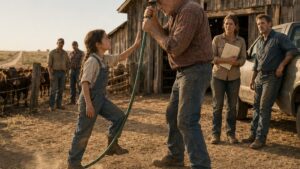
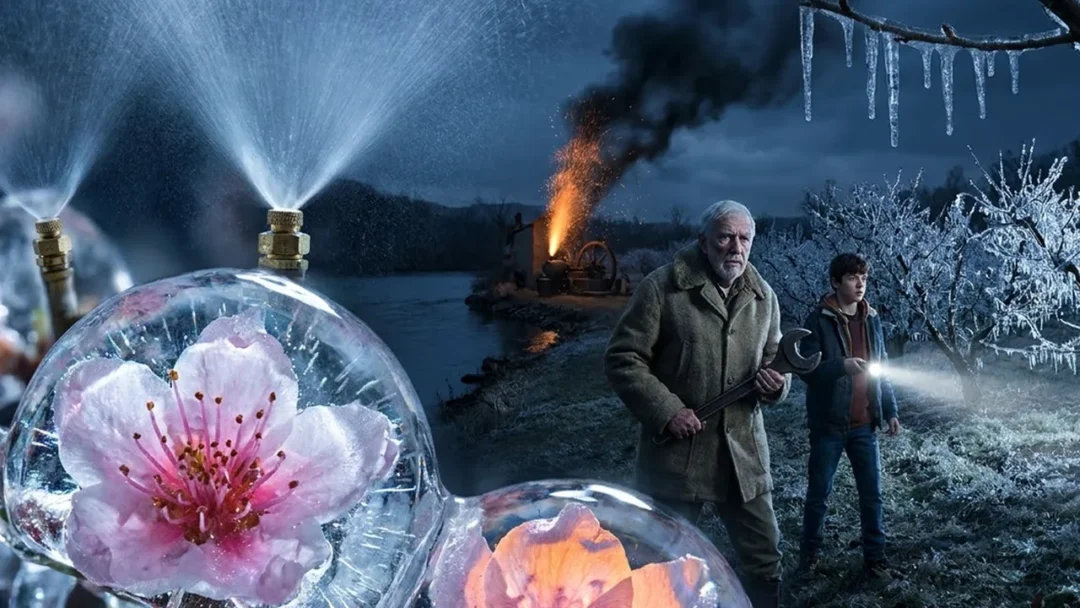
Toby sat on the tailgate of his grandfather’s pickup truck, an empty metal mug clutched between his gloved hands, watching the dawn break over Black Willow Valley. He was covered in frost, his muscles ached with an exhaustion so profound he could barely lift his head, but his eyes were filled with wonder.
As the first direct golden rays of the rising sun struck the seventy acres of Pendelton orchard, the entire valley exploded into an unimaginable spectacle of light.
Every single tree, from the low ground along the creek to the high ridge along the road, was encased in a flawless, crystal-clear shell of solid ice. In the horizontal morning light, the orchard did not look like an agricultural field; it looked like a vast, shimmering cathedral carved from diamonds and crystal glass. Millions of icicles hung like prisms from the branches, refracting the sunrise into blinding rainbows of ruby, amber, and emerald that danced across the valley floor.
And then, as the air warmed to forty degrees, the ice began to melt.
A gentle, musical sound filled the quiet morning—the sound of millions of crystal drops falling from the branches, splashing into the soft grass below like a spring shower.
Toby walked down row twelve beside his grandfather. Together, they stopped beneath the hundred-year-old Belle of Georgia peach tree that had weathered the storm.
With a soft, crystalline crack, the ice shell encasing the central blossom loosened, slid from the branch, and shattered harmlessly on the wet turf below.
Arthur reached out with bare, trembling fingers, gently tilting the branch toward the morning sun.
The blossom was immaculate.
The five delicate pink petals were fully expanded, soft and velvety as silk, radiant with vibrant, living color. The yellow stamens in the center stood proud and straight, heavy with golden pollen. As the sun warmed the petals, the rich, intoxicating fragrance of living peach blossoms rose into the clean morning air, sweet and triumphant.
Across the entire seventy acres, not a single bud had turned black. Not a single embryo had been lost.
Across the gravel road, the scene at the Vance Commercial Fruit Company was a tragic contrast. Caleb Vance stood in the middle of his blackened rows, surrounded by smoldering rubber tires and pools of greasy sludge. The Arctic wind had done its grim work. Every single blossom on his dwarf trees was curled, shriveled, and charred black by the frost, crumbling into brittle powder when touched. His entire multi-million-acre commercial crop was gone.
Caleb walked slowly to the boundary fence, staring across at the Pendelton orchard. His face was soot-stained, his shoulders bowed in complete and utter defeat. He looked at Arthur, then at Toby, and finally down at the crystal ice melting peacefully into the green grass.
“Arthur…” Caleb croaked, his voice cracking with humbled awe. “You… you saved every single tree.”
Arthur looked at his neighbor across the fence. There was no mockery in the old man’s eyes, no gloating triumph. There was only the quiet, enduring dignity of a craftsman who respected the earth and understood its laws.
“Nature doesn’t care about shortcuts, Caleb,” Arthur said gently. “She only responds to truth, patience, and the courage to stand your ground when the cold hits.”
Beyond the physical survival of the crop lay a profound vindication of regenerative generational stewardship. In an era dominated by corporate agricultural consolidation, where small family farms were routinely bought out and bulldozed for monoculture dwarf tracts, Arthur had proven that deep structural knowledge of natural laws was more powerful than brute industrial spending. By nine o’clock, the regional agricultural extension agents from Virginia Tech pulled onto the levee road, their clipboards and digital cameras at the ready. They had spent the early morning surveying frozen, blackened disaster zones across four counties. Walking into Arthur’s shimmering, blooming orchard, their faces mirrored the utter disbelief that Caleb Vance had shown hours earlier. They took endless core samples of the pristine green wood, recording the moisture levels, verifying that every single delicate pink petal was completely unblemished.
When the local agricultural extension agents arrived later that morning to inspect the miracle, they found an elderly man and his teenage grandson quietly cleaning the tractor nozzles, completely unbothered by the acclaim.
Arthur turned to Toby, putting his arm around his grandson’s shoulders.
By noon, the economic reality of the night began to register across regional commodity exchanges. Buyers from major wholesale produce distributors in Baltimore, Washington, and Philadelphia were burning up the telephone wires, desperate to lock in seasonal forward contracts for certified pesticide-free heritage stone fruit. With over ninety percent of the Mid-Atlantic peach crop wiped out by the black frost, the value of the Pendelton harvest had surged to four times its projected autumn baseline. The mortgage on the packing facility, the overdue property tax assessments, and Toby’s future college tuition in mechanical engineering were secured in a single night of frost and water.
“Come on inside, Toby,” Arthur smiled, his pale eyes shining in the brilliant morning light. “Your grandmother left a fresh pot of coffee on the stove. We have a harvest to prepare for.”