The Black Frost Midnight And The Blooming Peach Orchard Lanterns
CHAPTER 3: THE PHYSICS OF FUSION
Toby took a hesitant step forward, ducking under the freezing spray of the nearest overhead sprinkler. He wiped the mist from his goggles and aimed his beam at the branch his grandfather indicated.
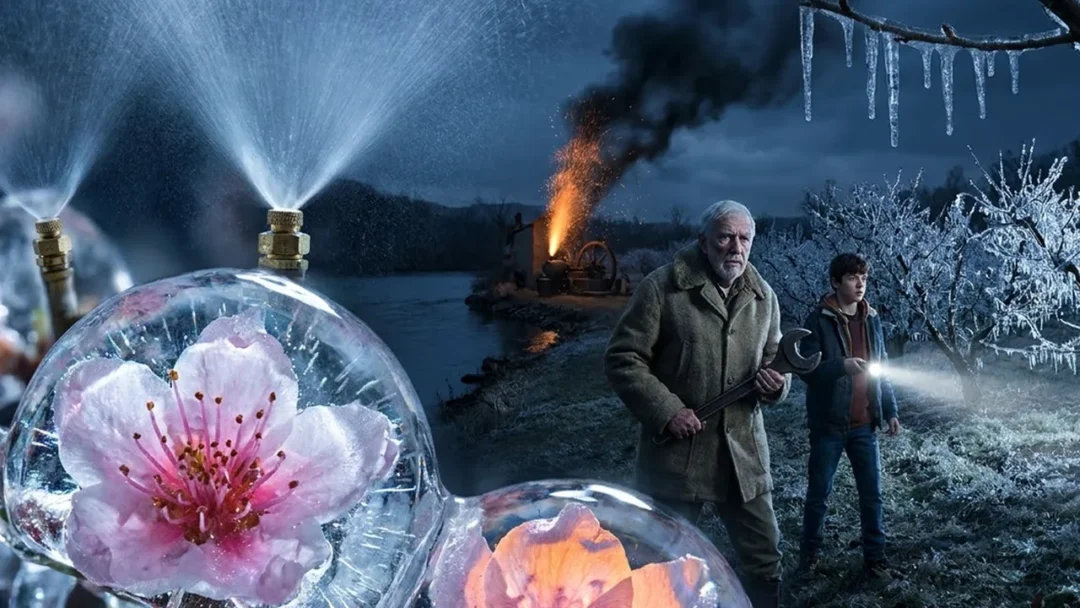
A cluster of three delicate pink peach blossoms hung before him, completely encased inside a three-millimeter-thick shell of clear, glistening ice. The ice was not milky or white; it was crystal-clear, like hand-blown Bohemian glass.
And inside that glass dome, the petals were not black. They were not curled or shriveled. They were a vivid, radiant, velvety pink, their delicate yellow stamens standing upright and firm, perfectly preserved in the center of the icy capsule.
“Why aren’t they freezing?” Toby whispered, his eyes wide with astonishment as he touched the smooth, wet outer surface of the ice shell. “The air out here is minus seven degrees. Why isn’t the flower turning into an ice cube?”
“Because of the latent heat of fusion,” Arthur explained, pulling a red thermal-imaging camera from his canvas coat pocket and handing it to the teenager. “Look through the screen.”
Toby pressed the rubber eyepiece of the thermal camera to his face. The monochrome gray world of the night exploded into vivid false-color infrared.
Outside the ice shell, the howling air was painted in deadly, abyssal shades of dark cobalt blue and deep violet—minus seven degrees Celsius. But inside the transparent ice dome, surrounding the delicate pink peach blossom, the display glowed with a bright, incandescent halo of warm orange and gold.
Toby blinked, unable to believe what the sensors were telling him. “Grandpa… the camera says the petal inside is at zero degrees Celsius. Exactly thirty-two degrees Fahrenheit. How is it warmer inside the ice than the air outside?”
“Thermodynamic physics, son,” Arthur said, tapping the screen with a gloved finger. “Water cannot change its physical state from liquid to solid without releasing energy. For every single gram of water that freezes onto that branch, eighty calories of heat are released into the immediate environment. As long as our sprinklers keep spraying fresh water, and as long as that water is actively freezing on the outside of the shell, that heat has nowhere to go except inward, directly into the blossom.”
The mathematical elegance of phase change had fascinated Arthur since his days monitoring marine boilers on Atlantic convoys. In pure water, the transition between states was governed by strict thermodynamic constants that neither corporate marketing nor emergency panic could alter by a single decimal point. While ambient air molecules lost kinetic energy rapidly in the howling north wind, the continuous deposition of liquid water molecules onto the forming crystal lattice created an uninterrupted exothermic reaction. It was, in the most literal scientific sense, a fire made of freezing water.
Arthur stepped beside the tree, pointing to the water droplets continuously coating the clear ice.
“The ice shell isn’t a tomb, Toby. It’s an insulator. A thermal barrier. The outside of the ice is exposed to the minus-eight gale, but the inside of the ice, where the liquid water is actively bonding to the crystal lattice, is locked at thirty-two degrees. As long as water remains in equilibrium between freezing and liquid, the temperature cannot drop below thirty-two. And a peach blossom doesn’t suffer cellular frost damage until it drops to twenty-eight.”
Toby lowered the camera, staring at the glowing orchard in rising awe. Across seventy acres, three thousand sprinklers were spinning, creating millions of tiny, glowing thermal lanterns across the dark valley.
“So the water is creating its own furnace…” Toby breathed.
“Exactly,” Arthur nodded. “Eighty calories per gram. But there is a catch, Toby, and it’s a deadly one. The process only works as long as the water never stops flowing. If the water supply interrupts for even five minutes, the freezing stops. The ice stops releasing latent heat. And once that happens, the ice shell conducts the sub-zero air straight into the petal, turning that protective shield into a frozen coffin.”