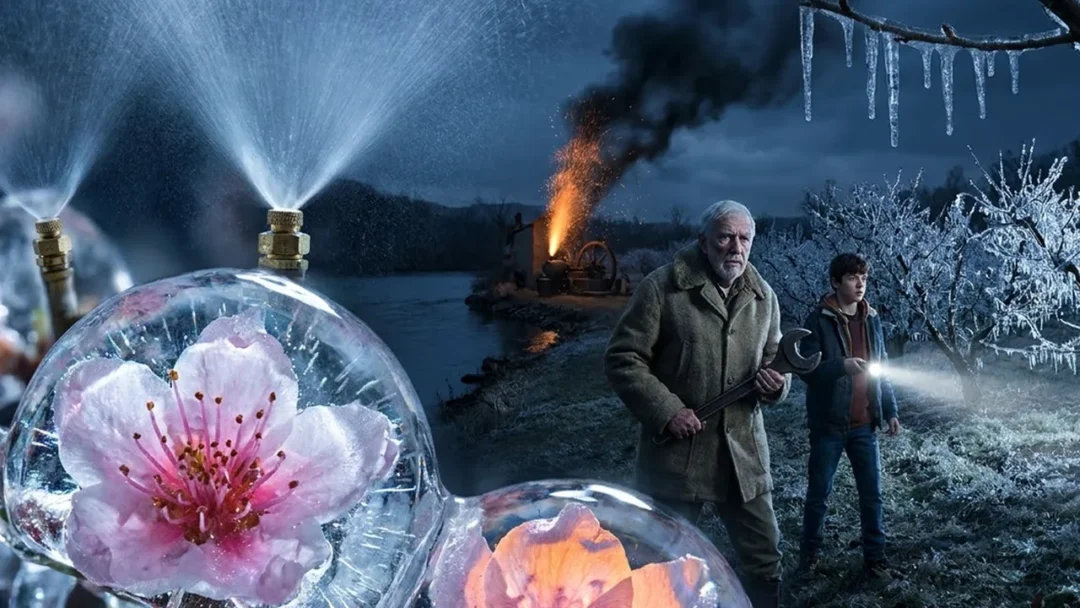
The Black Frost Midnight And The Blooming Peach Orchard Lanterns
CHAPTER 4: THE SMUDGE FIRE FIASCO
By 1:30 in the morning, the temperature on the weather mast dropped past -7.5°C.
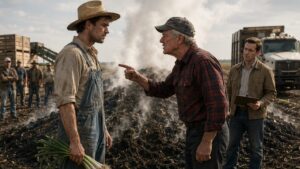
Across the gravel road at the Vance Commercial Fruit Company, conditions were deteriorating into absolute catastrophe. Caleb Vance’s heavy smudge fires were choking the low ground, but the fierce thirty-mile-an-hour north wind was sweeping the heat away before it could rise through the dwarf canopy. Worse still, the thick, oily black soot from the burning rubber tires had settled like a greasy shroud over Caleb’s delicate blossoms.
Caleb stood by his fence, coughing violently into a rag, watching his workers futilely dump more diesel onto the smoldering tire piles. The intense radiant heat from the open fires near the borders had actually scorched the lower limbs of the nearest trees, burning the leaves to ash, while thirty feet away, the sub-zero wind had flash-frozen the unshielded blossoms.
“Caleb!” Arthur called out from across the ditch, shining his flashlight toward the fence. “Shut those tire fires down! You’re scorching your border rows and the soot is coating your pistils! You’re killing whatever blooms the frost hasn’t touched!”
“Mind your own damn business, Arthur!” Caleb yelled back, his voice hoarse, his face smeared with black carbon. “At least my trees aren’t covered in fifty tons of ice! Look at your branches! They’re sagging under the weight! One good gust and your whole hundred-year-old orchard is going to split right down the trunk!”
Smudge pots had been the bane of fruit valleys for over a century. Developed during the California citrus booms of the early nineteen-hundreds, the heavy metal lard-pail pots burned dirty unrefined crude or discarded motor oil, producing thick particulate carbon meant to create an artificial radiation blanket over the trees. But in turbulent high-velocity winds exceeding fifteen miles an hour, the convective heat was stripped away instantaneously, leaving behind only toxic polycyclic aromatic hydrocarbons that coated the delicate stigma and style of the blossoms, preventing honeybee pollination even if the flower survived the cold.
It was true that the weight of the ice was accumulating. A three-millimeter shell of ice across seventy acres added tens of thousands of pounds of structural load to the ancient peach limbs. But Arthur’s Elbertas were not modern dwarf hybrids bred for mechanical harvesting and thin, brittle wood. They were century-old heritage standard trees, their trunks as thick as oak barrels, their major scaffold limbs pruned and trained over decades to carry five hundred pounds of heavy summer fruit. The wood bowed, flexing gracefully under the crystalline load, but the heavy cambium held firm.
Toby walked down row twelve, using a wooden measuring caliper to check the thickness of the ice shells on the outermost windward trees. The ice was building smoothly, a uniform four millimeters of glass-like armor that completely encased the buds. In the beam of his headlamp, the entire orchard looked like an enchanted forest carved from solid quartz, sparkling with kaleidoscopic reflections of moonlight and mist.
Along the county highway, two patrol cars belonging to the Shenandoah County Sheriff’s Department and an agricultural inspection truck pulled onto the shoulder. Chief Deputy Frank Miller climbed out, stepping up to the levee to observe the spectacle.
“Arthur!” Miller shouted over the hiss of the nozzles. “We’ve had three dozen calls from residents in the lower valley complaining about toxic smoke from the Vance property! But when dispatch looked out over Black Willow, they thought your place was on fire with all this mist!”
“No fire here, Frank!” Arthur called back. “Just forty-eight-degree spring water and latent heat! How bad is it across the county?”
Miller shook his head grimly. “Every apple and peach grower between here and Front Royal has called it a total loss. The mercury hit nine below zero on the high ridge fifteen minutes ago. The commercial associations are already drafting emergency federal disaster declarations. If your water trick works, Arthur, you’re going to have the only crop of peaches in the state of Virginia this summer.”
“It’s not a trick, Frank,” Arthur said, his eyes scanning the gauges. “It’s physics. And we still have four hours until the sun comes up.”