The Desert Sandstorm Gale And The Ancient Stone Aqueduct Canal
CHAPTER 3: THE GOLDEN RIVER
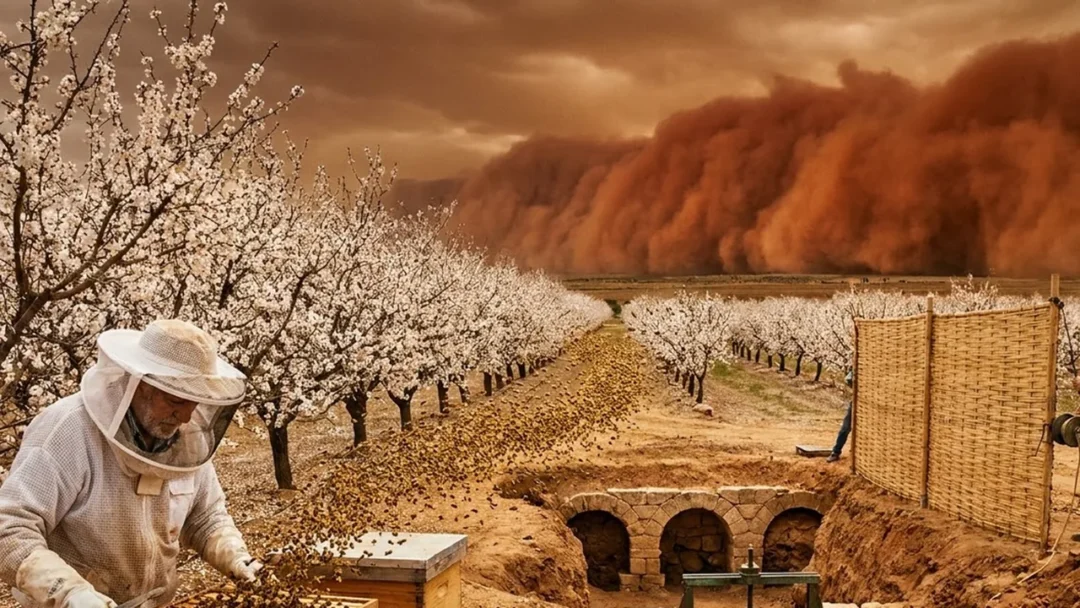
The sky above the Chuckwalla Valley had turned an unnatural, bruised amber-red as the towering 300-foot wall of dust consumed the sun. The temperature dropped ten degrees in ninety seconds, replaced by a strange, electric ozone charge that made the hairs on Elijah’s arms stand on end.
From every corner of the five-hundred-acre orchard, the bees were coming.
It was not a scattered return. It was an awe-inspiring, living river of gold. Millions of European honeybees, flying at their maximum aerodynamic velocity of twenty miles an hour, converged into five massive, churning aerial columns that roared through the orchard lanes. The sound of their combined flight was like the roar of a distant waterfall, a thunderous, low-frequency buzzing that drowned out the rumbling approach of the haboob.
The physiological synchronization of the returning swarm was an astonishing display of emergent collective intelligence. As the two million bees converged on the apiary corridor, their individual flight paths organized into a self-regulating fluid dynamics vortex. Rather than crashing into one another in chaotic collision, the bees maintained a precise lateral spacing of three body lengths, utilizing optical flow sensors in their compound eyes to gauge relative ground speed against the rising headwinds. The entire aerial formation moved like a single, colossal super-organism possessing a singular, urgent collective will.
Down on the eastern boundary road, Mateo Alvarez was fighting his own desperate battle against time.
Mounted along the high eastern ridge of the property was an eighty-foot-tall steel cable lattice, constructed ten years earlier during the great desert drought. Coiled at the base of the lattice were ten massive, continuous panels of heavy woven bamboo mesh and UV-stabilized agricultural windbreak fabric, each panel forty feet high and two hundred feet long.
The engineering of the twenty-foot woven bamboo windbreak was an ancient agricultural technique borrowed from the citrus terraces of southern Japan and the wind-scoured vineyards of the Rhône Valley. Solid timber walls or concrete barriers created an impenetrable bluff that forced high-velocity winds into violent downward eddies, gouging trenches in the soil and snapping tree limbs on the levee side. By utilizing natural split bamboo canes woven with thirty-percent open interstitial gaps, the barrier permitted a laminar boundary layer of decelerated air to bleed through the screen, establishing a permanent protective cushion of calm air that extended downwind for a distance equivalent to twenty times the height of the fence.
Mateo threw the transmission of his heavy four-wheel-drive farm tractor into reverse, locking the mechanical winch cable to the master hoisting bridle of the windbreak.
“Come on, you old beast!” Mateo shouted at the engine, slamming the hydraulic winch lever into high gear.
The mechanical strain on the heavy tractor’s hydraulic system was pushed to the absolute engineering limit. As the forty-foot woven bamboo curtain ascended into the gale, the surface area presented an immense aerodynamic sail that exerted upwards of fifteen tons of drag against the steel cables. The tractor’s sixteen-ply radial tires slipped momentarily in the loose gravel, digging deep ruts before finding traction on the hardpan below. Mateo kept his foot buried in the throttle, watching the hydraulic oil temperature gauge creep into the yellow warning zone as the heavy winch drum groaned with a high-pitched, harmonic whine.
The heavy steel cable groaned, snapping taut as it pulled four tons of woven bamboo upward into the sky. Inch by inch, the forty-foot-tall curtain rose against the gathering gale, forming an impenetrable, flexible barrier between the open desert and the delicate almond trees.
Unlike solid plywood walls that created violent low-pressure turbulence that pulled wind downward into the crop, the woven bamboo mesh was engineered with thirty-percent porosity. When high-velocity winds struck the bamboo, the screen acted as an aerodynamic ramp, deflecting seventy percent of the heavy, airborne mineral sand up and over the sixty-foot tree canopy, while allowing filtered, decelerated air to pass through without snapping branches.
Mateo locked the winch dogs, sprinted to the southern anchor post, and drove two heavy forged-iron locking pins through the cable clamps just as the first screaming gusts of red sand struck the outer ridge.
Back at the apiary rows, the living golden river was diving into the hive entrances.
Thousands of bees per second poured onto the wooden landing boards like liquid honey flowing down a chute. They did not fight for position; they packed their bodies tight against the entrance slots, fanning their wings inward to pull cool, clean air into the hive interior while their sisters squeezed through the narrow gaps into the dark safety of the wax comb chambers.
Elijah and Maria were running down the lines, their eyes burning from the fine red dust that was already beginning to swirl through the lanes.
“Hive row four is packed!” Maria yelled, wiping grit from her respirator goggles. “Row five is at ninety percent!”
Elijah checked the timer strapped to his forearm. Three minutes remaining before the main wall of the haboob struck the basin.