The Desert Sandstorm Gale And The Ancient Stone Aqueduct Canal
CHAPTER 5: THE RED HABOOB
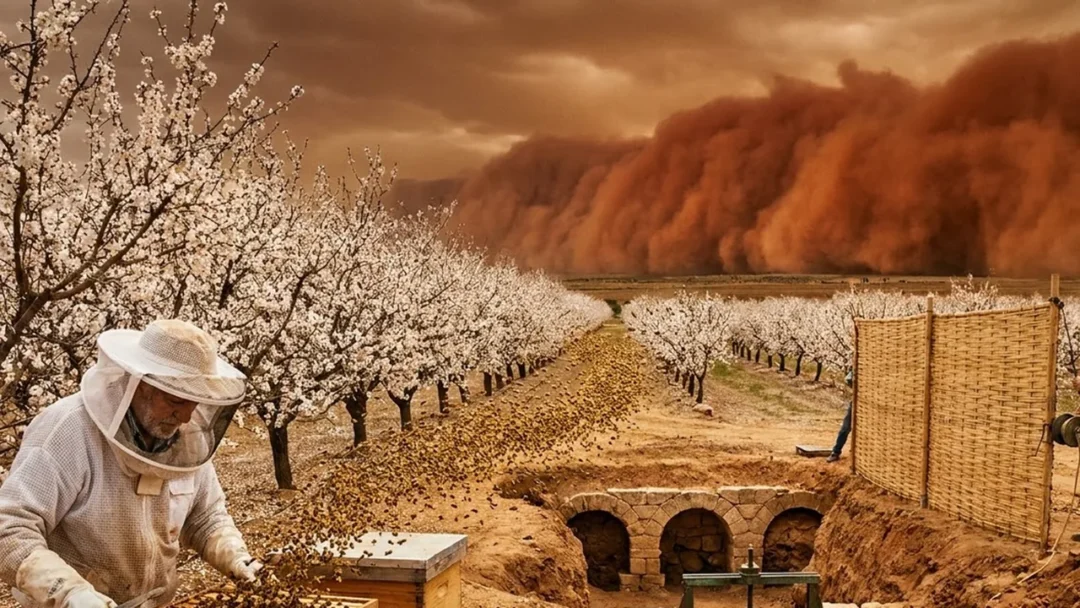
The meteorology of the Sonoran haboob was one of the most violent atmospheric phenomena on the North American continent. Generated when massive, high-altitude convective thunderstorms collapsed over the hot desert floor, the downdraft of dense, cold rain-cooled air plunged thousands of feet before spreading out horizontally across the alluvial plains like a rushing wall of water. As this density current raced across dry dry-lake playas and un-vegetated alluvial fans, it vacuumed up millions of tons of fine, desiccated clay and silt, lofting the particles into a vertical wall that blocked out one hundred percent of solar radiation and generated localized electrical fields exceeding ten thousand volts per meter.
Inside the sealed cab of the heavy John Deere tractor, day turned instantly into absolute, pitch-black midnight.
The darkness was not gray or shadowy; it was an impenetrable, suffocating blackness, tinged with a terrifying, bloody red glow whenever the headlights of the tractor reflected off the dense, swirling blizzard of pulverized sand that coated the glass.
The sound was apocalyptic. Sixty-mile-an-hour winds screamed against the steel cab, pelting the four-ton machine with millions of sharp, high-velocity sand particles that stripped the green paint from the hood in long, scouring ribbons. The tractor rocked violently on its heavy rubber tires, buffeted by turbulent microbursts that tested every weld on the chassis.
Mateo had his hands clenched white around the steering wheel, his eyes fixed on the front glass. “The windbreak… God almighty, look at the cables!”
Through the red-lit murk, illuminated by the tractor’s high-output halogen beams, the forty-foot woven bamboo windbreak was bowing inward under terrifying aerodynamic load. The heavy steel cables were stretched taut as piano wires, vibrating with a high-pitched, metallic hum that penetrated the cab.
Yet the bamboo held.
Instead of snapping under the blunt force of the storm, the woven panels flexed gracefully, creating a smooth, sweeping upward curve that caught the raging torrent of heavy desert sand and launched it skyward, thirty feet above the delicate white canopy of the almond orchard. Inside the sheltered lee of the windbreak, the wind was reduced by seventy percent—a swift, turbulent breeze, but entirely devoid of the destructive, sandblasting grains that were scouring the open desert into bare stone.
Inside the sealed Langstroth boxes, an extraordinary thermoregulatory drama was playing out in the darkness. Cut off from external air circulation, forty thousand bees per box formed a dense, vibrating sphere around the brood comb, where hundreds of thousands of delicate pupae and the queen resided. The bees on the outer layer of the cluster interlocked their legs to form an insulating mantle, while the workers inside the core flexed their flight muscles at high frequency, generating metabolic heat that maintained a stable ninety-two degrees Fahrenheit despite the howling tempest outside. It was a living, breathing thermodynamic engine operating in total isolation from the apocalypse raging beyond the pine boards.
Beside Elijah, Maria held a digital thermometer connected to the telemetry probes inside hive box number forty-two.
“Internal temperature is ninety-three point two degrees,” Maria reported, her voice steadying as she watched the glowing green display. “The bees are clustered around the brood frames, fanning their wings in unison. The ventilation gates are clear. The queens are safe.”
Inside the cramped, dust-filmed tractor cab, the three survivors sat shoulder-to-shoulder in the red gloom, listening to the roar of the tempest. For sixteen-year-old Maria, who had grown up watching her father battle blizzards in the Dakotas and heatwaves in the Central Valley, the moment cemented her determination to carry on the family’s migratory beekeeping tradition. She looked at her father’s hands—scarred from thousands of stings, steady on the emergency radio—and felt a profound, quiet pride that transcended fear. They were not merely fighting for a crop; they were defending a fragile thread of life in an unforgiving world.
For thirty-five agonizing minutes, the haboob hammered the valley.
Then, just as the barometric pressure began to stabilize, a violent, metallic shriek echoed from the eastern boundary near the canyon wash.
The wind had caught the overhanging corrugated iron roof of the historic honey extraction barn—an eighty-year-old timber structure built during the early mining booms of the nineteen-thirties. With a deafening, wrenching scream of shearing lag bolts, the entire fifty-foot tin roof was ripped away into the swirling red sky, tumbling into the desert like a sheet of paper.
“The extraction barn!” Mateo shouted in anguish. “The structural frames are tearing out!”
Before Elijah could answer, a violent downdraft slammed into the newly unroofed building, channeling thousands of tons of high-velocity wind straight down into the dirt foundation, scouring the dry desert sand around the perimeter like a colossal industrial water-jet cutter.