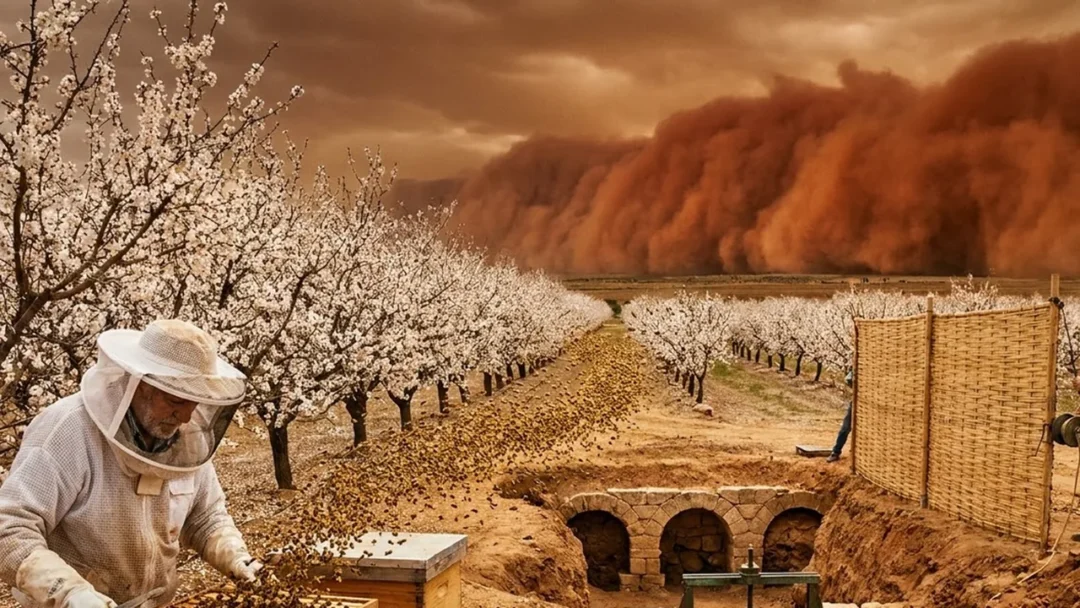
The Desert Sandstorm Gale And The Ancient Stone Aqueduct Canal
CHAPTER 8: THE LIVING AQUEDUCT
In California water law, the doctrine of prior appropriation—often summarized as ‘first in time, first in right’—governed the historical allocation of agricultural surface waters. If an agricultural water diversion could be documented as having been established prior to the landmark Water Commission Act of nineteen-fourteen, it held absolute senior priority over all modern municipal, corporate, and state agency claims. The carved granite date of eighteen-ninety on the bronze faceplate was an irrefutable legal shield, establishing an unchallengeable, pre-statutory senior appropriative water right that no corporate water broker could ever revoke or restrict.
Elijah looked up at Mateo, his eyes blazing with an incredible realization. “The aqueduct wasn’t destroyed by the flood in eighteen-ninety, Mateo. It was protected by it. The gravel sealed it like a tomb, keeping the spring water trapped and pressurized under the mountain for one hundred and thirty-six years.”
Mateo reached out, grabbing the thirty-inch circular bronze valve wheel that protruded from the center of the sluice housing. “Help me turn it, Elijah. Let’s see if the old Spanish engineers knew how to build a valve.”
Together, planting their boots against the granite stones, they threw their weight against the bronze wheel. The metal groaned with a sharp, squealing protest, then broke free. Inch by inch, they turned the heavy wheel counter-clockwise, raising the internal bronze gate from its seat.
Deep within the stone vault, an immense hydraulic surge shuddered through the rock.
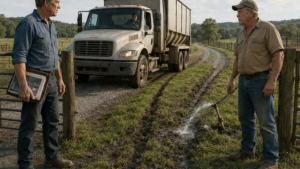
A jet of crystal-clear, icy cold mountain spring water erupted beneath the bronze gate, foaming white as it cascaded into the scoured trench. In less than three minutes, the trench filled to the brim with pure, forty-four-degree water that smelled of wild mountain ferns and snowmelt. The water overflowed the banks, rushing into the dry agricultural ditches of the almond ranch like an unbroken, shimmering ribbon of life.
Mateo knelt by the rushing torrent, plunging his bare hands into the cold water, laughing with a pure, unrestrained joy that echoed across the quiet valley.
Along the access road, a sleek white corporate SUV belonging to the regional agricultural insurance agency pulled to a halt. Travis Cole, the senior insurance adjuster, stepped out, carrying an official digital tablet pre-loaded with total crop loss declaration forms.
Cole walked toward the trench, his mouth open, staring from the five hundred hives of buzzing, happy bees to the towering white almond canopy, and finally down at the roaring river of mountain water cascading through the ancient stone aqueduct.
“Mr. Alvarez…” Cole stammered, dropping his tablet onto his knee. “The satellite reports said this valley was hit by a category-four haboob… We were preparing to write off your entire operation as an uninsurable total loss.”
Mateo stood up, wiping pure, cold mountain water from his face, looking his insurance adjuster dead in the eye.
“You can tear up those write-off papers, Mr. Cole,” Mateo smiled proudly. “The bees are safe, the blossoms didn’t lose a single petal, and the storm just gave us an inexhaustible, debt-free mountain water supply that will keep this valley green for the next two hundred years.”
The news of the flowing aqueduct spread through the desert communities like wildfire. By nightfall, neighboring date farmers, organic melon growers, and representatives from the local tribal council had gathered at the edge of the trench, their faces bathed in the golden headlights of farm trucks, watching the clear mountain water gush through the restored sluice gate. A historic gathering that had begun in terror had concluded in unprecedented unity, celebrating an ancient gift of stone and water that would nourish the people, the bees, and the blossoms for generations to come.
Elijah walked back to the apiary rows, where Maria was watching two million golden bees dive joyfully into the white almond blossoms under the brilliant desert sun.
The discovery of the San Gabriel aqueduct permanently altered the hydrological landscape of the eastern Coachella basin. Within forty-eight hours of the storm’s departure, hydrological surveyors from the state water resources control board confirmed that the unsealed granite conduit was drawing from an ancient, non-tributary perched aquifer recharged continuously by high-altitude snowmelt from the San Bernardino wilderness. The water was pure, alkaline-balanced, and completely free of the toxic agricultural salts that plagued the lower Colorado River canals, ensuring that the Alvarez orchard would remain a blooming desert oasis for generations to come.
In the weeks following the great storm, the partnership between Elijah Sterling and Mateo Alvarez deepened into an enduring commercial and ecological alliance. With an abundant, gravity-fed flow of pure, mountain spring water pouring through the San Gabriel aqueduct, Mateo was able to retire his expensive, diesel-burning deep-well turbine pumps permanently, cutting his operational overhead by sixty percent. Elijah established the ranch as the permanent winter headquarters for his five hundred colonies, planting perennial hedgerows of blue palo verde, desert ironwood, and fragrant lavender along the restored stone canal to provide a year-round nectar sanctuary for the bees.
The desert had tested them with fire and dust, but they had stood their ground, trusted the biology of the hive, and uncovered a miracle that had waited a century for the wind to set it free.