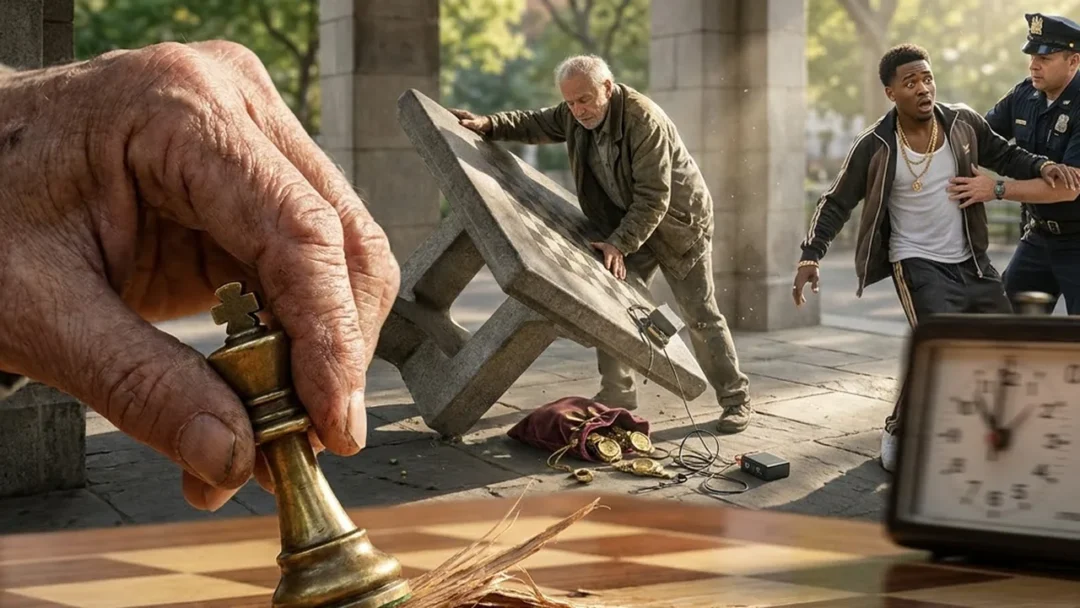
The Four Finger Pushup And The Magnetic Chess Hustler Trap
CHAPTER 6: THE FOUNTAIN AMBUSH
The Washington Square Park fountain was surrounded by hundreds of college students, artists, and tourists enjoying the mild autumn afternoon, completely unaware of the tactical net closing around the perimeter.
Dressed in plainclothes, Detective Frank Russo and three undercover detectives took positions along the granite basin, their eyes scanning the incoming foot traffic from the Fifth Avenue arch.
At precisely three-forty-three, a sleek, suited man carrying an expensive leather briefcase walked into the plaza. He was European, approximately forty years old, checking his smartphone with the discreet, paranoid precision of a professional courier. He paused beside the western rim of the fountain, entered a coded verification sequence into his messaging application, and looked toward the chess pavilion.
Instead of meeting Damon Cross, the courier was met by the cold, quiet presence of Officer Marcus Kane and two plainclothes tactical detectives.
Before the courier could turn or reach inside his wool overcoat, Kane stepped behind him, caught both of his wrists in an unyielding compliance lock, and pinned him against the cold granite wall of the fountain.
CLICK-CLACK.
The steel handcuffs were secured in less than three seconds. The leather briefcase was opened on the fountain rim, revealing forty thousand dollars in clean, banded one-hundred-dollar bills intended as the final payment for the stolen Fifth Avenue diamonds.
The entire fencing network—from the street-level drop point at the chess tables to the international export courier—was dismantled in a single afternoon without a single shot fired.
At four-fifteen, the Manhattan District Attorney, accompanied by the President of the Fifth Avenue Merchants Association, arrived at the chess pavilion.
Standing before the crowd of cheering park regulars, the District Attorney presented Leonid Varga with the city’s prestigious Meritorious Civic Valor Citation. Furthermore, under federal insurance recovery statutes, the jewelry association formally awarded a fifty-thousand-dollar civilian recovery bounty for the preservation of the eight-hundred-thousand-dollar diamond cache.
Leonid accepted the citation with a gracious, dignified bow, but when the bounty check was presented, he gently turned toward his nineteen-year-old granddaughter, Maya, who was standing beside the bench with tears of pride in her hazel eyes.
“This bounty belongs to the next generation,” Leonid announced with a gentle smile. “My granddaughter Maya is an honors mathematics student and a candidate master on the university chess team. This check will establish a permanent scholarship for young women competing in championship chess across the state of New York.”
The entire park pavilion erupted into a deafening, standing ovation, the clatter of clapping hands echoing all the way through the marble arch.
The restorative power of authentic craftsmanship within an urban community is a profound testament to the enduring human spirit. In a metropolis characterized by rapid commercial turnover, anonymous crowds, and digital isolation, the public spaces of New York City remain vital democratic arenas where generations meet, test their skills, and uphold the unspoken standards of fair play. The restoration of table eight in Washington Square Park was not merely an act of carpentry; it was a reaffirmation of the community’s collective soul—a declaration that the asphalt academy would remain a sanctuary of honest intellect, where young minds could learn the royal game free from the corruption of greed, shielded by the quiet dignity of masters who had lived the truth.
The tension in the southwest plaza of Washington Square was palpable. The evening air carried the chill of early November, and the golden hour had deepened into an indigo dusk. Around the dry stone fountain basin, shadows lengthened across the hexagonal paving blocks. As Arthur walked along the perimeter pathway, his gait remained unhurried, measured by the internal cadence of a lifetime spent regulating pendulum clocks. He could hear the muffled shuffle of rubber-soled boots forty feet behind him—two athletic men in hooded parkas keeping pace along the tree line. They were Marco Ramos’s runners, individuals who had watched their illicit payday spill across the concrete chess plaza and were now desperate to retrieve the ledger and the key that Arthur had handed over to the police.
When the lead runner cut across the gravel circle, attempting to corner Arthur against the stone parapet of the fountain, Arthur did not flinch or reach for a weapon. He stood tall, his hands resting naturally at his sides, his breathing deep and diaphragmatic. The young man lunged, reaching aggressively for Arthur’s coat collar.
“Hand over the bag, old man, or you won’t walk out of the park tonight,” the youth hissed, his knuckles whitening.
Arthur did not back away. Instead, he utilized the exact biomechanical principle that had preserved his joints through eight decades of rigorous physical culture. As the young man’s fingers reached within three inches of his woolen lapel, Arthur’s left hand rose like an uncoiling spring. With a fluid, circular wrist sweep honed from decades of guiding heavy iron lathe wheels, Arthur deflected the incoming momentum, stepping effortlessly inside the assailant’s center of gravity. His thumb and index finger locked onto the pressure junction between the young man’s radius and ulna—a two-finger pinch executed with eighty pounds of hydraulic tendon force.
The runner let out a sharp gasp of agony, his knees buckling instantly as his forearm muscles seized under the excruciating, localized compression. “What… what kind of grip is that?” the youth stammered, his face draining of color as he found himself pinned to the stone railing by nothing more than the elderly man’s thumb and index fingertip.
“It is the grip of a man who respects physical laws,” Arthur said quietly, his voice carrying the calm authority of an ocean tide. “When you rely on cheap tricks, deceit, and concealed magnets, you forfeit your footing in the world. Walk away before Detective Kowalski’s patrol car circles Fifth Avenue.”