The Four Finger Pushup And The Magnetic Chess Hustler Trap
CHAPTER 4: THE TILTED MONOLITH
The physical feat that followed was so staggering, so utterly contrary to the expectations of human age, that the cheering crowd fell into absolute, stunned silence.
The park chess tables in Washington Square are not lightweight recreational furniture. They are permanent municipal fixtures constructed of high-density cast concrete slabs mounted on two-hundred-pound steel-reinforced pedestals, capped with two-inch-thick solid white-oak timber tops designed to withstand decades of vandalism and weather. The total mass of table eight exceeded three hundred and eighty pounds.
Leonid Varga did not ask for assistance, nor did he use both hands.
Planting his leather oxfords firmly against the stone paving stones, Leonid lowered his center of gravity into a classical stone-mason’s deadlift stance. He engaged his right latissimus dorsi, locked his forearm tendons into a rigid bridge of biological iron, and heaved upward with his right arm alone.
With a deep, resonant groan of protesting wood and shifting concrete, the entire four-hundred-pound table lifted off its front pedestal.
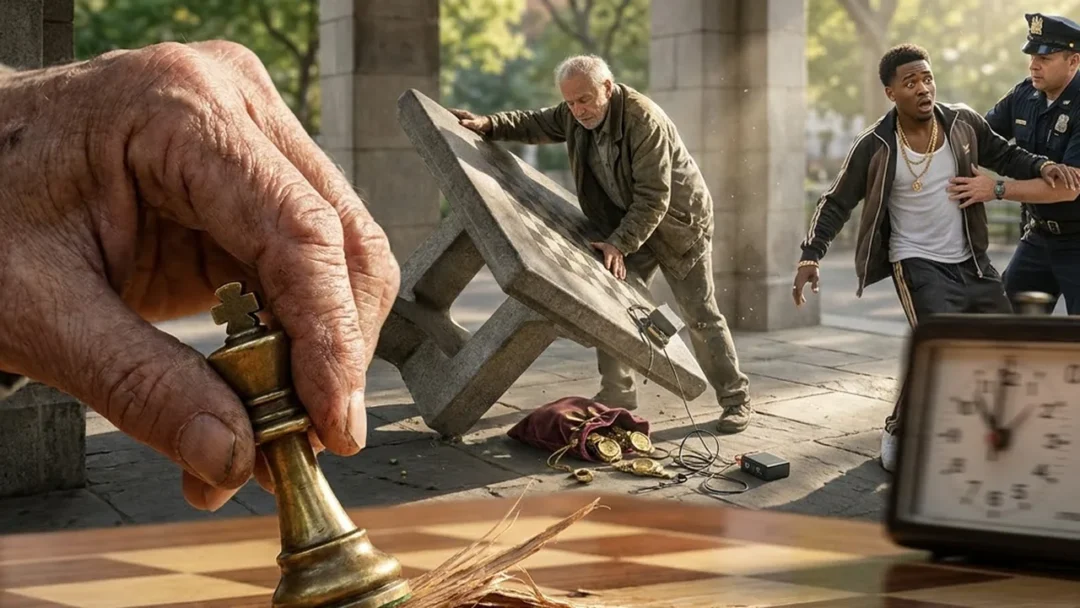
Leonid hoisted the massive timber monolith forty-five degrees into the air with one arm, holding the tilted furniture completely suspended against gravity as casually as a waiter holding a drink tray.
The tilted underside of the table was laid bare to the blinding afternoon sunlight.
CLATTER! CLATTER! CRASH!
The violent inclination instantly broke the adhesive tape holding Damon’s secret rigging.
Tumbling out from the hollow underside of the timber, clattering across the concrete pavement in a tangle of red and black copper wiring, was a heavy black twelve-volt lithium battery pack, an electronic remote-relay module, and the freshly torn neodymium electromagnet, its mounting screws bent and sheared.
And tumbling out right behind the battery pack was a large, heavy black velvet drawstring pouch.
The velvet pouch struck the pavement with a heavy metallic clink, bursting its seams open.
Spilling across the stone paving stones of Washington Square Park, tumbling between the feet of the gasping spectators, was a breathtaking fortune in stolen luxury jewelry: nine solid-eighteen-karat gold Rolex and Patek Philippe wristwatches, three diamond-encrusted platinum tennis bracelets, and two velvet cases containing unmounted, certified emerald-cut diamonds.
The crowd gasped in collective horror.
Damon Cross’s jaw dropped to his chest. His knees buckled, and he scrambled backward in frantic panic, attempting to turn and sprint through the arch toward Fifth Avenue.
He didn’t make two steps.
Standing directly behind Damon’s bench, his broad arms crossed over his chest, his radio mic already keyed to the precinct dispatch, was Officer Marcus Kane of the NYPD Parks Enforcement Patrol.
Beside Kane stood two uniformed tactical officers, their hands resting on their duty belts.
“Going somewhere, Damon?” Officer Kane asked, his voice deadpan and icy cold. “We’ve been looking for that Fifth Avenue jewelry shipment since Wednesday morning.”
Kane reached out, caught Damon by the collar of his designer hoodie, spun him around, and slammed him chest-first onto the tilted edge of the table. With two sharp, metallic clicks, heavy steel handcuffs were locked around Damon’s wrists.
Leonid Varga slowly, gently lowered the four-hundred-pound table back onto its concrete pedestal. The heavy furniture settled with a soft, solid thud that did not kick up a speck of dust.
Leonid brushed his tweed lapels, looked down at the scattered gold watches gleaming on the stone pavement, and looked at Officer Kane with a quiet, polite nod.
“Officer,” Leonid said softly, “I believe this young gentleman dropped his batteries. And his retirement fund.”
The mechanical action of a concert grand piano represents the most complex acoustic engineering system developed during the industrial revolution. Containing over ten thousand individual moving components constructed of seasoned hard rock maple, hornbeam, virgin wool felt, and tempered steel wire, a concert piano action requires regulatory adjustments calibrated to one-thousandth of an inch. As the chief technician for the world’s premier piano house, Leonid had spent fifty years setting the escapement, let-off distance, and drop of thousands of action hammers, testing the repetition levers with finger-tip sensitivities that could detect a variation of two grams of key resistance. This exquisite tactile sensitivity, combined with the crushing grip developed from turning high-torque steel tuning pins into laminated beech wrest-planks, endowed Leonid with a hand that was simultaneously an instrument of supreme artistic nuance and an unyielding tool of pure mechanical power.