The Four Finger Pushup And The Magnetic Chess Hustler Trap
CHAPTER 2: THE BLITZ GAMBIT
The rules of park blitz chess are brutal and unyielding. Each player is allocated exactly three minutes of total thinking time on an analog or digital clock. There is no increment; when a player’s flag falls, they lose the game immediately, regardless of material advantage on the board. The game is played at a furious, blistering tempo—often two to three moves per second—accompanied by the deafening, continuous slapping of clock buttons that echoes like gunfire across the stone pavilion.
A crowd of thirty spectators—university students, neighborhood chess veterans, and curious tourists—quickly formed a tight circle around table eight, sensing an irresistible generational clash: the flashy, trash-talking young street hustler against the elegant European grandfather in tweed.
Damon played with White, slamming his King’s pawn forward to e4 with an aggressive, showy flick of his wrist that knocked over a fallen pawn on the sideline.
“Let’s see what you got, old school!” Damon trash-talked, hitting his clock button with a concussive slap. “Clock is ticking! Two minutes and fifty-eight seconds!”
Leonid Varga did not blink, nor did he allow Damon’s frantic speed to disturb his neurological rhythm. With an economical, silent motion of his forefinger and thumb, Leonid moved his c-pawn to c5, deploying the razor-sharp Sicilian Defense.
The game erupted into an intense, tactical firefight.
Damon played the hyper-aggressive Morra Gambit, sacrificing a wing pawn to open central lines for his rooks, hoping to overwhelm the old man with a blizzard of rapid tactical threats. He slammed his pieces onto the wood with violent force, constantly bouncing his leg against the table rail, whispering rapid-fire taunts to distract his opponent’s focus: “Watch the diagonal, pops! Your bishop’s trapped! You’re losing thirty seconds on the clock! Better hurry up!”
Leonid did not speak a single word. His breathing remained completely calm, flowing in deep, measured cycles.
His mind—honed across seven decades of master-level tournament play in the coffeehouses of Vienna and Budapest—saw the board not as a collection of wooden figures, but as a dynamic geometric web of force vectors and structural control squares. While Damon’s queen lunged across the board in flashy, superficial attacks, Leonid’s knights maneuvered with quiet, deadly efficiency, fortifying the central outposts and systematically trading off Damon’s attacking minor pieces.
By move twenty-four, the momentum of the game had decisively shifted.
Damon had overextended his kingside pawns, leaving his white king completely exposed along the open f-file. Leonid sacrificed an exchange—a rook for an enemy bishop—shredding Damon’s protective pawn shield and locking the white monarch into a terminal mating net.
Damon’s trash-talking choked off in his throat. Sweat began to bead on his forehead, his foot tapping frantically against the concrete.
He glanced up at the dual-faced analog chess clock. The red plastic indicator flag on his side was dangling precariously above the minute hand: Damon had only fourteen seconds remaining. Leonid, by contrast, had played with such ruthless precision that he maintained forty-five seconds on his timer.
“Move, man!” Damon hissed, his eyes darting toward the crowd. “Hit the clock!”
Leonid’s queen delivered a devastating check on f2. Damon’s king was forced to flee to the corner square on h1.
Leonid’s dark-squared bishop swept across the board to d5, cutting off all avenues of escape. The checkmate was unavoidable. On the next move, Leonid’s heavy brass-weighted king would slide from g8 to h8, unmasking his rook along the back rank to deliver an absolute, inescapable checkmate.
Damon Cross knew he was beaten. But Damon had not dominated the park tables by accepting defeat.
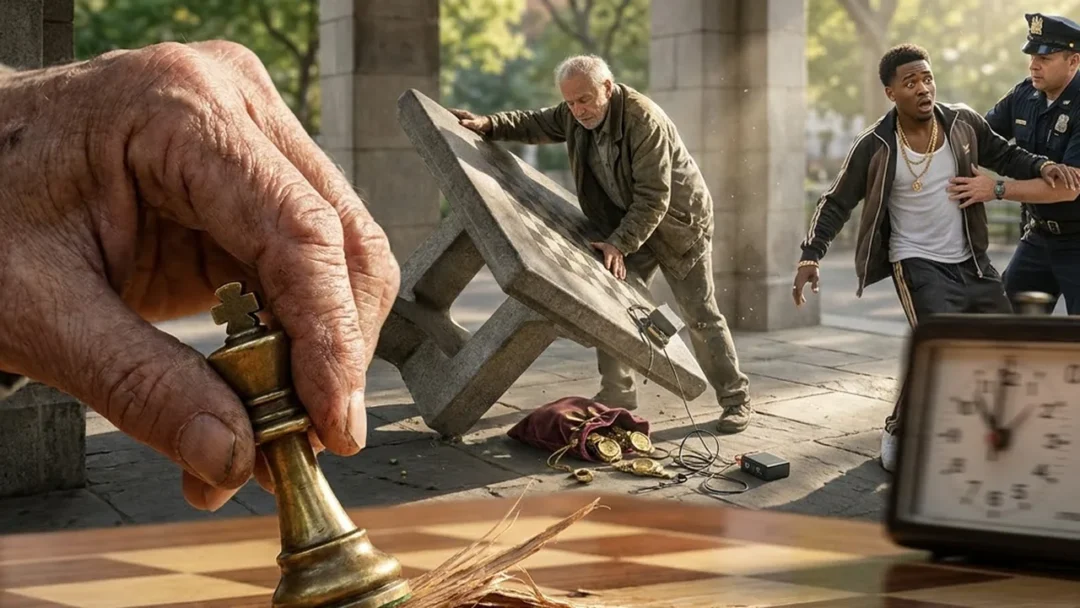
With twelve seconds remaining on his clock, Damon slid his left hand beneath the table edge, pretending to scratch his thigh. Beneath the wooden apron, his knee pressed firmly against a hidden, spring-loaded electrical pressure plate.
Beneath the board, deep within the hollow underside of the table veneer, a powerful, twelve-volt high-density neodymium electromagnet hummed to life.
The chess history of Washington Square Park reflects the intellectual and counter-cultural evolution of Manhattan from the post-war era through the digital age. Beginning in the nineteen-forties, when European emigrés fleeing fascism gathered around the concrete tables near the fountain, the park became an open-air laboratory for aggressive, blitz tactical innovation. Known among international masters as ‘the asphalt academy,’ the park demanded not only profound opening theoretical knowledge, but psychological fortitude, rapid-fire pattern recognition, and an unshakeable defense against street psychological warfare. Masters such as Roman Dzindzichashvili, Maurice Ashley, and Kamran Shirazi frequently tested their tactical intuition across these concrete slabs, proving that true chess mastery requires an intuitive harmony between mind and hand that no computer chess engine can replicate in the raw theater of the street.