The Four Finger Pushup And The Magnetic Chess Hustler Trap
CHAPTER 7: THE MASTER’S GAMBIT
By five o’clock in the afternoon, the police tape had been removed, the emergency vehicles had departed, and the deep, enduring peace of Washington Square Park returned beneath the golden elms.
Table eight had been lovingly restored by the park regulars. A neighborhood cabinetmaker had arrived with clean wood glue, clamps, and a fresh sheet of polished walnut veneer, repairing the damaged chessboard until the squares were smooth, level, and true.
Leonid Varga sat on the wooden bench, his linen sleeves rolled back, his grey eyes shining with warmth.
Sitting across from him on the opposite bench was his granddaughter Maya. The pieces were set—not with weighted iron cheats or hidden electronic magnets, but with an antique, hand-carved boxwood and ebony Staunton set that Leonid had carried from Budapest fifty years ago.
“Your move, Grandfather,” Maya said with an affectionate, challenging smile, tapping her clock.
Leonid looked at the board, then met his granddaughter’s bright, intelligent gaze. He reached forward with his bare fingers—fingers that had held four hundred pounds of concrete, fingers that had torn through magnetic fields, fingers that had tuned the most delicate concert pianos in the world—and gently advanced his King’s pawn to e4.
“A true master moves the piece with the mind, Maya,” Leonid said softly, his voice carrying the timeless wisdom of the working centuries. “A cheat relies on toys and shortcuts because his soul is hollow. But a man who honors the craft… he knows that genuine strength, whether in chess or in life, is born in the patient, honest cultivation of the truth.”
The clock ticked softly in the golden twilight.
Across the historic pavilion, the games continued—pure, honorable, and alive—under the watchful care of an old master whose hands had proven that truth and courage will forever outplay the cleverest lies.
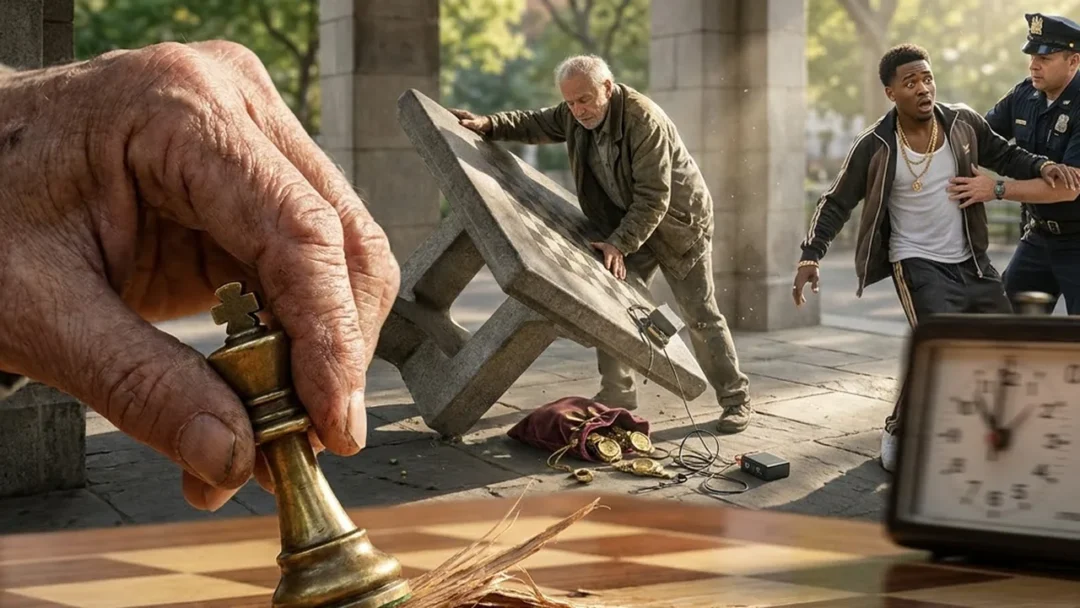
Three weeks later, the crisp morning air over Washington Square Park was crisp and pristine, scented with roasted chestnuts and damp autumn leaves. The southwest chess pavilion had been cleaned and restored; the gouged wooden tabletop where Marco Ramos had mounted his magnetic coil had been replaced with solid Vermont granite, funded quietly by an anonymous patron whose family heirloom had been safely returned to her mantelpiece.
Detective Frank Kowalski walked through the archway, holding a cardboard tray carrying two steaming paper cups of dark roast coffee from the Italian bakery on Bleecker Street. He found Arthur Vance sitting at the newly installed granite table. Arthur was not performing fingertip push-ups today. He was seated comfortably on the concrete bench, his weathered hands methodically arranging a set of hand-carved boxwood and ebony chessmen across the polished stone squares.
“The district attorney accepted Ramos’s full confession yesterday afternoon,” Kowalski said, placing a coffee cup gently beside the analog chess clock. “Marco gave up the entire ring—the jewelers who were repolishing the serial numbers in Queens, the runners who staked out the Fifth Avenue estates, and the illegal lithium battery supplier who fabricated his electromagnetic rigs. Evelyn Montgomery cried when we hand-delivered her late husband’s Patek Philippe back to her parlor. She asked who found it. I told her it was a seventy-nine-year-old grandfather who refused to let an iron King stay pinned to a crooked board.”
Arthur offered a warm, subtle smile, lifting the coffee cup and breathing in the rich chicory aroma. “In horology, Detective, an escapement can only function if every tooth on the balance wheel is true. If a single cog is filed crooked, the entire mechanism eventually grinds to a halt under its own friction. Marco Ramos forgot that truth. He believed that shortcuts and hidden coils could replace forty years of patience.”
A young girl, barely ten years old with a woolen scarf wrapped around her neck, stepped timidly up to the edge of the stone table, holding a small drawstring pouch containing her plastic chess pieces. She looked at Arthur’s carved wooden board with wide, curious eyes. “Excuse me, sir… do you play blitz?”
Arthur chuckled softly, his eyes crinkling at the corners. He reached out with two fingers, gently picking up his white King and placing it precisely in the center of the royal square. There was no resistance, no hidden magnetic pull, and no deceit—only the clean, honest resonance of seasoned wood meeting solid granite.
“I play chess, young lady,” Arthur replied with gentle warmth, gesturing to the empty stone seat opposite him. “Sit down. Let us begin from the opening move.”
As the little girl moved her black pawn forward two squares to initiate the game, a quiet hush settled over the surrounding benches. Retired grandmasters, neighborhood dog walkers, and college students from New York University leaned in, captivated by the timeless rhythm of the board. Arthur Vance placed his fingertips gently against the edge of the granite table, his breath even and tranquil. In the heart of Greenwich Village, amidst the swirling leaves of late autumn, the truth of forty years of discipline remained unbroken, carved into the stone and rooted in the quiet, unyielding strength of an honest craftsman.