The Hundred Kilo Harvest Walk And The Counterfeit Fertilizer Scandal
CHAPTER 4: THE SUSPENDED WHEELS
The high-displacement V8 engine of the cargo van roared to life with a violent shriek of belts.
Inside the locked cab, Julian Vance was breathing like a cornered animal, his eyes wide with frantic terror. He knew that in rural Iowa, selling counterfeit agricultural chemicals was not treated as a minor civil trade infraction; under state felony fraud statutes, deliberately distributing adulterated fertilizers that threatened regional food security was classified as aggravated economic sabotage, carrying a mandatory ten-year prison sentence.
Julian slammed the heavy automatic transmission selector into reverse, determined to floor the accelerator, smash past Caleb’s pickup truck, and hit the state highway before the local cooperative managers could block the gate.
“Get out of the way!” Julian screamed through the closed glass, his face twisted in desperate rage.
Luke and Seth scrambled backward onto the high concrete dock, shouting in panic as the heavy cargo van shuddered, its reverse lights blazing white.
Caleb Thorne did not run.
Standing near the edge of the loading dock, resting against a stack of empty cedar pallets, was an antique, heavy-duty hydraulic pallet jack manufactured of three-inch solid channel iron and rated for an industrial payload of five tons. The pallet jack was heavy, painted faded industrial safety red, and equipped with a three-foot steel steering handle connected to a double-acting hydraulic piston.
In a single, fluid motion that displayed the lightning-fast tactical reflexes of a lifelong rigger, Caleb lunged forward.
He gripped the steel T-handle with his bare right hand, spun the heavy steel-wheeled pallet jack ninety degrees on its front casters, and shoved the four-foot solid steel forks straight beneath the rear bumper of Julian’s van.
With an engineer’s eye for mechanical leverage, Caleb didn’t slide the forks beneath the sheet-metal body. He drove the heavy steel tines dead-center beneath the solid cast-iron pumpkin of the van’s rear differential housing.
Caleb dropped his left boot onto the frame, grabbed the hydraulic handle with both hands, and delivered two explosive, full-stroke downward pumps.
CLACK-HISS. CLACK-HISS.
The five-ton industrial hydraulic cylinder engaged with tremendous mechanical advantage.
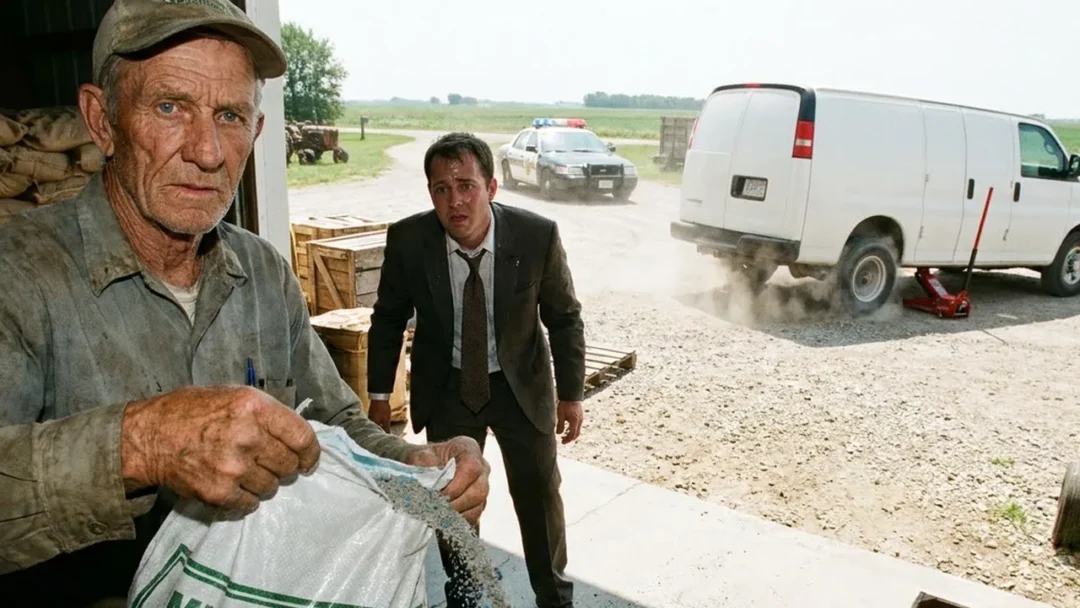
Before Julian Vance could release the emergency brake and touch the gas pedal, the rear suspension of the cargo van lifted violently into the air. The heavy rear drive axle was hoisted two and a half inches completely clear of the crushed limestone gravel.
Julian mashed the accelerator pedal to the floorboards.
WHRRRRRRRRRRRRRRRRRRR!
The van’s engine screamed at six thousand revolutions per minute. But instead of rocketing backward down the driveway, the two massive rear tires simply spun harmlessly in mid-air at one hundred miles an hour.
A high-pitched, metallic whine echoed across the cooperative yard as the differential gears whirred in their oil bath. The tires kicked up a useless shower of fine limestone dust that drifted through the morning sun, while the heavy vehicle remained suspended completely motionless on Caleb’s red hydraulic jack.
Inside the cab, Julian Vance frantically pumped the brake pedal, shifted from reverse to drive, and floored the gas again. The tires spun furiously in the empty air, smoking slightly against the cool morning breeze, but the vehicle did not budge a single millimeter.
Caleb Thorne walked calmly to the driver’s side window.
He leaned one elbow against the high hydraulic handle of the pallet jack, his grease-stained seed cap tipped back on his head, a faint, amused smile creasing his weathered face. He tapped on the glass with one calloused knuckle.
“Front-wheel drive costs extra on those commercial models, son,” Caleb drawled through the glass, his voice calm and unhurried. “Have a seat. Keep your foot on the gas if it makes you feel better. Deputy Kowalski just turned into the driveway.”
Down the county gravel road, the high-frequency wail of a siren echoed across the cornfields.
Cresting the railroad crossing at eighty miles an hour came the white-and-gold four-wheel-drive patrol SUV of the Black Hawk County Sheriff’s Department, its red-and-blue emergency light bar flashing brilliantly against the morning sky.
The hydraulic mechanics of the industrial pallet jack are grounded in Pascal’s Law, which states that pressure exerted on a confined fluid is transmitted equally in all directions throughout the liquid. In a commercial five-ton pallet jack, an operator pumping the three-foot manual tiller handle drives a small high-pressure plunger piston into a hydraulic reservoir, forcing fluid through a one-way check valve into a massive main ram cylinder. Because the surface area of the main lifting ram is thirty times greater than that of the hand plunger, a mere fifty pounds of manual force applied to the handle translates into over fifteen hundred pounds of vertical lifting thrust at the forks. By driving the solid steel tines under the heavy cast-iron pumpkin of the truck’s rear differential, Caleb had applied that multiplied mechanical force directly to the vehicle’s un-sprung mass, lifting the entire drive assembly off the earth with effortless efficiency.