The Hundred Kilo Harvest Walk And The Counterfeit Fertilizer Scandal
CHAPTER 3: THE DYE ON THE LEATHER
Julian Vance’s patronizing smile vanished in an instant, replaced by a dark, defensive sneer. His knuckles tightened around the leather invoice folder until his knuckles turned pale.
“What kind of rural backwater nonsense is that?” Julian snapped, taking an aggressive step toward the rear of the van. “You think your arthritic collarbone is more accurate than an automated robotic packaging facility in Hamburg? That bag was weighed on laser-calibrated digital scales! Put the product down before you damage the packaging, old man, or I’ll have the county sheriff cite you for criminal mischief!”
Luke Bradley and Seth Miller exchanged uneasy glances on the dock. Luke stepped forward, his voice hesitant. “Mr. Thorne… maybe the plastic is just stiff from the morning cold? It has the European import stamps right on the face.”
Caleb Thorne did not lower the bag. He stepped down out of the van cargo bay, his boots planting firmly into the gravel three feet in front of Julian Vance.
“A digital scale can be recalibrated by any thief with a screwdriver, Luke,” Caleb said evenly. “A man’s shoulder doesn’t lie. When you carry thirty tons of fertilizer a season for fifty years, your nervous system knows the difference between ninety-two pounds and one hundred and ten pounds better than any machine.”
Caleb brought the sack down from his shoulder, cradling the heavy bag across his knees in a deep, balanced squat.
The sack was constructed of heavy, three-ply cross-laminated polyethylene, sealed along the corner with heavy-duty, triple-stitched industrial nylon thread designed to withstand oceanic shipping. Julian watched him with a sneer, convinced that the impenetrable industrial plastic would protect his fraudulent cargo from amateur inspection.
“You need commercial shears to cut that nylon seam, grandpa,” Julian scoffed, checking his watch again. “Now sign the voucher or get off my loading dock.”
Caleb did not reach into his pocket for a knife.
He set his bare right thumb and index finger against the corner seam of the thick plastic bag. His fingers were not large, but they were cross-hatched with thick, scarred calluses that had spent half a century handling barbed wire, frozen implement iron, and rusted tillage bolts. Beneath his skin, the flexor tendons of his fingers had developed an unyielding, vice-like crushing strength.
Caleb pinched the triple-stitched nylon thread between the pads of his fingers, twisted his wrist ninety degrees, and gave one explosive, shearing tear.
RRRRIIIP!
The reinforced industrial nylon threads did not merely stretch; they sheared cleanly under the concentrated mechanical torque of Caleb’s grip. The thick plastic corner burst open like an overripe melon.
Before Julian Vance could lunge forward to stop him, Caleb tilted the torn corner downward.
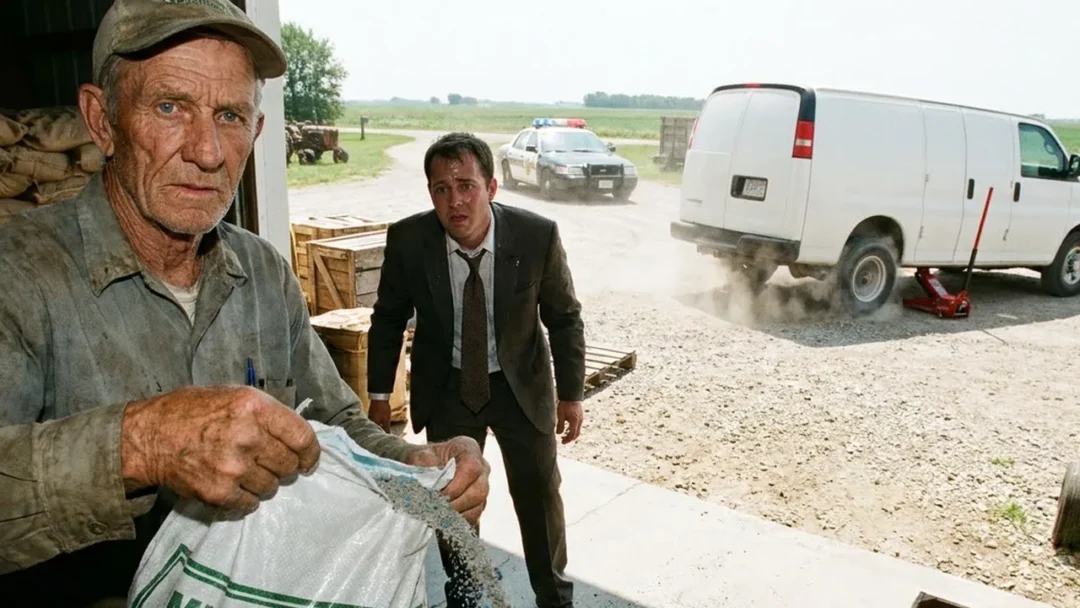
A heavy, continuous stream of coarse, gritty grey sediment poured out of the bag in a thick, choking cascade, splashing directly across the pristine, hand-shined Italian leather dress shoes of Julian Vance.
The air did not fill with the sharp, clean, mineral scent of potassium salt. It smelled of stagnant pond mud, wet river silt, and caustic synthetic chemicals.
Mixed within the coarse grey construction sand were thousands of microscopic flakes of bright-blue industrial textile dye and jagged chunks of cheap crushed rock salt. The blue dye, dissolving instantly in the morning humidity, began to bleed into the wet sand, staining Julian’s four-hundred-dollar leather shoes in an indelible, blotchy chemical smear of bright turquoise.
“What in God’s name…” Luke Bradley gasped from the dock, stepping down into the gravel. “That’s not potash! That’s grey construction aggregate! It’s dredging sand!”
Caleb stood up slowly, brushing a handful of the grey silt from his palm, his eyes boring directly into Julian Vance’s pale, sweating face.
“River silt dredged from the Mississippi sandbars, mixed with cheap ice-melting salt and fifty cents worth of textile dye,” Caleb said, his voice ringing across the quiet cooperative yard like a judge’s gavel. “You bought this sand for eight dollars a ton at the quarry, bagged it in counterfeit plastic, and came out here to rob thirty-six thousand dollars from family farmers who are fighting to keep their land.”
Caleb looked down at the blue dye soaking into the salesman’s expensive shoes.
“You put this toxic salt on twenty thousand acres of young corn, and you’d sterilize the soil for seven years. You’d bankrupt half the county before harvest.”
Julian Vance’s arrogance shattered completely.
With a wild, feral snarl of panic, he shoved the heavy burlap bag into Luke’s chest, spun on his heel, and sprinted toward the driver’s side of his cargo van. He leaped inside, slammed the door shut, hit the electronic power locks with a heavy thud, and jammed the ignition key into the column.
The manufacturing of counterfeit agrochemicals had become a multi-million-dollar transnational criminal industry following global supply-chain disruptions. Criminal syndicates operating out of regional shipping hubs utilized sophisticated commercial packaging equipment purchased from liquidated industrial plants. They sourced bulk polyethylene film from overseas suppliers, reverse-engineered the graphic branding of elite European chemical consortiums, and utilized commercial heat-sealing machines to mimic tamper-evident factory seams. However, while they could forge the visual aesthetics of the packaging, they could not alter the immutable laws of mineral density. Pure muriate of potash has a specific bulk density of approximately sixty-four pounds per cubic foot, whereas wet dredged river sand mixed with coarse aggregate exceeds ninety-five pounds per cubic foot when wet, yet yields far less mass when aerated. To an artisan whose nervous system was attuned to the exact density of genuine potash, the tactile disparity was as unmistakable as brass masquerading as solid gold.