The Hundred Kilo Harvest Walk And The Counterfeit Fertilizer Scandal
CHAPTER 8: THE WEIGHT OF HONEST BREAD
Saturday morning dawned clear and magnificent across eastern Iowa.
The cold front had passed, leaving behind a sky of brilliant sapphire blue and a warm southern breeze that smelled of rich, awakening earth. Across the rolling contours of Caleb Thorne’s three-hundred-acre homestead, the soil was ready.
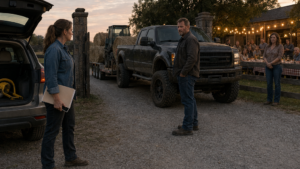
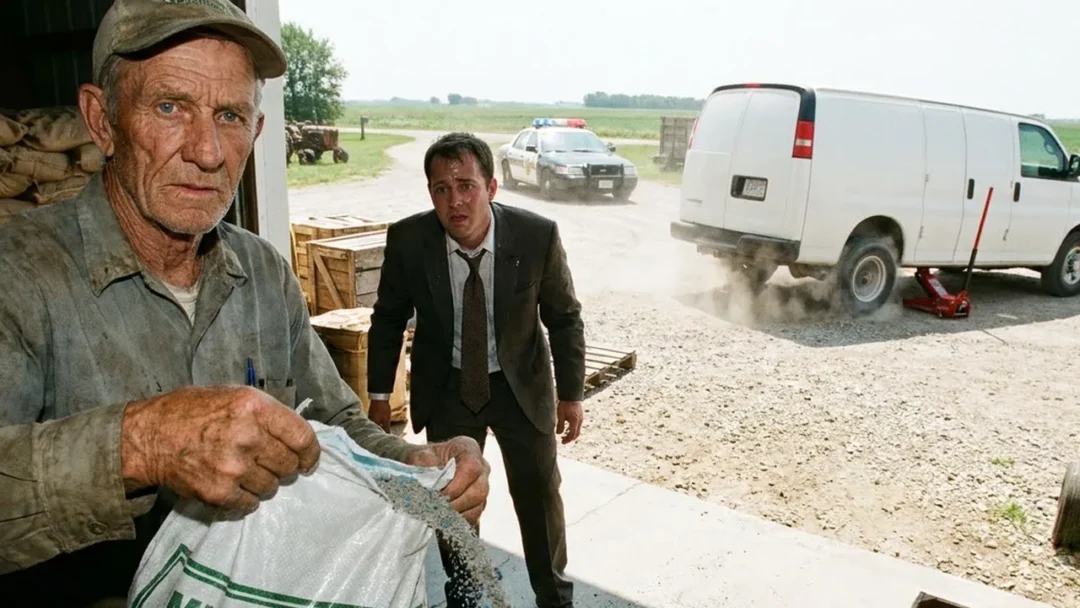
Beside the equipment shed, the nineteen-seventy-four Chevrolet farm truck sat loaded with five tons of certified, sparkling white Canadian potash crystals.
Working alongside Caleb, their movements steady, rhythmic, and guided by newfound discipline, Luke Bradley and Seth Miller were hoisting the heavy sacks with their knees, balancing the loads across their shoulder girdles, and walking the oak plank with steady, confident steps. The arrogance was gone from their eyes, replaced by the calm, focused pride of apprentices learning an ancient, honorable craft.
Caleb climbed into the cab of his John Deere tractor, his hand resting on the familiar cast-iron steering wheel. Behind him, the six-row dry fertilizer seeder was filled to the brim with clean, honest nutrients that would feed the roots of fifty thousand corn plants.
As the tractor diesel purred to life, sending a clean plume of exhaust into the morning air, Caleb looked across his fields.
The black prairie loam stretched out to the horizon like an unbroken sea of dark silk, waiting for the seed. It was land that had been cleared by his grandfather’s axes, preserved through the Great Depression by his father’s sweat, and defended against modern thieves by an old man’s unyielding hands.
Caleb shifted the transmission into gear and eased the clutch out.
The steel seeder disks sliced into the damp, fertile earth, depositing the pure white mineral crystals deep into the soil alongside the golden kernels of corn. It was the honest weight of honest bread—a harvest protected by truth, sustained by sweat, and rooted deep in the enduring strength of the land.
As twilight settled over the prairie on Saturday evening, Caleb sat on his porch looking out over the neat, dark furrows of his planting. The air was cool, carrying the sweet, clean scent of damp turned earth and distant clover. For over a century, the Thorne homestead had survived mortgage panics, brutal dust storms, economic recessions, and the steady encroachment of corporate industrial farming. But looking across the field where Luke and Seth were carefully greasing the seeder bearings for Monday morning, Caleb knew that the heritage of Black Hawk County was secure. The true strength of the land was never measured in horsepower, chemical patents, or digital commodity tickers; it lived in the quiet, watchful discipline of men who knew the weight of honest earth and held the line against those who sought to poison it.
The brass plaque presented by the cooperative board was mounted inside the main seed room at Black Hawk, right beside the ancient iron balance scale that Caleb’s grandfather had installed in nineteen-eighteen. Below the engraved letters, local farmers had hung a small glass vial containing a sample of the blue-dyed river sand, beneath which was etched a simple inscription: ‘A digital meter can be fooled by a wire, but an honest shoulder knows the truth.’ For generations of young farmers walking onto that dock, the vial stood as a quiet reminder of the morning when a seventy-two-year-old man carried two hundred pounds across a flexing oak plank, ripped open a corporate lie with his bare fingertips, and saved the bread of twenty thousand acres with an unbending grip on the soil.
And as night fell completely over the black soil of Iowa, the stars emerged in crystal clarity above the quiet silos. Caleb stood at his fence line, the cool wind brushing his weathered brow, knowing that when the Monday rains arrived, the water would sink into pure, fertile earth, carrying life to every seed that waited in the dark.