The Hundred Kilo Harvest Walk And The Counterfeit Fertilizer Scandal
CHAPTER 5: THE LEDGER IN THE GLOVE BOX
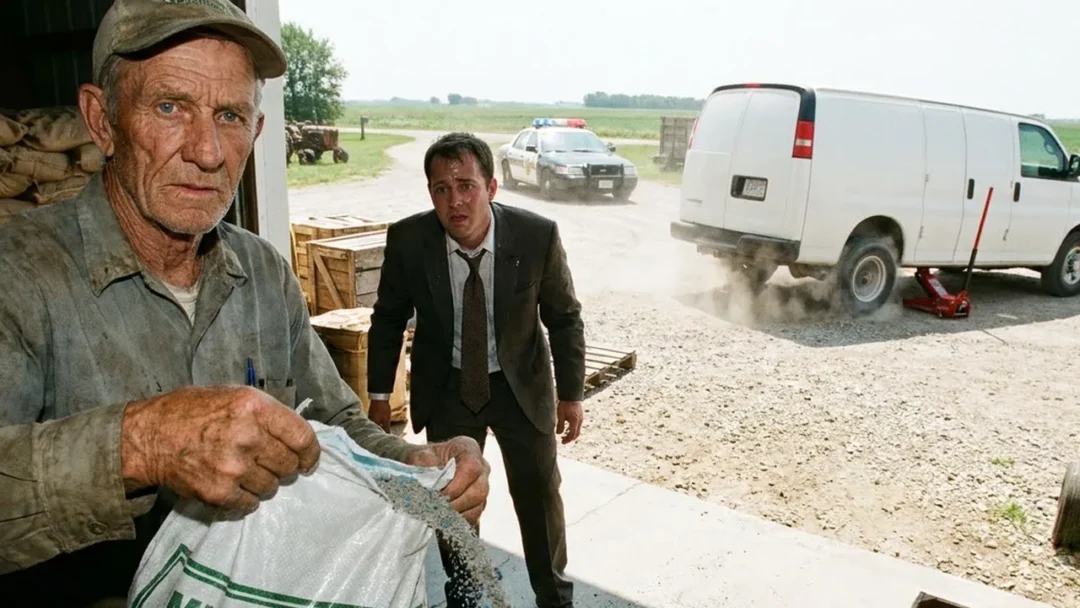
Deputy Dan Kowalski swung his patrol cruiser in front of the suspended van, blocking the front bumper at an angle that left no possible avenue of escape.
Kowalski stepped out of his vehicle, his hand resting firmly on the retention hood of his sidearm, his eyes widening in pure astonishment as he took in the scene: the screaming engine, the rear tires spinning furiously two inches off the dirt, and seventy-two-year-old Caleb Thorne casually leaning on a hydraulic pallet jack like a man waiting for a haircut.
“Cut the engine, Julian!” Kowalski barked, drawing his service weapon to the low-ready position. “Turn the key off and drop your hands outside the window right now!”
Inside the cab, Julian Vance finally realized the game was over.
With trembling fingers, he switched off the ignition. The high-pitched whine of the spinning tires slowly wound down into an embarrassing, dead silence, broken only by the hiss of cooling transmission fluid and the heavy breathing of the terrified salesman. Julian raised his shaking hands, pressing them flat against the glass of the driver’s window.
Kowalski reached through the open vent, unlocked the door, and hauled the sweating corporate broker out onto the gravel shoulder. With a pair of sharp, brutal clicks, Kowalski snapped heavy steel handcuffs around Julian’s manicured wrists, securing his hands behind his back.
“Caleb,” Kowalski said, shaking his head with a broad, disbelieving grin. “I’ve been patrolling Black Hawk County for twenty-six years, and I have never seen a man arrest an out-of-state cargo truck with a five-ton pallet jack.”
“Leverage is leverage, Dan,” Caleb replied with a shrug, wiping a speck of sand from his overalls. “Archimedes figured that out two thousand years ago. If the wheels don’t touch the dirt, all the horsepower in Detroit won’t move you an inch.”
Kowalski walked Julian to the rear of the patrol cruiser, deposited him in the back seat, and returned to search the cab of the commercial van under incident-to-arrest inventory procedures.
When Kowalski opened the glove compartment, his whistle of disbelief brought Caleb and the two young farmhands to his side.
Inside the glove box, tucked behind a stack of forged German customs manifests, was a leather document case stuffed with cashier’s checks, certified bank drafts, and thick stacks of banded hundred-dollar bills totaling over sixty-four thousand dollars.
Every check was made out to Apex Agro-Chemical Wholesalers, and every check was signed by elderly family farmers from neighboring Benton and Tama counties. Attached to each payment voucher was a delivery receipt for the same counterfeit “German potash.”
“Dear God…” Kowalski muttered, flipping through the checks. “Arthur Miller… Harold Jenkins… the Henderson brothers over in Dysart. He hit four family farms before breakfast. These folks emptied their operating reserves to buy this junk.”
Suddenly, a high-pitched digital chime sounded from the center console.
A burner smartphone, mounted on a magnetic dashboard clip, lit up with an incoming encrypted text message from a contact labeled DAVENPORT TERMINAL DISPATCH:
“Five semi-loads of dyed river mix cleared outbound scales at 06:30. En route to cooperative silos in Cedar Falls, Waterloo, and Grundy Center. Total volume: 450 metric tons. Collect remaining cash balances on delivery and head for the Chicago transit line.”
Caleb Thorne leaned over the console, his eyes turning to cold, hard iron.
“They’re not just selling pallets out of vans, Dan,” Caleb said, pointing at the glowing screen. “They’re running commercial bulk trailers of construction silt directly into the regional distribution elevators. If that dyed sand gets blended into the commercial fertilizer bins, twenty thousand acres of Iowa corn will be poisoned by tomorrow night.”
The federal legal framework surrounding the distribution of counterfeit agricultural inputs is enforced under the Federal Insecticide, Fungicide, and Rodenticide Act and the Interstate Commerce Clause. When a chemical broker distributes adulterated or counterfeit soil amendments across state lines, the offenses escalate from state-level misdemeanors into Class B federal felonies, carrying statutory forfeiture of all transport vehicles, bank accounts, and real estate used in the commission of the fraud. Furthermore, because the application of toxic borate salts directly threatens the environmental integrity of interstate watersheds like the Cedar and Iowa river systems, the United States Environmental Protection Agency possesses statutory authority to levy criminal restitution penalties exceeding ten million dollars against corporate officers who knowingly introduce hazardous waste into agricultural production.