The Hundred Kilo Harvest Walk And The Counterfeit Fertilizer Scandal
CHAPTER 2: THE SHOULDER SCALE
Julian Vance was thirty-six years old, sharp-featured, and dressed in a tailored charcoal European fleece vest over an immaculate white dress shirt, his pressed chinos tucked into a pair of glossy, hand-burnished Italian leather dress shoes that had never touched farm mud. In his manicured right hand, he carried an embossed leather invoice folder and an electronic credit-card terminal.
Julian strutted across the gravel apron with the theatrical urgency of a high-pressure corporate broker, flashing a brilliant, veneer-white smile that had sold dozens of questionable investment packages across three states.
“Morning, gentlemen!” Julian called out, clapping his hands together with a sharp, commanding snap. “I hear Black Hawk County is short on soluble potassium oxide! Lucky for you, my distribution network just diverted twenty pallets of premium European import from the Mississippi river barge terminal. Five hundred bags of fifty-kilo, ninety-nine-percent pure German muriate of potash! Soluble crystals, zero heavy metals, and guaranteed sixty-percent active K2O content!”
Julian leaned against the side of his cargo van, tapping the invoice folder against his palm with aggressive rhythm.
“Now, the grain markets don’t wait for paperwork, folks,” Julian said, his eyes darting toward the two young farmhands. “I have three large commercial syndicates in Tama County offering ten percent over market in cash right now. If you want this pallet dropped on your dock, I need thirty-six thousand dollars in certified cashier’s checks or cash upfront before my driver unloads the tailboard. First come, first served.”
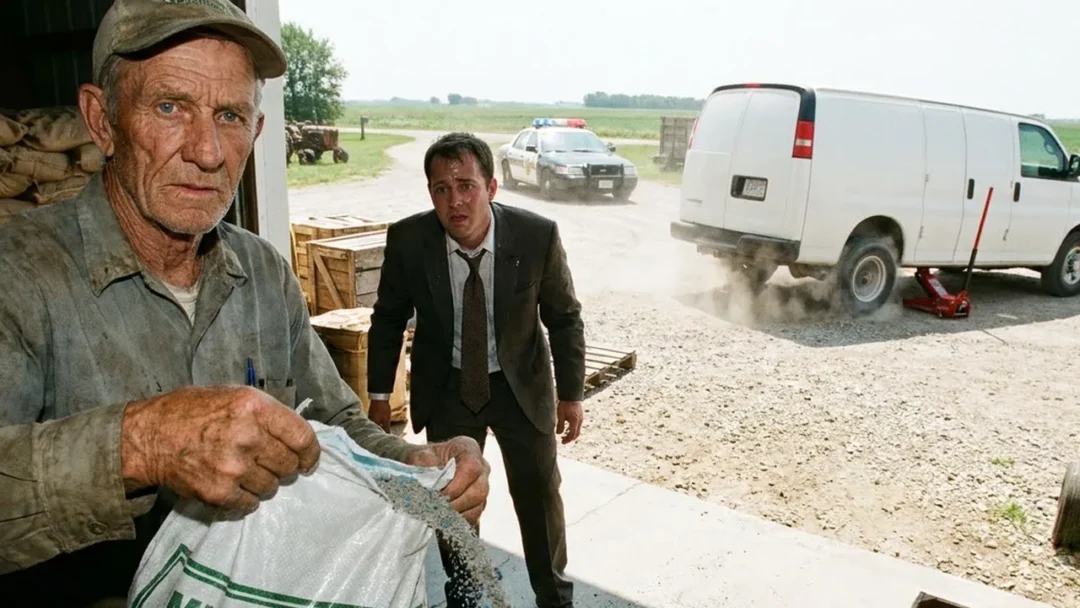
Luke Bradley stepped forward, looking eagerly at the freshly shrink-wrapped pallet resting in the open cargo bay of the van. The heavy plastic sacks were immaculate, printed with crisp German flag banners, bold gothic typography, and official-looking European inspection stamps: KALISALZ PREMIUM AGRAR-POTASH – NET WEIGHT: 50.0 KG.
“Mr. Thorne, we should take it,” Luke whispered urgently, looking at Caleb. “The cooperative warehouse has been out of potash for ten days. If we don’t get potassium down before Saturday’s rain, the young corn will suffer from leaf scorch and root rot. Thirty-six thousand is steep, but it’s better than losing forty percent of our yield.”
Caleb Thorne did not reach for his checkbook. He walked slowly down the oak ramp, his worn work boots crunching softly on the limestone gravel until he stood beside the open rear doors of Julian’s van.
Caleb’s blue eyes swept across the shrink-wrapped pallet. To an ordinary observer, the shipment looked pristine. But Caleb had spent fifty years handling commercial fertilizers, starting in the nineteen-sixties when potash was shoveled by hand out of wooden boxcars into canvas wagons. He knew the physical properties of agricultural minerals down to their crystalline geometries.
“Mind if I inspect the seal, son?” Caleb asked quietly.
Julian rolled his eyes, sighing with theatrical impatience as he glanced at his gold wristwatch. “Make it quick, grandpa. I have six cooperative managers burning up my cellular line. It’s German manufacturing—ISO nine-thousand certified. You won’t find a broken seal on that pallet.”
Caleb stepped into the rear of the van. He reached down to the top tier of the pallet, hooked his calloused fingers into the thick plastic ears of a sealed bag, and heaved it upward.
With a single, smooth, effortless motion born of sixty years of muscle memory, Caleb swung the heavy fifty-kilogram bag onto his right shoulder.
The instant the sack settled against his trapezius, Caleb froze.
His eyes narrowed into two slits of cold, flinty blue. His posture went completely rigid. To an untrained bystander, nothing seemed amiss. But to Caleb Thorne, whose spinal cord and shoulder girdle had functioned as a human balance scale for half a century, the feedback transmitted through his vertebrae was an immediate, glaring alarm bell.
When fifty kilograms of granular crystalline potash rests on a human shoulder, the mass is dense, compact, and exhibits an internal friction angle of approximately thirty-five degrees. The angular potassium chloride salt crystals interlock, creating a firm, cohesive center of gravity that rests steady against the clavicle.
This bag did not interlock.
The material inside the thick plastic sack shifted with a wet, sluggish, fluid roll—a dense, sliding inertia that moved like damp gravel dredged from an alluvial riverbed. And more importantly, the compressive load pressing down through Caleb’s right clavicle was light.
Noticeably, unmistakably light.
Caleb bounced the sack once against his shoulder, feeling the mass compress and slide. A thin, grim line tightened across his weathered mouth.
“Funny thing about German precision, son,” Caleb said, his voice dropping into a dry, dangerous drawl that silenced the dock. “This sack is labeled fifty kilograms. But according to my shoulder, it only weighs forty-two. And the center of gravity rolls like wet river sand, not crystal potash.”
The agronomic significance of potassium—chemically represented by the element symbol K—is vital to the physiological survival of monoculture corn crops in the upper Midwest. Potassium is not metabolized into structural cellular tissue like nitrogen or phosphorus; rather, it functions as the master enzymatic catalyst within plant xylem and phloem. It regulates the opening and closing of microscopic stomata on the undersides of the leaves, controlling cellular turgor pressure and vapor transpiration during severe heat waves. Furthermore, potassium strengthens the cellulose cell walls of the stalk, preventing lodging—the catastrophic collapse of mature corn plants during severe autumn windstorms. A severe potassium deficiency causes marginal chlorosis, premature senescence, and severe root rot. For family farmers operating on thin four-percent profit margins, applying counterfeit fertilizer is not merely a financial loss; it represents total agronomic bankruptcy, destroying a full year of labor and forfeiting crop insurance coverage.