The Sawed Cedar Fence Panel In The Austin Hillside Backyard
CHAPTER 5: THE IRON PIN OF 1978
By Tuesday morning, the final boundary resolution had moved to the sunlit lawn between the two properties on Ridgeview Terrace.
A specialized team of licensed state geodetic surveyors from the Texas Department of Transportation, dispatched by formal order of the Travis County District Court, had set up a five-thousand-dollar Leica robotic total station and dual-frequency satellite real-time kinematic GPS receivers on the hillside. The morning air was clean, smelling of dew-damp cedar and morning mist rising from the waters of Lake Austin below.
Leading the field investigation was Marcus Boyd, the chief boundary administrator for the county.
Nathan Hayes stood beside his limestone waterfall, holding the original, yellowed linen survey plats dated June 4, 1978, signed by legendary Texas state surveyor William J. Vance.
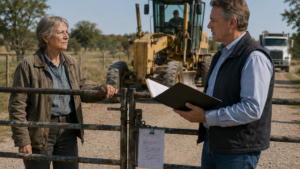
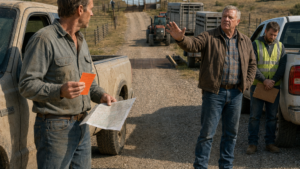
Across the lawn stood Bradley Thorne, looking utterly broken and exhausted. Beside him was an emergency commercial demolition crew from Austin Wrecking & Remediation, their skid-steer loader, concrete breakers, and industrial diamond-bladed concrete saws idling at the curb, waiting for the official judicial boundary determination before swinging their sledgehammers. Beside the demolition crew stood two senior safety inspectors from Texas Gas Service and Glenn Miller from the city building division, ensuring that every safety protocol was enforced.
Marcus Boyd adjusted the optical crosshairs of the total station, aligning the telescope with the prism pole Nathan held on the southwest corner monument.
“Nathan,” Boyd called out with a wide, professional grin. “Hold that prism plumb on the brass punch mark.”
Nathan held the stainless-steel prism pole steady on the center mark of the 1978 brass medallion, centering the bubble level with practiced, muscle-memory precision. He had performed this exact measurement thousands of times across the state of Texas; the brass pin was like an anchor tied directly into the geodetic core of the continent.
The robotic total station whined as its electronic servomotors locked onto the reflective prism, firing an invisible infrared laser beam across the green turf.
The digital display on Boyd’s handheld receiver chimed twice, calculating the geodetic coordinates down to the millimeter.
“Elevation: seven hundred and forty-two point eight feet,” Boyd read aloud, recording the verified coordinates in the official state field ledger. “Coordinate match: ninety-nine point nine nine percent. Nathan, your boundary monument is an original, undisturbed state geodetic benchmark. It is legally absolute, unchallengeable, and completely inviolable under Texas real property statutes. Every title deed in this entire section derives its legal authority from this single pin.”
Boyd picked up a can of bright fluorescent green industrial survey marking paint. He walked thirty paces across the lawn, shaking the aerosol can with a sharp, rhythmic rattle of the mixing ball. With a slow, deliberate stride, he sprayed an indelible, two-inch-wide green stripe directly across the travertine patio pavers, up the masonry face of the brick outdoor kitchen island, across the polished Brazilian granite countertop, and down the arched stone facade of the wood-fired pizza oven. The green stripe cut the kitchen clean in two, a glaring visual demarcation of law and property rights that no amount of social influence could erase.
He turned to Bradley Thorne, the city inspectors, and the demolition supervisor, holding out the legal papers.
“Gentlemen,” Boyd declared, handing Bradley a certified judicial boundary map signed by the presiding Travis County district judge. “Everything to the left of this green stripe belongs to Nathan Hayes in fee simple absolute. The structural encroachment measures exactly three feet, eight inches in width, extending twenty-two feet along the property line. Under Texas law, a permanent masonry encroachment of this magnitude creates an immediate, actionable cloud on title and an unlawful physical occupancy of private real estate. Furthermore, the Texas Gas Service emergency safety order requires that all masonry, concrete foundations, and gas piping within ten feet of the gas lateral be completely dismantled down to the native bedrock within twenty-four hours.”
Bradley took the certified decree, his hands trembling so violently that the paper fluttered in the breeze. He looked at the green line, then at the heavy steel machinery waiting at the curb. For six months, he had financed his wife’s lavish projects, ignoring the warning signs and writing checks to appease her demands for neighborhood status. Now, the final accounting had arrived.
He swallowed hard and looked at the demolition supervisor with dead, defeated eyes.
“Tear it down,” Bradley said, his voice barely louder than a whisper, yet carrying across the entire lawn. “Tear the whole thing down. Don’t leave a single brick standing.”
The demolition crew didn’t hesitate.
Two workers wearing heavy safety respirators, steel-toed boots, and impact goggles fired up seventy-pound pneumatic jackhammers connected to an industrial air compressor. With a bone-jarring, rhythmic roar that shook the hillside, the hardened steel chisel points bit into the imported brickwork of Vanessa Thorne’s seventy-thousand-dollar kitchen island.
Glazed bricks, polished granite slabs, and structural concrete cracked, shattered, and pulverized under the relentless blows, tumbling into steel wheelbarrows to be hauled away to the dump. The gas manifold was carefully severed, purged with pressurized nitrogen, and capped with heavy forged-steel plugs by Texas Gas Service technicians, permanently removing the hazardous connection from the county grid. The vibration rattled the patio, sending billowing clouds of red brick dust and pulverized mortar into the morning air.
Vanessa Thorne watched the destruction from behind the closed blinds of her second-story master bedroom window. She drew the heavy silk curtains shut with trembling hands, clutching her robe tightly against her throat as the monument to her social vanity was reduced to fifty wheelbarrows of dusty rubble.
Nathan watched the work for five minutes, noting the precise millimeter line where the jackhammers stopped at his green paint mark, then turned his back on the demolition. He picked up his wooden garden rake and knelt beside his crushed flower beds, gently turning the rich black loam to prepare the earth for replanting.