The Twelve Kilogram Sledgehammer And The Hollow Oak Beam
CHAPTER 3: THE TIMBER ESCAPE
The temperature inside the Great Hall was rising exponentially as the solvent-fueled blaze consumed the dry cedar wall studs, sending burning embers cascading down onto the sawdust-covered floor. Thick, toxic pine smoke hung like an impenetrable black curtain three feet off the deck, reducing visibility to zero in the upper reaches of the hall.
Thomas dropped low, keeping his mouth and nose pressed into the thick wool collar of his buffalo-plaid shirt. In fifty years of industrial logging and bridge construction, he had survived timber landslides in the White Mountains and flash floods along the Hudson River; he knew that smoke inhalation killed long before flames reached the skin.
He moved with deliberate, calculated speed toward the exterior double doors.
The doors were heavy, four-inch-thick solid laminate structural panels, framed in white oak and secured on the outside by an external forged-steel drop-bar designed to prevent unauthorized entry from the job site. The fire was already beginning to singe the interior trim, but the heavy oak core remained unyielding.
Thomas did not waste kinetic energy hammering randomly against the center of the four-inch wood panels. In timber engineering, the weakest point of any door assembly is not the face; it is the shear boundary where the forged-steel butt hinges are screwed into the rough structural framing.
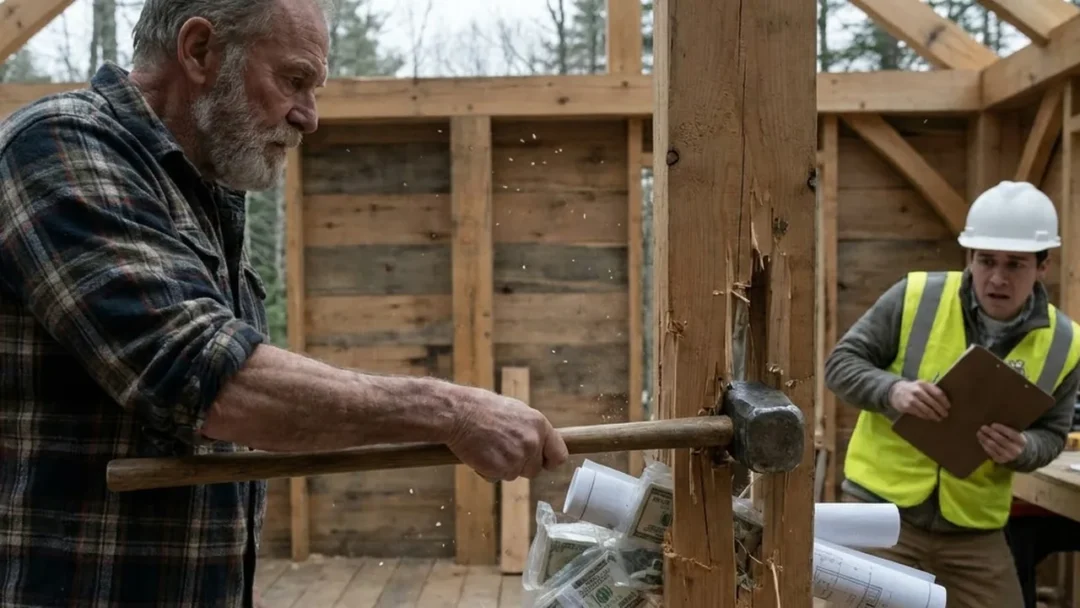
Thomas dropped into a wide, stable sumo squat, grounding his weight through his steel-toed boots. He raised the twelve-kilogram sledgehammer in a compact, vertical overhead arc.
BAM!
The twelve-kilogram hardened steel head struck the top forged-iron hinge pin with the concussive force of a pneumatic pile-driver. The structural timber frame shuddered violently, spraying cast-iron fragments and splintered oak across the threshold.
Without pausing to admire the strike, Thomas cycled his hips, driving the sledgehammer into the bottom hinge with the rhythmic, terrifying power of an industrial forge.
CRACK-BOOM!
The two-inch steel hinge bracket sheared completely in half under the catastrophic impact, tearing three-inch lag bolts cleanly from the charred pine wall studs.
Dropping the hammer handle to his hip, Thomas lowered his shoulder, planted his boots against the floorboards, and delivered an explosive eighty-pound leg-drive against the compromised door seam.
With a deafening splintering crash, the heavy timber door blew outward into the pouring rain, ripping the exterior steel drop-bar from its brackets and sending the door crashing down onto the gravel parking terrace.
Thomas stumbled out onto the gravel, coughing deeply as the cold Adirondack rain washed the soot from his face. He wiped his streaming eyes, breathing in the sweet, clean mountain air.
Fifty yards away, down the winding access road toward the state highway, a high-speed confrontation was underway.
Inspector Clara Jenkins, having just arrived on site in her state inspection sedan, was standing beside her open car door, clutching a radio microphone. She had spotted the smoke billowing from the lodge and was attempting to call for emergency structural response.
Surging out of the blinding rain came Damon Vance’s heavy-duty, customized three-ton four-wheel-drive diesel truck, its oversized steel bull-bar lowered like a battering ram, accelerating directly toward Clara’s sedan at sixty miles an hour in an attempt to run her off the road and destroy the state radio before she could transmit the alert.
“Clara! Jump!” Thomas roared through the storm.
Clara scrambled backward into the timber ditch, diving clear just as Damon’s truck clipped the driver’s side of the state vehicle, tearing off the door and crushing the front quarter-panel in a shower of shredded sheet metal.
Damon did not stop. His diesel engine bellowed black exhaust into the gray rain as his four oversized tires churned the mud, fish-tailing onto the paved mountain bypass heading toward the interstate corridor.
Thomas sprinted across the gravel to Clara’s side, hoisting the shaken inspector to her feet with one arm. “Are you injured, Clara?”
“I’m unhurt, Thomas!” Clara gasped, coughing through the rain as she clutched a water-damaged file folder she had salvaged from her seat. “Damon Vance has the entire town’s bond authorization file in that truck! If he reaches the Canadian border at Champlain, he’ll wire the funds out of the country before the state police can freeze his foreign accounts!”
Thomas looked down the mountain road, where the red taillights of Damon’s truck were disappearing into the winding switchbacks of the Ausable River gorge.
He gripped the hickory handle of his twelve-kilogram sledgehammer, his jaw locking into granite resolve. “He has to cross the Ausable Chasm bridge to reach the highway, Clara. And on that bridge, timber mechanics always win.”
The mechanical principles governing structural door assemblies dictate that an inward-facing deadbolt or external security drop-bar derives its holding power entirely from the shear resistance of the perimeter frame attachments. When Thomas evaluated the four-inch laminate fire doors, his experienced eye immediately bypassed the reinforced steel crossbar, focusing instead on the heavy forged-iron butt hinges securing the leaf to the rough opening. In heavy-timber construction, door hinge fasteners are subjected to intense cantilevered gravitational pull and localized tension. By applying the twelve-kilogram concentrated mass of the forged sledgehammer directly to the hinge pins, Thomas exerted a dynamic kinetic shockwave that exceeded the ultimate tensile shear limit of the three-inch iron lag screws, stripping the threads out of the compromised pine studding in two synchronized impacts. It was a masterclass in structural demolition—destroying the anchoring points of the obstacle rather than dissipating energy against its impenetrable center.