The Twelve Kilogram Sledgehammer And The Hollow Oak Beam
CHAPTER 5: THE FORENSIC GRAIN
The rain had ceased by midnight, leaving the Adirondack air cold, crisp, and so clear that the stars glittered like ice diamonds over the black ridgelines of the High Peaks. The Great Hall of the community lodge, though charred along its western perimeter, had been saved from total destruction by the swift response of the volunteer fire brigade from Lake Placid.
Inside the hall, illuminated by portable industrial floodlights, a team of six forensic structural engineers and state criminal investigators from Albany were methodically dismantling the central timber framing.
Leading the technical team was Chief Engineer David Miller of the New York State Department of Transportation, his ultrasonic wood-testing transducers pressed against the remaining vertical support posts.
Beside him stood Thomas MacIntyre and Inspector Clara Jenkins, reviewing the master timber requisition manifests recovered from the water-damaged files in Damon Vance’s truck.
“Look at these acoustic velocity readouts, Thomas,” Chief Engineer Miller said, pointing to the digital screen of his non-destructive testing monitor. “A healthy, solid white-oak structural column transmits a sonic pulse along the longitudinal grain at approximately four thousand meters per second. This second pillar over here is clocking in at barely eight hundred meters per second. The entire core has disintegrated into spongy, dry-rot cellulose.”
Thomas nodded gravely, running his calloused fingers along a hairline crack in the column’s veneer. “He used salvage beams taken from the old pulp mill flumes in Tupper Lake. That wood spent thirty years submerged in stagnant industrial wastewater. The hemicellulose is completely gone. Under sustained roof compression, this entire hall would have pancaked within eighteen months.”
Deputy Sheriff Owen Brooks stepped into the light, holding a thick stack of certified bank records that had just been transmitted from the state attorney general’s financial crimes bureau.
“It goes far deeper than this lodge, Thomas,” Deputy Brooks announced, his face grim with professional outrage. “The subpoenaed records from Northern Adirondack Trust show that over the last three fiscal years, Damon Vance and his uncle, Commissioner Arthur Vance, diverted two point four million dollars in municipal school construction bonds into an offshore holding company in the Cayman Islands. They used this exact same hollow-timber substitution trick on the Saranac Lake elementary school gymnasium and the new county ambulance substation in Keene.”
Clara Jenkins gasped, her hands shaking as she read the project manifests. “The school gymnasium? There are four hundred children in that building every single day!”
“The state police have already dispatched emergency building inspectors to both locations,” Deputy Brooks assured her. “Both buildings have been placed under immediate emergency closure until every structural load-bearing member can be replaced with certified steel or solid timber.”
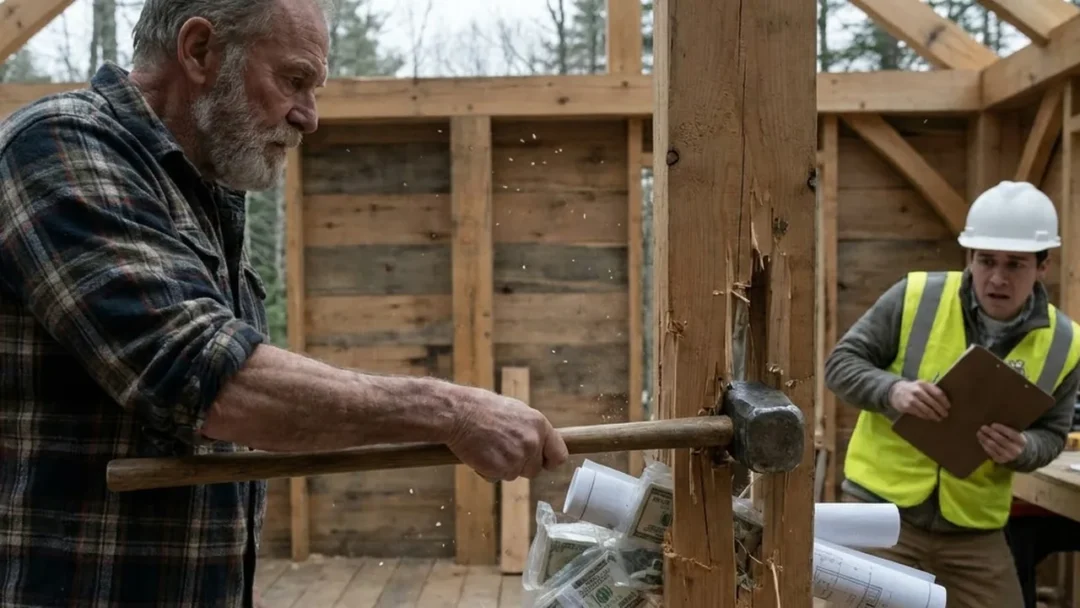
Just then, two state troopers escorted Damon Vance into the hall. Damon was in handcuffs, his expensive jacket soaked in mud, his face pale and sunken as he looked at the open forensic testing equipment and the shattered hollow columns lying on the floor.
“Damon,” Clara Jenkins said, stepping forward with her state inspector’s badge gleaming in the white floodlights. “Your uncle was arrested thirty minutes ago at his lakefront residence in Lake George by federal marshals. He has already signed a full statement claiming that you were the sole architect of the timber substitution scheme.”
Damon’s knees buckled. The final vestige of his arrogant composure shattered completely.
“That lying bastard!” Damon screamed, tears of rage and terror streaming down his mud-streaked face. “He came up with the entire plan! He was the one who found the abandoned pulp mill wood! He took sixty percent of every cash brick that came out of those bonds! I kept the duplicate ledgers! I kept every signed disbursement voucher with his personal initials in my safe in Plattsburgh!”
Thomas MacIntyre looked down at the weeping contractor with quiet, sorrowful contempt.
“A man who cuts corners on the timber that shelters his own neighbors isn’t a builder, Damon,” Thomas said, his voice echoing off the charred rafters with unyielding moral finality. “He’s just a thief waiting for the roof to fall in.”
The application of ultrasonic pulse velocity testing to structural timber forensics represents a transformative advancement over destructive coring methods. Developed originally for aerospace composites and specialized nuclear reactor shielding, ultrasonic testing measures the time of flight of an induced high-frequency acoustic wave traveling between two piezoelectric transducers mounted across opposite faces of a wooden member. Because the longitudinal acoustic velocity is directly proportional to the dynamic modulus of elasticity and the continuous density of the cellular wood matrix, any internal interruption—such as termite tunneling, fungal brown rot, or an intentional hollow void—causes the acoustic wave to diffract around the defect, dramatically increasing propagation time and dropping the calculated velocity below the threshold of structural safety. When Chief Engineer Miller’s instrumentation recorded an acoustic velocity of only eight hundred meters per second through Damon’s king-posts, the empirical data provided an unassailable mathematical proof of internal hollow voids that could be introduced directly into a court of law without relying upon visual speculation or subjective witness accounts.