The Twelve Kilogram Sledgehammer And The Hollow Oak Beam
CHAPTER 4: THE QUARRY ROADBLOCK
The Ausable River roared thirty feet below the narrow, single-lane timber-decked bridge that connected the high mountain logging roads to Route 9. The river was running swollen and white with autumn rain, churning over ancient granite boulders in a deafening torrent of glacial foam.
Because of heavy seasonal logging traffic from the nearby stone quarry, the county had placed a staging pile of heavy structural materials on the southern approach to the bridge: a dozen thirty-foot, eighteen-inch-diameter un-barked white-oak timber pilings, each weighing over two thousand pounds, seasoned and dense as cast iron.
Standing in the bed of his old 1978 flatbed Ford truck, which had brought them ahead of Damon via an old logging shortcut through the quarry, Thomas MacIntyre worked with the speed and precision of a veteran river-driver.
In his hands, he wielded a six-foot forged-steel timber cant-hook—a massive lever tool used by lumbermen to roll multi-ton logs off skids.
“Thomas, he’s coming down the gorge!” Inspector Clara Jenkins shouted from the cab of the truck, pointing through the sweeping wipers.
Through the descending gloom and driving rain, the blinding halogen light bars of Damon Vance’s heavy-duty diesel truck appeared around the switchback, sliding sideways through the mud as Damon floored the accelerator, determined to blast across the bridge and reach the interstate before state police roadblocks could form.
Thomas didn’t look up from his work. He jammed the hardened steel duck-bill of the cant-hook beneath the apex of the top two-thousand-pound oak log resting on the roadside staging skid.
With a deep, diaphragmatic grunt, Thomas threw his entire body weight onto the hickory lever shaft, levering the unyielding oak trunk over the wooden retaining chock.
CREEEAK-THUD!
The massive, two-thousand-pound log rolled off the skid, crashing down across the asphalt approach road and settling horizontally directly across both lanes, precisely twenty feet before the bridge abutment.
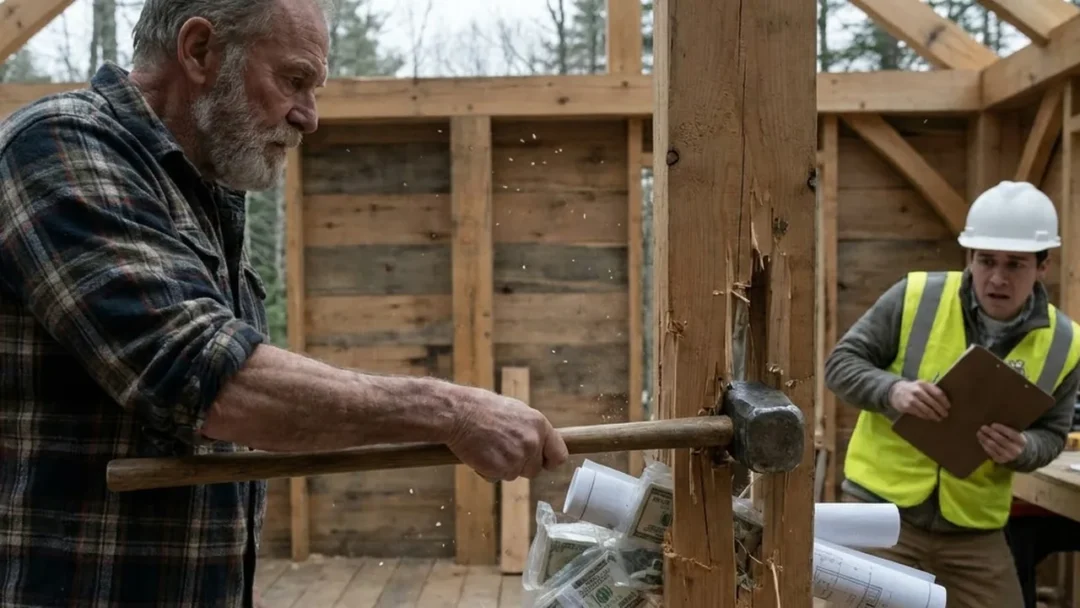
Moving with seamless economy of motion, Thomas jumped from the flatbed, grabbed his twelve-kilogram sledgehammer from the truck rack, and drove a five-inch structural steel drift-pin deep into the asphalt behind the log, locking the timber into an immovable kinetic wedge anchored against the bridge’s granite bedrock footings.
Damon Vance rounded the final corner at sixty miles an hour.
His high beams caught the massive, bark-covered oak trunk lying across the road. Damon panicked, stomping on the power anti-lock brakes.
SCREEEEEECH!
The three-ton truck skidded across the rain-slicked asphalt, its tires smoking in the wet, sliding sideways with terrifying momentum. Realizing he could not stop in time, Damon clamped his hands on the steering wheel, closed his eyes, and braced for impact, hoping his reinforced steel bull-bar would shatter the timber log.
KA-BOOOOOOM!
The collision sounded like a locomotive jumping the tracks.
The heavy steel bull-bar of the modern pickup truck crumpled like aluminum foil against the unyielding, forty-eight-pound-per-cubic-foot density of the solid white-oak trunk. The truck’s front suspension collapsed instantly, the steering knuckles snapping with a sharp, explosive crack as the front axle was torn completely from its leaf-spring shackles.
The truck shuddered to a violent, dead halt, its radiator bursting in a boiling cloud of green antifreeze steam, its rear wheels lifted six inches off the pavement by the kinetic rebound.
Inside the shattered cab, the steering wheel airbag had deployed, pinning Damon Vance against his seat. He sat dazed, bleeding from a superficial cut on his forehead, coughing weakly into the chemical dust of the airbag.
Thomas MacIntyre walked calmly across the wet asphalt, his twelve-kilogram sledgehammer resting over his shoulder, his red buffalo-plaid shirt soaked through with mountain rain.
He walked up to the driver’s window, which had shattered into a web of safety glass. Thomas reached out with his bare left hand, pushed the spider-webbed glass into the cab with a crunch, and unlocked the door from the inside.
He pulled the heavy door open, reached inside, and grabbed Damon Vance by his designer vest, dragging the trembling contractor out of the cab and dumping him onto the wet pavement beside the unyielding oak log.
“A truck has horsepower, Damon,” Thomas said, his deep voice carrying above the roar of the swollen river below. “An oak tree has two hundred years of mountain roots. You can’t bribe an oak tree with stolen bond money.”
From down the highway, the wailing chorus of four Essex County sheriff’s cruisers and two state police interceptors cut through the rain, their flashing blue lights painting the granite cliffs in brilliant emergency hues.
The hydrodynamic and structural properties of un-barked white-oak timber pilings make them the premier material for heavy civil engineering works in riverine environments. When harvested during late-autumn sap dormancy, a thirty-foot, eighteen-inch white oak log possesses a green density exceeding sixty pounds per cubic foot, resulting in a single timber trunk that weighs upwards of twenty-two hundred pounds. The dense outer bark acts as an elastomeric dampener that absorbs kinetic impacts, while the interlocking cellulose grain prevents catastrophic longitudinal splitting under sudden compressive shock. When Thomas dropped the two-thousand-pound log across the asphalt approach road and pinned its base with structural steel drift-pins against the granite bedrock abutments, he established an unyielding kinetic energy barrier that functioned as an immovable shear wall, redirecting the momentum of Damon’s three-ton diesel truck into its own frame and front axle components.