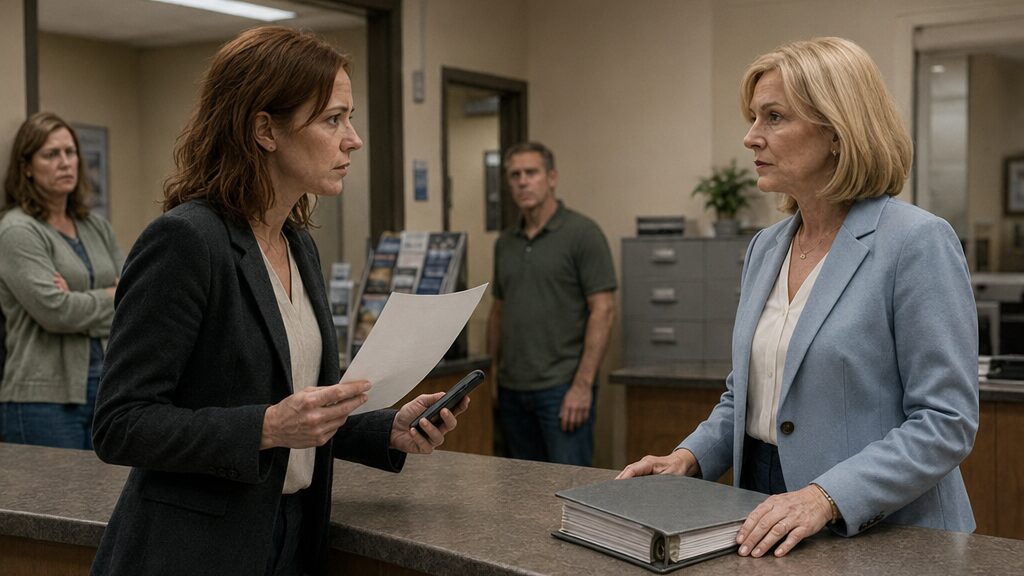
The Check Bounced While Her Grandfather Was Dying, Then One Wrong Date Exposed the HOA
Chapter 1: The Check Failed Before the Nurse Could Finish Speaking
“The payment didn’t go through.”
Rachel Wilson tightened her hand around her grandfather’s before the hospice nurse could finish the sentence.
Edward’s fingers lay cool and dry against hers. A pulse monitor clicked softly beside the bed, steady enough to be reassuring if Rachel did not look at the oxygen tubing beneath his nose or the gray hollows under his cheekbones.
“I’m sorry,” the nurse said. “Billing tried the card twice. They asked me to let you know before the medication delivery is released.”
Rachel stared at her.
“What payment?”
“The supplemental hospice account. The one listed for home-transition services.”
For a moment Rachel heard only the mechanical breath of the oxygen line.
“That account has money in it.”
The nurse’s expression changed in the careful way professionals’ faces changed when they knew they had crossed from medicine into someone else’s crisis.
“You may want to call the bank.”
Edward shifted weakly. His eyelids lifted.
“Rach?”
She bent toward him at once. “I’m here.”
“You arguing?”
“No.”
His mouth moved in something close to a smile.
“Sound like your mother.”
Rachel almost laughed. Instead she touched his wrist with her thumb.
“Go back to sleep.”
Three weeks, the hospital social worker had told her that morning. Possibly less. Edward wanted to leave the hospital if they could stabilize his breathing. Hospice had arranged equipment, medication, and nursing support for the house he had lived in for forty-one years.
Rachel had spent the previous month making lists.
Medication.
Transport.
Insurance.
Legal forms.
The automatic reserve payment Edward had established years earlier for property-related expenses and emergency care.
That money was supposed to be the easy part.
In the corridor, Rachel called the bank.
The first representative repeated a phrase about insufficient available funds. Rachel asked for a supervisor. The second person asked security questions Edward had answered two months earlier when Rachel received limited authorization to assist with his accounts.
Then the woman on the line went quiet.
“I need to be precise,” she said. “This was not a declined transaction caused by a card problem.”
Rachel leaned against the wall.
“Then what caused it?”
“The balance is lower than the amount requested.”
“How much lower?”
“I can’t discuss every linked transaction under your current authorization.”
“I’m not asking for every transaction. I’m asking whether money that was there last month is still there.”
Another pause.
“No.”
Rachel closed her eyes.
“How much is missing?”
“I can confirm a substantial transfer from the linked community reserve account.”
Rachel opened them again.
“What community reserve account?”
The representative gave her a reference description. It contained the name of Edward’s subdivision and the same homeowners association that had mailed him quarterly statements for decades.
Rachel wrote the words on the back of a hospital cafeteria receipt.
“What does the transfer say?”
“I can only read the posted description.”
“Read it.”
“Association reallocation.”
Rachel looked through the glass panel in Edward’s door. He had fallen asleep again with one hand still turned toward the empty chair where she had been sitting.
“Reallocated to where?”
“I’m sorry. I can’t see a final destination from this screen.”
By the time Rachel reached the parking garage, she had called the HOA office four times.
No answer.
On the fifth call, someone picked up and told her the office closed at five.
Rachel checked the dashboard.
4:37.
She drove there in twelve minutes.
The association office sat near the clubhouse at the entrance to the subdivision, a low beige building Edward had once called “the most expensive shed in the county.” The lawn outside was clipped so evenly it looked printed.
Rachel entered carrying the cafeteria receipt, the declined hospice notice, and a folder of Edward’s account papers.
A woman in a pale blue blazer sat behind the front counter.
Carol Mitchell.
Rachel recognized her from board newsletters and annual meeting photographs. Carol had the composed posture of someone who had spent years speaking into microphones no one else had asked to use.
“I’ve been calling,” Rachel said.
Carol glanced at the clock.
“We are still open.”
“My grandfather’s account was drained.”
That got her eyes up.
“Who is your grandfather?”
“Edward Wilson.”
Something small changed in Carol’s face. Not shock. Recognition.
Rachel put the hospice notice on the counter.
“A payment failed today. The bank says funds were transferred through an association reallocation. I want to know where his money went.”
Carol folded her hands.
“Mr. Wilson’s account was adjusted pursuant to the community stabilization plan.”
Rachel stared at her.
“The what?”
“The board approved temporary reallocations from eligible reserve-linked balances.”
“You took money from his account?”
“That is not accurate.”
“Then use an accurate word.”
A man near the copier turned his head.
Carol lowered her voice.
“Ms. Wilson, the association has maintained this neighborhood through significant financial pressures. Roof drainage, retaining-wall exposure, insurance compliance. These things cost money.”
“My grandfather is dying.”
Carol’s expression tightened, but only briefly.
“I’m sorry to hear that.”
“His hospice payment bounced.”
“I understand you’re upset.”
“No. You understand the sentence. I’m asking where his money is.”
Carol rose.
“Come around to the side desk.”
Rachel almost refused. Then she followed.
Carol unlocked a cabinet and removed a thick binder. She opened it to a section marked EMERGENCY STABILIZATION AUTHORIZATIONS.
Rachel’s training returned before she consciously invited it.
Years earlier, she had worked in municipal records, where people lied in grand ways and exposed themselves in small ones: missing initials, inconsistent routing codes, dates that fell on holidays, attachments entered in the wrong sequence.
Carol turned several pages.
“There.”
Rachel saw Edward’s name.
A transaction amount.
A signature.
She stopped breathing for half a second.
“What is this?”
“Authorization.”
“For what?”
“The temporary use of designated funds.”
“He never told me about this.”
Carol gave a faint, exhausted smile.
“Families are not always informed of every financial decision.”
Rachel looked at the signature again. It resembled Edward’s handwriting. The high loop in the W. The compressed final stroke.
Her certainty faltered.
Carol noticed.
“Your grandfather has lived here a very long time,” she said. “He understood the association’s needs.”
Rachel heard the insult inside the gentleness.
“He also understood what hospice costs.”
Carol closed one hand over the edge of the binder.
“Ms. Wilson, older residents sometimes approve things and later forget the details.”
Rachel’s head came up.
“Don’t do that.”
“Do what?”
“Turn his age into your explanation.”
Carol’s patience thinned.
“We maintained his property while he was hospitalized. We cut his lawn. We kept violation notices from accumulating. Frankly, the association has shown your grandfather considerable consideration.”
Rachel looked through the office window toward the immaculate grass outside.
Forty-one years Edward had lived there.
He had planted a maple in the front yard when Rachel’s mother was still in high school. He had attended drainage meetings, argued over mailbox rules, brought coffee to volunteers after storms.
And now, while he lay struggling to breathe, Carol was telling Rachel to be grateful for lawn care.
Rachel tapped the page.
“I want a copy.”
Carol hesitated, then slid a photocopy from a pocket in the binder.
“You may take that.”
Rachel picked it up.
At the bottom sat Edward’s name.
His signature.
And, beside it, a handwritten date Rachel barely registered through the heat in her face.
“Why would he do this?” she asked.
Carol closed the binder.
“Because he agreed it was necessary.”
Rachel looked at her.
Carol’s voice remained calm.
“He signed it himself.”
Chapter 2: The Date Beside His Name Could Not Be True
Rachel reached the office door before the date stopped her.
She did not understand at first why her hand had frozen against the metal push bar.
Then she looked down again.
October 14.
The numbers sat beside Edward’s signature in blue ink.
Rachel read them twice.
Behind her, Carol was returning the binder to the cabinet.
Rachel turned around.
“Did he sign this here?”
Carol did not answer immediately.
“You said he signed it himself.”
“Yes.”
“Here?”
Carol shut the cabinet.
“I believe so.”
“You believe so?”
“The authorization was properly submitted.”
Rachel walked back to the counter.
“Was he physically in this office?”
Carol’s mouth tightened.
“Ms. Wilson, I’m not going to reconstruct every routine administrative interaction from months ago.”
“Then tell me what the record says.”
“The record says he authorized it.”
Rachel put the paper flat between them and pointed to the date.
“October fourteenth.”
Carol glanced down.
“Yes.”
A strange calm entered Rachel’s body.
Not relief. Something colder.
She took out her phone.
On the hospital portal, she opened Edward’s admission history. Her thumb slipped once because her hands had begun to shake.
October 12: emergency admission.
October 13: inpatient respiratory evaluation.
October 14: inpatient.
October 15: inpatient.
October 16: inpatient.
She turned the screen toward Carol.
“He was in the hospital.”
Carol barely looked.
“That does not mean—”
“He was admitted two days before this date.”
“Documents can be signed remotely.”
“You said he signed here.”
“I said I believed—”
“No.” Rachel’s voice remained low. “You said he signed it himself.”
A resident entering behind her slowed near the brochure rack.
Carol noticed and stepped closer.
“Lower your voice.”
“I am.”
The fact that she was made Carol flush.
Rachel placed her phone beside the authorization.
“Was this witnessed?”
“Board documentation is not available for casual inspection.”
“Was there a vote?”
“That is internal.”
“A meeting minute?”
“Internal.”
“Bank transfer approval?”
“You are not entitled to unrestricted financial records because you walked in upset.”
Rachel felt the words land and hated that part of her wanted to strike back simply to make Carol lose that smooth expression.
Instead she looked down at the date.
October 14.
The longer she stared at it, the more obscene it seemed.
She remembered that week with painful precision.
Edward had arrived by ambulance after collapsing near his kitchen sink. Rachel had flown through three red lights behind the ambulance before losing it in traffic. On October 14, she had spent eleven hours in a plastic chair outside pulmonary care because visitors were restricted during a procedure.
He had not been signing HOA forms at a front counter.
“Give me the supporting record,” she said.
“No.”
“Then give me the name of whoever witnessed this.”
“No.”
Rachel looked up.
Carol exhaled.
“I will not permit you to turn a routine board matter into an accusation because you’re under stress.”
“A routine matter emptied an account my grandfather needed for care.”
“The funds were not stolen.”
“Where are they?”
“They were reallocated.”
“That is not a destination.”
Carol’s jaw set.
Rachel heard her own pulse.
Here was the moment she usually ruined things.
At work, people had called her exacting. Difficult when they wanted to be polite. Once, after a compliance meeting, a director had told her that being right too early could make everyone else stop helping.
She had hated him for saying it.
She hated that she remembered it now.
Rachel gathered the photocopy.
“I need his complete authorization file.”
“You’re not getting it.”
“I need board approval records.”
“No.”
“Then I’ll request them elsewhere.”
Carol’s expression changed.
“Elsewhere?”
“County filings. City records. Anything tied to the transfer.”
For the first time, Carol smiled.
Then she laughed.
It was not loud. That made it worse.
“Rachel,” she said, using her first name now, “you think county records are going to explain an internal HOA allocation?”
Rachel stared at her.
Carol shook her head with something almost like pity.
“You worked in records, didn’t you? Years ago?”
Rachel did not ask how she knew.
“Then you should know better than this.”
The resident by the brochure rack looked away.
Rachel folded the photocopy once.
“Maybe.”
She left.
In the hospital parking lot, she sat in her car without starting the engine.
Her first impulse was to call Carol back and tell her exactly what she thought. Her second was to email every homeowner in the subdivision.
She did neither.
Instead she returned upstairs.
The hospice nurse met her near Edward’s room.
“We got a temporary medication release approved,” she said. “Forty-eight hours.”
Rachel nodded.
Forty-eight hours.
Inside the room, Edward was awake.
“You disappear,” he whispered.
“I had to check something.”
“Always checking.”
She sat beside him.
He looked at her face for several seconds.
“Trouble?”
Rachel wanted to show him the paper.
Wanted to ask whether the signature was his.
Wanted to know whether he had given away money meant for his own care.
But his breathing was shallow, and she could see fatigue moving over him like a shadow.
“Nothing I can’t handle.”
The lie hurt as soon as she said it.
Edward closed his eyes.
Rachel stayed until he slept.
Then she went to the nurses’ station.
“I need documentation of his October admission.”
The clerk hesitated.
“For what purpose?”
“Financial dispute.”
Because Rachel held valid medical authorization for limited administrative matters, the process was slower than she wanted but possible. She signed a request, waited, answered questions, and finally received a stamped admission summary showing continuous inpatient status from October 12 through October 18.
She stood under the corridor’s fluorescent lights with both documents in her hands.
Authorization: October 14.
Hospitalization: October 12 through October 18.
For the first time that day, one question had an answer.
Carol’s explanation could not be true as presented.
But the answer opened something larger.
Rachel took a photograph of both documents side by side.
At 8:16 p.m., she emailed the HOA.
Please preserve all records associated with Edward Wilson’s authorization, transfer, account reallocation, board approval, witness verification, and related disbursement.
She added no accusation.
No threat.
At 8:29, a reply arrived.
Your request has been received. Further communications regarding internal association financial matters should be directed through formal channels.
Rachel read it once.
Then again.
She opened a blank spreadsheet and typed the first entry in a new chronology.
October 12 — Edward admitted.
October 14 — disputed authorization dated.
October 18 — discharge from continuous inpatient stay.
She saved the file.
Carol had laughed at county records.
Rachel looked at the three dates on her screen.
Then she opened the county portal.
Chapter 3: Public Records Showed a Project the City Never Approved
The first contradiction appeared at 11:43 p.m.
Rachel almost missed it.
She had been searching the county portal for more than two hours, moving between property filings, assessment records, contractor notices, and association documents that were public only because somebody, somewhere, had needed an official stamp.
Most of it was useless.
Then she opened a recorded notice tied to a drainage stabilization project along the subdivision’s eastern retaining wall.
The filing referenced emergency work.
The HOA ledger summary Rachel had photographed from Carol’s open binder listed the same project category.
But the dates did not align.
Rachel sat straighter.
The contractor invoice appeared to predate the city’s acknowledgement of the project.
That alone proved nothing. Emergency work could begin before final administrative processing.
She knew better than to fall in love with a discrepancy simply because she wanted one.
So she wrote it into the chronology and kept searching.
At 12:17 a.m., she found a second invoice reference.
Same contractor.
Different section of the subdivision.
Again, emergency stabilization.
Again, a date pattern that did not fit.
At 12:44, she found a third.
Rachel stopped.
The apartment around her had gone silent. Edward’s account folder lay open beside an untouched cup of coffee. On her laptop, three entries formed a pattern she did not yet trust.
She called no one.
Instead she created columns.
Project.
Invoice date.
Board approval.
Permit number.
City acknowledgement.
Payment source.
She worked until her eyes burned.
At 2:06 a.m., one column remained nearly empty.
Permit number.
The next morning, Rachel arrived at the city permit office nine minutes after it opened.
The clerk behind the counter listened while she explained that she was verifying whether specific retaining-wall and drainage work had corresponding permits.
“HOA property?” the clerk asked.
“Yes.”
“That can get messy.”
“I’m not asking you to interpret anything.”
The clerk studied her.
“Just existence?”
“Existence and dates.”
That seemed to earn her something.
The clerk searched.
The first project had no matching approval under the address range Rachel provided.
The second had an application, but it had been submitted months after the invoice date.
The third referenced work in a common area for which the city had no final approval at all.
Rachel felt genuine fear for the first time.
Not triumph.
Fear.
Because if the records were incomplete, that was one problem.
If the work had been billed, paid, and described to residents as approved when approval did not exist, that was another.
“Could it be under a different parcel?” she asked.
The clerk checked.
“Possible, but I’m not seeing it.”
Rachel slid another reference number across the counter.
The clerk typed.
“No.”
Another.
“No.”
Rachel left with certified search results for only those records she could properly request. She resisted the urge to interpret them beyond what they said.
In her car, she added each result to the chronology.
Then her phone buzzed.
An HOA email.
NOTICE REGARDING UNAUTHORIZED REQUESTS FOR CONFIDENTIAL ASSOCIATION MATERIALS.
Rachel opened it.
The message accused an unnamed individual of contacting outside entities with incomplete information and warned residents that “misleading allegations” could damage insurance negotiations and property values.
Unnamed.
But everyone would know.
Rachel read the message again, anger climbing through her.
Her first instinct was immediate.
She forwarded it to two neighboring homeowners whose addresses she still had from Edward’s emergency contact sheet.
Then she typed:
You should ask Carol where Edward’s money went.
She stared at the sentence.
Sent it.
Within ten minutes, one neighbor replied.
What money?
The second response came three minutes later.
Rachel, please don’t start this publicly. People are already scared about assessments.
She should have stopped.
Instead she wrote back:
Then maybe they should be scared about the board moving money without valid authorization.
By noon, the HOA’s private resident email chain had become a fight.
Rachel knew because screenshots began arriving.
Some residents demanded records.
Others accused her of exploiting Edward’s illness.
One message said she was “an out-of-town heir trying to cash out before the body is cold.”
Rachel stared at that line until the words blurred.
She had not been out of town for three years.
But she had been absent in other ways.
There had always been another deadline when Edward asked her to visit.
Another quarter-end review.
Another weekend she promised to make up later.
Now later had narrowed to three weeks.
Her phone rang.
Hospital.
Rachel answered at once.
Edward had experienced a breathing episode but was stable.
She gripped the steering wheel.
“I’ll be there.”
Before starting the car, she looked again at the resident messages.
Her anger had made the situation public before her evidence was ready.
Carol now had exactly what she needed: a grieving granddaughter who looked reckless.
Rachel closed the email.
No more accusations.
Not yet.
That afternoon she returned to the records.
The transaction trail was harder because she could not access private bank data. But public filings, board summaries, contractor notices, and the limited account information Edward had preserved began to overlap.
One large outgoing amount appeared repeatedly in fragments.
Not once.
In pieces.
A reserve transfer.
An emergency project payment.
A stabilization advance.
A contractor deposit.
Rachel built the chain carefully.
$72,000.
$118,500.
$96,000.
$41,750.
Then smaller related disbursements.
The total moved upward.
She checked every line twice.
Nearly $400,000.
Her stomach tightened.
The destination description was not Carol Mitchell.
That surprised her.
It pointed instead toward a privately controlled holding account associated with the contractor handling several of the disputed projects.
Rachel leaned back.
If Carol were simply stealing, the trail was strangely indirect.
If the board were paying legitimate emergency work, the missing approvals made no sense.
And if the contractor account were merely a normal holding channel, why had Edward’s personal reserve-linked funds been swept into it under an authorization dated while he was hospitalized?
Her phone rang again.
This time it was the bank representative returning a message.
Rachel answered.
“I need one thing,” she said. “Can you confirm whether my grandfather’s transfer was part of a larger batch?”
The representative hesitated.
“I cannot disclose other customers.”
“I’m not asking for names.”
Silence.
Then: “I can say the processing reference indicates grouped association activity.”
Rachel closed her eyes.
“How many?”
“I can’t answer that.”
“More than one?”
Another silence.
“Yes.”
The call ended two minutes later.
Rachel looked at the chronology covering her screen.
Edward’s money was not the whole story.
Maybe not even the largest part.
At the bottom of the spreadsheet, she added the connected transfers one final time.
The figure stopped just under four hundred thousand dollars.
Rachel stared at it.
Until that moment, she had believed she was looking for a thief.
Now she was no longer certain what she was looking at.
Carol could be stealing.
She could be hiding a financial collapse.
Or she could be doing both.
Chapter 4: The Signature Was Wrong, but the Simple Story Was Wrong Too
Andrew Garcia did not say the word Rachel had driven across town to hear.
He held the photocopy beneath a desk lamp, studied Edward’s signature for less than ten seconds, and said, “I can’t call this forged.”
Rachel stared at him.
“You haven’t even compared it yet.”
“Exactly.”
Andrew set the page down.
His office occupied two rooms above a tax-preparation business, with metal filing cabinets along one wall and a scanner large enough to make the desk look temporary. Rachel had brought six verified examples of Edward’s handwriting: checks, a notarized form, a Christmas card, two repair authorizations, and a note he had written to the pharmacy.
She pushed them toward him.
“The signature is dated while he was hospitalized.”
“That matters.”
“It matters a lot.”
“It may matter more than the handwriting.”
Rachel sat back.
For two days she had lived inside a theory that felt increasingly complete. Carol had access. Carol defended the transfer. Carol restricted records. Nearly four hundred thousand dollars had moved through a contractor-controlled account. Edward’s authorization could not have happened the way Carol claimed.
The shape of it seemed obvious.
“You’re telling me the signature looks real?”
“I’m telling you a photocopy of one disputed signature is not enough to support the conclusion you want.”
“I don’t want a conclusion.”
Andrew looked at her over his glasses.
Rachel heard herself and stopped.
He waited.
She folded her arms. “Fine. I want a conclusion.”
“That’s what worries me.”
He arranged Edward’s known signatures in a row.
“People think handwriting examination is pattern matching. Same loop, same slant, same answer. It isn’t that simple. Illness changes writing. Medication changes writing. Position changes writing. So does fatigue.”
“He was hospitalized.”
“Yes.”
“Then how did he sign this?”
“I don’t know.”
Rachel exhaled sharply.
Andrew pointed to the disputed page.
“But I can tell you what concerns me.”
He enlarged the signature on his monitor.
Edward Wilson.
Rachel leaned forward.
Andrew indicated the first stroke.
“See this hesitation?”
She saw a slight thickening in the line.
“Maybe.”
“Now compare the known signatures.”
He brought up the notarized form.
Edward’s W began decisively, almost too hard, the first downstroke deeper than the rest.
On the disputed page, the beginning looked slower.
Andrew moved to the final letters.
“Here. Your grandfather usually compresses the last two letters into one continuous motion. This one separates them.”
“So it’s forged.”
“No.”
Rachel’s jaw tightened.
“It is inconsistent.”
“That sounds like a professional way to avoid saying anything.”
“It’s a professional way to avoid saying more than the evidence supports.”
The words hit harder because Andrew did not sound offended.
He showed her three more points: unusual pen lifts, an awkward retracing of one stroke, spacing that did not match Edward’s usual rhythm.
Then he said, “There is enough here for a formal examination if you can obtain the original.”
“And if I can’t?”
“Then your date conflict may remain stronger than my opinion.”
Rachel looked at October 14 on the photocopy.
The date again.
Always the date.
A life reduced to ink beside a name.
Andrew began examining the other documents she had brought, including the transaction chronology. He was not an accountant, he reminded her twice. Still, he noticed something Rachel had seen and then mentally filed under evidence of wrongdoing.
“The reserve balance was already low,” he said.
Rachel looked up.
“What?”
He tapped a quarterly statement.
“This association was spending ahead of collections.”
“I know.”
“No, I mean well before your grandfather’s transfer.”
Rachel moved closer.
He traced a sequence of balances.
Insurance increase.
Drainage repair.
Retaining-wall engineering.
Emergency work.
The reserve account had been losing strength for more than a year.
“That doesn’t authorize taking Edward’s money.”
“I didn’t say it did.”
“It doesn’t excuse a false signature.”
“I didn’t say that either.”
She hated how defensive she sounded.
Andrew leaned back.
“You came in thinking one bad person stole money.”
Rachel said nothing.
“I’m saying your documents show something else too. A community that may already have been in financial trouble.”
“That could be the cover story.”
“It could.”
“Carol could have manufactured the crisis.”
“She could.”
“You’re not helping.”
Andrew took off his glasses.
“My job is not to help your theory.”
The silence that followed was clean and humiliating.
Rachel gathered the pages more roughly than she intended.
Andrew stopped her before she reached the door.
“I’ll do the formal comparison.”
She turned.
“There are enough inconsistencies to justify it.”
It was not the victory she wanted.
But it was something real.
That evening, the HOA meeting room was full before Rachel arrived.
She knew immediately that Carol had prepared for her.
Printed packets sat on every folding chair. At the top of the first page:
COMMUNITY FINANCIAL STABILITY AND MISINFORMATION RESPONSE.
Rachel felt heat climb her neck.
Carol stood near the front beside the current treasurer. Margaret Hill sat in the second row, hands folded over a large purse. Rachel remembered her vaguely from Edward’s block—white hair, careful posture, a woman who had once brought him soup after a surgery.
Carol called the meeting to order.
For ten minutes, she discussed insurance premiums, deferred maintenance, and resident anxiety.
Then she looked directly at Rachel.
“Recently, incomplete claims have been circulated regarding association finances by an individual with a personal financial interest in a homeowner’s estate.”
A murmur moved through the room.
Rachel stood.
“My grandfather is alive.”
Carol paused.
“I did not state otherwise.”
“You implied it.”
“Please sit down.”
“No.”
That was the mistake.
Rachel knew it even as she continued.
“You moved money under an authorization dated while he was hospitalized. You paid contractors for projects the city cannot verify. Nearly four hundred thousand dollars passed through a private account.”
The room erupted.
A neighbor demanded to know what account.
Another asked whether assessments were coming.
Someone behind Rachel said, “This is exactly what she wants.”
Carol did not raise her voice.
“Thank you,” she said.
Rachel stopped.
Carol held up one hand.
“This is precisely the danger of partial information.”
She displayed a reserve report on the projector.
The balances were real.
Painfully real.
Insurance premiums had risen sharply. A retaining wall had been flagged. Drainage failures had produced repeated repair costs. Residents had rejected two proposed assessment increases.
Carol turned toward the room.
“We faced the possibility of losing coverage.”
Silence replaced the noise.
Rachel looked at the figures.
They did not prove the transfers legitimate.
But they proved Andrew right.
The crisis had not been invented from nothing.
Carol continued.
“Some people have the luxury of arriving after years away and demanding purity from those who kept the neighborhood functioning.”
Rachel’s face went cold.
Years away.
She thought of every postponed visit to Edward.
Every time she had said next weekend.
A man near the aisle asked, “Is the money gone?”
Carol answered, “No association officer has stolen resident funds.”
Not the same question.
Rachel heard it.
But now fewer people were listening to her.
The meeting dissolved into arguments. Carol ended it early.
Rachel packed her papers while residents moved around her in tight, anxious groups.
She had evidence.
She had been right about the date.
And she had still managed to make herself look exactly like the person Carol described.
As Rachel reached the exit, Margaret Hill stepped into her path.
“You shouldn’t have done that,” Margaret said.
Rachel laughed once without humor.
“Which part? Asked where the money went?”
“Thrown numbers into a frightened room before you knew what they meant.”
“You sound like Carol.”
Margaret flinched.
Rachel saw it and pressed anyway.
“If you knew something, you should have spoken before my grandfather’s care payment failed.”
Margaret’s face changed.
Not anger.
Pain.
Rachel nearly missed it because she was still trying to win.
Then Margaret said, very quietly, “Your grandfather knew there was a problem.”
Rachel stopped.
Behind them, chairs scraped across the meeting room floor.
Margaret tightened both hands around her purse.
“He knew before he went into the hospital.”
Chapter 5: Her Grandfather Had Stayed Silent for Someone Else’s Home
“I asked him to wait.”
Margaret said it before Rachel had taken off her coat.
They stood in a small kitchen three houses from Edward’s, with a kettle beginning to click on the stove and two untouched cups between them.
Rachel did not sit.
“Wait for what?”
Margaret looked at the table.
“To report it.”
The answer was so close to what Rachel had wanted that she distrusted it instantly.
“You knew about the transfers.”
“Not all of them.”
“You knew about Edward’s money.”
“No.”
“Then be precise.”
Margaret looked up.
The old defensiveness returned.
“You don’t have to speak to me like I’m on trial.”
“My grandfather may have been used to move money he never authorized.”
“And I told you I didn’t know that.”
Rachel pulled out a chair and sat.
“Start again.”
Margaret turned off the kettle.
For several seconds, she busied herself with tea neither of them wanted.
“I was treasurer before Carol became president,” she said. “Not recently. Years ago.”
Rachel waited.
“We always had reserve problems. People wanted low dues. Everyone wanted perfect landscaping, good insurance, clean common areas, and no assessments.”
“That sounds familiar.”
Margaret ignored the edge in her voice.
“Then the drainage failures started. Then insurance. Then the retaining wall.”
“And Carol moved money.”
“Carol found ways to keep work going.”
“Illegal ways?”
Margaret looked away.
“That’s not an answer.”
“No,” Margaret said. “It isn’t.”
Rachel felt anger returning.
“Why did Edward know?”
“Because he paid attention.”
That almost made Rachel smile.
Edward read every notice. He kept appliance warranties for twenty years. He once found a six-dollar error in a hospital statement and pursued it for four months.
Margaret continued.
“He noticed that a project number in a board summary didn’t match a contractor notice. He asked me because I used to be treasurer.”
“When?”
“Late summer.”
“Before he was hospitalized.”
“Yes.”
“What did you tell him?”
“The truth I knew. That the reserves were in trouble. That Carol was trying to avoid an emergency assessment.”
Rachel leaned forward.
“And the truth you didn’t tell him?”
Margaret’s fingers tightened around the cup.
“That I was terrified.”
Rachel said nothing.
Margaret looked toward the kitchen window. Her yard was visible through it—small, neat, bordered by aging wood.
“My mortgage is paid,” she said. “People hear that and think you’re secure. I’m not. Taxes go up. Insurance goes up. My husband’s pension ended when he died except for the survivor portion. An eight-thousand-dollar assessment would not be inconvenient for me.”
Her voice thinned.
“It could take my house.”
Rachel felt the first crack in the clean anger she had carried into the room.
Margaret wiped one thumb along the cup handle.
“I knew others in the same position. Older owners. One family with medical debt. People who had voted against higher dues for years because they couldn’t absorb them.”
“So you asked Edward to stay quiet.”
“Yes.”
“Even though he thought something was wrong.”
“I asked him to give us time.”
“Us?”
“Carol said she could stabilize it.”
Rachel laughed softly.
“There it is.”
Margaret’s face hardened.
“You think I’m protecting her.”
“Aren’t you?”
“I’m telling you why I made a bad choice.”
The words stopped Rachel.
Margaret looked directly at her now.
“I was scared. That doesn’t make the records correct. It doesn’t make your grandfather’s signature real. It means I was scared.”
No document could have surprised Rachel more.
She had wanted a hidden accomplice and found an old woman afraid of losing a kitchen.
That did not absolve anyone.
But it made accusation feel less satisfying.
“What did Edward say?”
Margaret’s expression softened.
“He said silence had a due date.”
Rachel’s throat tightened.
“That sounds like him.”
“He told me he would wait until he understood the full picture. Not forever.”
“Did he tell Carol?”
“I don’t know.”
“Did he agree to move his money?”
Margaret shook her head immediately.
“No.”
The speed of the answer mattered.
“You’re certain?”
“Yes.”
“How?”
“Because he complained about that exact possibility.”
Rachel went still.
Margaret stood.
“He left notes.”
“Where?”
“At his house, I think. He kept a yellow pad near the desk. After he went into the hospital, I didn’t touch anything.”
Rachel was already reaching for her coat.
Edward’s house smelled closed.
The hospice equipment delivery had not happened yet, so the living room remained as he had left it: reading glasses on the side table, mail stacked under a ceramic bowl, one shoe slightly ahead of the other by the chair.
Outside, the lawn was freshly cut.
Rachel unlocked the desk drawer.
Nothing.
She checked the shelves.
Receipts.
Tax folders.
Old board newsletters.
Her frustration rose with every empty search.
Then she remembered Edward’s habit of hiding useful things in places no one else would choose because, as he once said, thieves understood desks.
She opened the cabinet beneath the old printer.
A yellow legal pad lay under a box of extension cords.
Rachel sat on the floor.
The first pages contained ordinary notes.
Call pharmacy.
Replace filter.
Ask Rachel about phone.
Her chest tightened at that one.
She turned the page.
A project number.
A contractor reference.
Then a date.
September 3.
Rachel stopped.
The motif had become a language between them now. Dates. Tiny fixed points against everyone’s changing explanations.
Edward had written:
Asked M. about reserve transfers. Says emergency. Need invoices.
September 11:
Amounts do not match board summary.
September 19:
Told M. I will wait until October meeting. Do not want people assessed out of homes.
Rachel pressed her lips together.
He had known.
Not everything.
Enough.
She kept reading.
October 2:
Carol says temporary transfer authority available. I said no use of my designated reserve without written consent.
Rachel read the sentence twice.
Then a third time.
No use of my designated reserve without written consent.
Below it:
Check bylaws 7.14? beneficiary rights if incapacity.
Rachel’s breathing changed.
She turned the page.
October 8:
Need ask county about project approval.
October 10:
M. frightened. Told her silence not consent.
The last entry before Edward’s hospitalization was underlined once.
Rachel sat on the floor holding the pad.
He had stayed quiet.
But he had not agreed.
He had tried to protect people like Margaret without surrendering his own consent.
And Rachel, in one angry meeting, had nearly turned every frightened resident into an enemy.
Her phone buzzed.
A message from the hospice nurse.
Edward awake. Asking for you.
Rachel closed the pad carefully.
At the hospital, Edward was too weak for questions.
She sat beside him and placed her hand over his.
“I found your notes,” she whispered.
His eyelids moved.
“The yellow pad.”
A faint smile.
“Bad hiding place?”
“Terrible.”
He took a shallow breath.
Rachel wanted to ask everything.
Instead she said, “You wrote that silence wasn’t consent.”
His fingers moved beneath hers.
Once.
Enough to break her heart.
She stayed until his medication pulled him back into sleep.
Then, in the corridor, Rachel opened a digital copy of the HOA bylaws.
Section 7.14.
She almost skipped it because the heading concerned fiduciary review procedures.
Halfway down the page, she stopped.
Under specified circumstances, a trust beneficiary or authorized representative affected by reserve-linked transactions could petition for independent examination when material authorization was disputed.
Not automatic.
Not easy.
But real.
Edward had found it before she had.
Rachel photographed his handwritten note beside the bylaw text.
For the first time since the check bounced, she saw a path that was neither private revenge nor public destruction.
A path with rules.
A path Carol did not control.
Chapter 6: The Board Offered Her Money to Let the Record Stay Buried
The association attorney placed a check-sized settlement schedule in front of Rachel and said, “Your grandfather can be made whole.”
Every dollar.
Rachel looked at the figure.
The meeting room was too cold, the kind of deliberate office cold that made people keep their jackets on and their visits short. Carol sat at the far end of the table. She had not greeted Rachel.
The attorney folded his hands.
“The association is prepared to restore the full amount transferred from Edward Wilson’s designated reserve-linked funds.”
Rachel did not touch the paper.
“When?”
“Initial payment within five business days. Balance shortly thereafter.”
Five days.
The hospice account had forty-eight-hour extensions and temporary releases. Rachel had spent the morning negotiating another medication delivery.
She looked at Carol.
“Why now?”
Carol answered before the attorney could.
“Because this has become destructive.”
“To whom?”
“To everyone.”
Rachel almost laughed.
Then she remembered Margaret’s kitchen.
She stayed quiet.
The attorney slid a second document forward.
“This resolves the dispute without prolonged expense.”
Rachel read the first page.
Restitution.
No admission of liability.
Mutual release.
Confidentiality.
Withdrawal of records requests.
Withdrawal of complaint activity.
She turned another page.
“Independent audit too?”
The attorney’s expression remained neutral.
“All pending demands arising from the same disputed matter.”
Rachel looked at Carol again.
“So I get Edward’s money if I stop looking.”
“That is not what the agreement says,” Carol replied.
“It’s exactly what it does.”
Carol’s composure thinned.
“You have spent days telling people I stole four hundred thousand dollars.”
“I said money moved through a private account.”
“You knew what people would infer.”
Rachel felt the accusation land because it was partly true.
Carol leaned forward.
“You sent messages before you had complete records. You stood in a meeting and used numbers you did not understand.”
Rachel said nothing.
Carol continued.
“You want me to be a thief because that would be easier.”
The room went still.
Rachel’s fingers rested on the settlement.
“Then explain it.”
The attorney began to speak.
Carol stopped him.
“No.”
She looked at Rachel.
“I will.”
For the first time since they met, Carol sounded tired rather than controlled.
“The association received notice that our insurance renewal was at risk. Drainage claims. Retaining-wall exposure. Deferred maintenance.”
“I saw the reserve balances.”
“Then you saw what residents kept voting down.”
“Higher dues.”
“And assessments.”
Carol’s mouth tightened.
“People want boards to fix everything without charging them. They want reserves without contributions. They want insurance without repairs.”
“So you moved money without authority.”
“I kept emergency work moving.”
“Through a contractor-controlled account.”
“Yes.”
The admission was so direct that Rachel stopped.
Carol continued.
“The contractor would not continue without deposits. Formal approval timelines were too slow. City processing was delayed. Insurance deadlines were not.”
“That does not explain Edward’s signature.”
“No.”
One word.
No defense.
Rachel felt something shift.
“Did you know the date was impossible?”
Carol looked toward the attorney.
Then back at Rachel.
“I knew questions had been raised.”
“That isn’t what I asked.”
Carol’s eyes hardened again.
“I did not create that signature.”
“Did you know it was unreliable?”
Silence.
The attorney intervened.
“We are not here to litigate factual characterizations.”
Rachel turned to him.
“I am.”
She pushed the settlement aside.
Carol stood.
“Do you know what happens if you blow this open?”
“You keep asking me to care about consequences after using my grandfather’s money.”
“I am asking you to understand consequences before pretending you can control them.”
Carol’s voice had risen only slightly, but it was the first time Rachel had heard real fear in it.
“Full audit. Immediate restitution. Vendor claims. Insurance review. Possible lender concerns. Special assessments.”
“Then maybe residents deserve to know.”
“Some of them will lose their homes.”
Margaret’s kitchen flashed in Rachel’s mind.
Carol saw the hesitation.
“That’s what Edward understood.”
Rachel’s face went cold.
“Do not use him.”
“He understood that numbers have consequences.”
“He wrote that silence was not consent.”
Carol froze.
Only for a second.
It was enough.
Rachel leaned forward.
“You knew he was questioning the transfers.”
Carol sat slowly.
The attorney closed the settlement folder.
No one spoke for several seconds.
Then Carol said, “Your grandfather was not naïve.”
“That still isn’t consent.”
“No.”
Again that word.
Rachel looked down at the paperwork.
The settlement schedule promised everything she had wanted on the first day.
Medication.
Home equipment.
Nursing support.
Enough money to remove the immediate terror from Edward’s final weeks.
Her phone vibrated in her bag.
Hospital.
She excused herself and answered in the hallway.
The nurse spoke gently.
Edward’s pain medication needed adjustment. One supplier was still waiting on payment confirmation. No emergency yet, but decisions could not be delayed indefinitely.
Rachel pressed her forehead against the cool wall.
“How long do I have?”
“We can manage tonight.”
Tonight.
She returned to the meeting.
The settlement waited under the fluorescent lights.
Carol did not look triumphant.
That made it harder.
Rachel sat and read every page.
Near the end, she found the corrected transaction schedule.
Edward’s authorization date had been altered.
Not October 14.
A later administrative date appeared in the proposed settlement ledger.
Rachel’s pulse slowed.
She compared it to the original.
“You changed the date.”
The attorney said, “The schedule corrects a disputed entry.”
“But the original remains in the association file?”
No answer.
Rachel looked at Carol.
“You want to repay him, correct the date in this agreement, and leave the original authorization sitting in the record.”
“It would remain subject to dispute.”
“No. It would remain useful.”
Carol’s expression tightened.
Rachel understood then what the settlement truly purchased.
Not just silence.
Continuity.
The ability to say the matter had been resolved privately without admitting that a hospitalized man’s name had been used on a document he may never have signed.
Rachel imagined Edward in the hospital bed.
Three weeks, perhaps less.
She imagined the medication supplier calling again.
Then Margaret at her kitchen table.
Then the dates on the yellow pad.
Silence not consent.
Rachel closed the settlement.
The attorney said, “Take the evening.”
“I don’t need it.”
“Rachel,” Carol said.
It was not patronizing this time.
Almost a warning.
Almost a plea.
Rachel stood.
“I’m not asking the neighborhood to collapse.”
She picked up her folder.
“I’m asking for an independent accounting of what happened.”
“The consequences will not stay contained,” Carol said.
“I know.”
And now she did.
That was the difference.
Rachel left without the check.
In the hospital parking structure, she sat in her car with both hands on the steering wheel and cried for the first time since the day the payment failed.
Not because she doubted the decision.
Because she understood its cost.
Then she wiped her face, opened Edward’s notes, and pulled up Section 7.14.
She attached the disputed authorization.
The hospitalization record.
The transaction chronology.
The permit discrepancies.
Andrew’s preliminary findings.
Edward’s dated notes.
At 9:12 p.m., Rachel filed the formal petition for independent audit and fiduciary review.
At 9:14, she sent the preservation notice.
At 9:17, she submitted the fraud complaint concerning the disputed authorization.
Then she placed the phone facedown on the passenger seat.
For the first time, she had not shouted.
She had not accused everyone.
She had not demanded that anyone trust her grief.
She had made the record answer.
And somewhere beyond the parking structure, the audit demand was already moving toward a board that could no longer close the binder and call the matter internal.
Chapter 7: The Audit Found the Harm No One Person Could Own Alone
“The authorization cannot be relied upon.”
The auditor said it without drama.
No pause for effect. No glance at Rachel. No satisfaction in the room.
Just a sentence delivered beneath the flat white light of the HOA clubhouse while Edward’s disputed signature filled the projector screen behind him.
Rachel looked at the date before she looked at anyone else.
October 14.
The same blue numbers that had stopped her at Carol’s office door weeks earlier now stood six feet high on the wall.
Below them, in the auditor’s chronology:
October 12 — Edward Wilson admitted for continuous inpatient care.
October 14 — disputed authorization dated.
October 18 — inpatient period ends.
The room was packed. Folding chairs extended into the side aisle. Residents stood along the back wall with arms crossed. The association attorney sat beside the current treasurer. Carol sat at the end of the front table with a closed binder before her.
No pale blue blazer today.
Just a dark gray jacket and a face that seemed smaller than Rachel remembered.
The auditor continued.
“We found insufficient support for treating Mr. Wilson’s document as valid authorization for the transfer attributed to him.”
Someone behind Rachel whispered, “So it was forged.”
The auditor looked up.
“I did not say that.”
A wave of irritation moved through the room.
Rachel almost smiled.
Andrew would have approved.
The auditor changed slides.
“However, the authorization process was materially defective. The date conflict was not resolved. Witness verification was incomplete. The association retained the document after questions were raised regarding its reliability.”
Rachel looked at Carol.
Carol did not look away this time.
The auditor continued through the findings.
Reserve balances had deteriorated for more than a year.
Insurance renewal had genuinely been threatened.
Drainage failures were documented.
The retaining wall required intervention.
Residents had rejected two assessment proposals and one dues increase large enough to improve reserves meaningfully.
None of that surprised Rachel anymore.
What surprised the room came next.
The auditor displayed the transaction map.
Nearly four hundred thousand dollars moved from multiple association-linked sources through a privately controlled account associated with the contractor handling emergency work.
A man near the aisle stood.
“There. That’s the theft.”
“Please sit down,” the auditor said.
“Whose account is it?”
“The contractor’s holding channel.”
The room changed.
Rachel felt it happen.
Not relief.
Confusion.
A woman in the second row said, “Not Carol’s?”
“No.”
The auditor pointed toward the diagram.
“The funds did not transfer into a personal savings account belonging to the board president.”
The man remained standing.
“Then where did they go?”
“Primarily toward project deposits, subcontractor payments, equipment costs, and invoices associated with common-area work.”
Several people began speaking at once.
Carol closed her eyes briefly.
Rachel stared at the transaction map.
For weeks, the private account had occupied her mind like a locked room. She had imagined personal enrichment because personal enrichment was simple. Money moved. Someone took it. Find the someone.
But the audit showed something uglier in a less satisfying way.
The work had often been real.
So had the money.
So had the concealment.
The auditor raised his voice.
“There are significant concerns.”
The room quieted.
“Several payments bypassed ordinary controls. Some work began before required approvals were complete. Documentation was inconsistent. The board did not maintain adequate separation of duties. Vendor oversight was deficient.”
He changed slides again.
A list appeared.
Duplicate mobilization charges.
Unverified emergency premiums.
Unsupported administrative fees.
Payments made before final scope confirmation.
A current board member leaned toward the microphone.
“Did the contractor overcharge us?”
“In several instances, the audit could not establish reasonable support for the amounts paid.”
The answer produced the anger everyone had been waiting for.
Residents shouted.
Someone demanded criminal charges.
Someone else demanded Carol’s resignation.
Another voice yelled that every board member should repay the money personally.
Rachel sat very still.
The auditor waited.
Then he displayed the next slide.
COMMUNITY CONTRIBUTION TO FINANCIAL EXPOSURE.
The room quieted more slowly this time.
“Over a period of several years,” he said, “the association’s reserve funding recommendations were repeatedly reduced or rejected.”
A resident near the wall said, “That’s not the same as falsifying documents.”
“No,” the auditor replied. “It is not.”
Rachel heard the distinction.
That mattered.
He continued.
“But it is part of the financial condition in which these decisions occurred.”
The projected chart showed votes.
Years of them.
Recommended increase: rejected.
Special assessment: rejected.
Reserve contribution adjustment: reduced.
Maintenance delayed.
Insurance premium increased.
Emergency repair.
Another delay.
Another rejection.
Rachel looked around the room.
People were no longer watching Carol.
They were watching the screen.
Some of them were seeing their own votes.
Margaret sat two rows ahead, rigid, hands clasped.
The auditor spoke carefully.
“The board had lawful options it did not pursue adequately. It had disclosure obligations it did not meet. It used financial channels that created unacceptable risk. Those findings remain.”
Carol opened her eyes.
“But,” the auditor continued, “the record does not support the claim that one individual created this financial crisis alone.”
The anger in the room had nowhere clean to go.
Rachel understood then why Carol had fought so hard to preserve control.
Not because she was innocent.
Because the whole truth was worse for her than either innocence or theft.
She had inherited a real crisis.
She had used that crisis to justify secrecy.
She had treated procedure as an obstacle.
She had allowed an unreliable authorization to remain useful because correcting it would have exposed what she was doing.
She had not stolen four hundred thousand dollars and bought herself a new life.
She had decided that saving the neighborhood gave her permission to make decisions no resident had actually granted her.
The auditor returned to Edward’s chronology.
October 14 filled the screen again.
“This date became a critical audit marker,” he said. “Because once the authorization failed basic reliability review, related transactions required broader examination.”
Rachel felt the room turn toward her.
She hated it.
Not because she was ashamed.
Because she had once imagined this moment differently.
In that version, the date appeared, everyone gasped, Carol was defeated, and Rachel felt vindicated.
Instead, Edward was still dying.
The association was still financially unstable.
People like Margaret were still afraid of losing their homes.
And the truth had arrived carrying invoices.
The current treasurer asked the question Rachel had been avoiding.
“What happens if we repay everything now?”
The auditor was silent for a moment.
“Everything?”
“Mr. Wilson. Unsupported vendor charges. Reserve corrections.”
The auditor looked down at his report.
“Immediate full correction would create a severe liquidity event.”
A resident said, “In English.”
The auditor met his eyes.
“The association could become unable to meet current obligations.”
Silence.
“Bankrupt?” someone asked.
“Potentially.”
The word landed harder than fraud.
Rachel looked at Margaret.
Margaret had gone pale.
Carol spoke for the first time.
“This is what I was trying to prevent.”
The room turned on her instantly.
“You lied.”
“You hid it.”
“You used his name.”
Carol did not flinch.
“Yes.”
The single word quieted them.
She looked at the projected date.
“I believed we were weeks away from losing coverage. I believed if the assessment number became public before we had stabilized the work, people would panic, sales would fall through, and owners who could least afford it would be trapped.”
“That gave you no right,” Rachel said.
Carol looked at her.
“No.”
Rachel had expected an argument.
The absence of one unsettled her more.
Carol continued.
“I thought temporary dishonesty was better than permanent collapse.”
A woman near the front said, “And Edward?”
Carol’s face changed.
“He questioned the transfers.”
“You knew?”
“Yes.”
Rachel’s hands tightened.
“Before he was hospitalized?”
“Yes.”
The room erupted again.
The auditor called for order.
Rachel rose.
This time she did not speak until the room quieted.
Weeks earlier, she would have accused.
Now she looked at the screen first.
The date.
Then the transaction map.
Then the reserve chart.
“I want Edward’s money restored,” she said.
Someone clapped once.
Rachel turned toward the sound.
“No.”
The room stilled.
“No applause.”
She faced the front again.
“I want the disputed authorization formally removed as a valid basis for transfer. I want the original preserved in the audit trail. I want the vendor accounts reviewed. I want financial authority removed from anyone who bypassed controls.”
Carol lowered her eyes.
“And,” Rachel said, “I don’t want immediate correction structured so badly that the first people forced out are the same fixed-income owners my grandfather was trying to protect.”
A man in the back said, “So we just forgive it?”
“No.”
“What then?”
Rachel looked at the auditor.
Then at the residents.
She had spent weeks building a chronology of what had gone wrong.
For the first time, she used it to propose what might happen next.
“Restitution to Edward on a fixed schedule secured before discretionary spending. Independent financial controls. Removal of unilateral transfer authority. Vendor recovery where overcharges can be supported. A phased reserve contribution instead of one catastrophic assessment.”
The current treasurer stared at her.
“That raises dues.”
“Yes.”
“How much?”
“I don’t know yet.”
A bitter laugh came from the back.
Rachel continued.
“But I know pretending repairs are free is what helped get us here.”
No one applauded.
Good.
Margaret looked down at her hands.
Carol looked at Rachel with something that might have been anger or relief.
The auditor asked for the proposal in writing.
Rachel sat.
Her phone vibrated.
Hospital.
For one terrifying second, she could not move.
She answered.
The hospice nurse told her Edward was stable, but weaker. He had asked whether Rachel was coming.
“I’m leaving now.”
She gathered her papers.
At the door, Carol spoke behind her.
“Rachel.”
Rachel turned.
Carol stood alone at the front table beneath the projected date.
“You think he would accept that plan?”
Rachel looked at October 14.
Then at Carol.
“I think he would ask who it hurts first.”
She left before Carol could answer.
In the hospital, Edward was awake but barely.
Rachel sat beside him and described none of the shouting.
She told him only this:
“The date held.”
His eyes opened slightly.
“They checked it?”
“Yes.”
His fingers moved against the blanket.
Rachel leaned closer.
“The whole thing was more complicated than I wanted.”
A faint breath escaped him. Almost a laugh.
“Usually is.”
Rachel closed her eyes.
Then she told him about the proposed remedy.
Restitution.
Independent controls.
Phased costs.
No sudden assessment if it could be avoided.
Edward listened with his eyes closed.
When she finished, he whispered, “Put it in writing.”
Rachel laughed through tears.
“Of course you’d say that.”
The next morning, she did.
Chapter 8: She Corrected One Date and Refused to Erase What It Cost
The final vote began with a number large enough to frighten everyone in the room.
A phased dues increase.
Three years.
Mandatory reserve restoration.
No one pretended it was painless.
The HOA meeting room was quieter than Rachel had ever seen it. Residents sat with printed copies of the remedy plan in their laps, reading the same lines repeatedly as if the figures might soften.
At the front table, Carol’s nameplate was gone.
She still sat there, but only because the findings required her presence for the transition vote.
The proposed remedies were listed on the screen.
Edward’s improperly transferred funds restored according to a secured payment schedule.
Disputed authorization removed from any valid basis for association action.
Original document preserved in the audit record.
Independent oversight for reserve transfers.
Vendor recovery process.
Financial authority suspended for officers who had bypassed controls.
Phased contributions to prevent immediate insolvency.
Rachel looked at the first payment date.
Two weeks away.
Edward had survived longer than the doctors first predicted, though the extra time had not been gentle. He was home now under hospice care, in the house with the maple tree and the desk where he had hidden the yellow pad.
Every morning Rachel checked his breathing before she checked her phone.
The current treasurer called the vote.
One by one, hands rose.
Some reluctantly.
Some not at all.
The first motion passed narrowly.
The second passed by more.
The phased dues increase nearly failed.
A man in the back stood.
“I voted against every increase for six years.”
No one interrupted.
“I kept saying the board should manage better.”
He looked at the figures.
“They should have. But I also kept voting like concrete repairs itself.”
He sat down.
His vote changed.
The motion passed.
No applause followed.
Rachel felt something in her chest loosen.
Not victory.
Something sturdier.
Then Margaret stood.
She had not been scheduled to speak.
The current treasurer looked uncertain.
Margaret said, “I need the microphone.”
A few residents shifted.
Rachel’s stomach tightened.
Margaret walked to the front slowly.
She did not bring notes.
“I was treasurer years ago,” she began. “Most of you know that.”
Several people nodded.
“I knew the reserves were weak before Carol became president. I knew because I helped approve budgets that kept dues lower than they should have been.”
A murmur moved through the room.
Margaret gripped the edge of the lectern.
“When Edward Wilson started asking questions, I asked him to wait.”
Rachel looked at her.
Margaret’s voice thinned but did not stop.
“I told him an emergency assessment could force people out. I told him it could force me out.”
Someone near the front whispered her name.
Margaret shook her head.
“No. Let me finish.”
The room quieted.
“I was afraid. And because I was afraid, I treated delay like it was harmless.”
She looked toward Rachel.
“Edward did not consent to his money being moved. He did not approve that document. But he stayed quiet for a time because I begged him not to trigger something I could not afford.”
Rachel felt tears rise and hated them for arriving here, under fluorescent lights.
Margaret continued.
“He was trying to protect people. I let myself believe that meant he agreed with what was happening.”
Carol closed her eyes.
Margaret looked at her.
“We all became very skilled at confusing silence with permission.”
No one moved.
The sentence did what no audit chart could.
It placed the harm in the room.
Not evenly.
Not innocently.
But honestly.
Margaret returned to her seat.
The final motion concerned Carol.
Removal from all financial authority.
Mandatory cooperation with recovery proceedings.
No future signatory power during the remediation period.
The current treasurer asked whether Carol wished to contest the motion.
Carol stood.
Rachel expected a defense.
Instead Carol removed a key from her ring.
The small brass key to the financial records cabinet.
She placed it on the table.
“No.”
The current treasurer looked surprised.
“No contest?”
Carol looked at the residents.
“I still believe the neighborhood was in danger.”
A few people muttered.
She waited.
“I believed delay would cost us insurance. I believed disclosure would create panic. I believed I could fix the finances before anyone had to know how bad they were.”
Her gaze moved to Rachel.
“I was wrong about what that allowed me to do.”
Rachel said nothing.
Carol touched the key once with one finger.
“I did not create Edward’s signature.”
The room tightened.
“But I knew enough to stop relying on it.”
There it was.
Not confession to everything.
Not absolution.
Responsibility.
Carol pushed the key toward the current treasurer.
“I chose not to.”
The motion passed.
Afterward, residents did not gather around Rachel.
Some avoided her.
Some thanked her quietly.
One woman told her the dues increase might force her to take extra work.
A man asked whether the vendor recovery could reduce future payments.
Two neighbors argued near the door.
It felt nothing like justice in stories.
It felt expensive.
Rachel preferred that.
She returned to Edward’s house after dark.
The hospice nurse met her in the hallway.
“He’s been asking for you.”
Rachel entered the bedroom.
Edward’s eyes were open.
She sat beside him.
“The vote passed.”
His mouth moved.
“All?”
“Enough.”
She told him about the restitution schedule.
About independent oversight.
About Carol’s key.
About Margaret.
At that, his eyes closed.
Rachel waited.
Then Edward whispered, “She tell them?”
“Yes.”
“Good.”
Rachel held his hand.
“The record is being corrected.”
His fingers tightened faintly.
“Date?”
“The original stays.”
His eyes opened.
Rachel leaned closer.
“They’re not erasing October fourteenth. It stays in the audit trail as the disputed date that triggered the review. The corrected record goes beside it.”
Edward looked at her for a long time.
Then he nodded once.
Rachel understood.
Correction was not the same as disappearance.
That had been the danger all along.
Bad institutions erased their own mistakes by rewriting them until no one could prove where harm began.
Edward had taught her to keep the date.
Three days later, the association sent the final corrected record.
Rachel printed it at his desk.
Original disputed authorization: preserved.
Reliance status: invalidated.
Corrected transaction entry: recorded.
Restitution obligation: secured.
She carried the pages into his room.
Edward was sleeping.
Rachel placed them on the bedside table and sat with him until morning.
The first restitution payment was due the following week.
Edward died before it cleared.
There was no dramatic final sentence.
No last-minute revelation.
His breathing simply grew quieter through the early hours while Rachel held his hand in the same room he had wanted to return to.
At dawn, the hospice nurse touched Rachel’s shoulder.
Rachel already knew.
For several minutes she did not move.
Then she looked toward the window.
The lawn outside was dark with morning moisture.
Cut neatly.
Of course it was.
Weeks later, the first restitution payment arrived.
Rachel almost laughed when she saw the bank confirmation.
All that pressure.
All those records.
And the money had come too late for the thing she first needed it to do.
She sat at Edward’s desk with the yellow pad open.
September 19:
Do not want people assessed out of homes.
October 2:
No use of my designated reserve without written consent.
October 10:
Silence not consent.
Rachel touched the page.
She had spent much of her life believing precision protected people because precision had protected her. Dates. Signatures. procedures. Records.
But Edward had understood something she had nearly missed.
A record mattered because a person did.
Not the other way around.
Two months after the vote, Rachel attended one final transition meeting.
The phased plan was imperfect.
Vendor recovery had begun.
Some charges were being challenged.
Dues had risen.
No one was happy.
No one had lost a home because of a single immediate assessment.
Not yet.
Carol no longer controlled finances.
Margaret had joined a resident budget committee, though Rachel privately suspected she hated every meeting.
The corrected Edward Wilson record was entered formally.
Rachel reviewed it before signing receipt.
At the bottom, the audit chronology still showed October 14.
She could have asked them to remove it.
Instead she wrote beside the acknowledgment:
Preserve original disputed date as part of permanent review history.
Then she signed her own name.
Outside, a maintenance crew moved down the street.
One worker guided a mower past Edward’s property. Another trimmed the common strip near the sidewalk.
Rachel stood beside her car and watched.
For years, the association had pointed to lawns like that as proof of care.
Green grass.
Straight edges.
No visible disorder.
Carol had once told Rachel she should be grateful because they maintained Edward’s lawn.
Rachel looked at the house.
The maple tree.
The window of the room where he had died.
The lawn was neat.
It had always been neat.
And it had meant nothing about whether anyone had listened to him.
Rachel folded the corrected record and placed it in her bag.
Then she walked up the path toward Edward’s front door.
She could not repair every choice that had brought them there.
She could not turn restitution into more time.
She could not make Carol innocent, Margaret fearless, the board blameless, or herself the granddaughter who had never postponed a visit.
But she could refuse one final lie.
Care was not the same as control.
Silence was not the same as consent.
And a corrected record did not have to erase the date that proved someone had once tried to make a dying man disappear inside the paperwork.
The story has ended.