The Bedrock Iron Boundary Post And The Torn Chrome Bumper
CHAPTER 1: THE IRON HORSE AT JAEGER STREET
The crisp October morning sun rose above the steeply pitched slate roofs and red-brick chimneys of German Village, casting long, geometric shadows across the historic cobblestones of Jaeger Street. Located just south of downtown Columbus, Ohio, the neighborhood was one of the largest privately restored historic districts in the United States. Here, nineteenth-century brick carriageways, limestone lintels, and wrought-iron gas lamps were preserved with fierce, uncompromising devotion. Every architectural detail, from the lime-mortar composition in the brick walls to the placement of iron hitching posts, was protected under strict municipal historic preservation covenants.
Walter Krause stood in the narrow brick carriageway between his ancestral cottage and the two-story brick duplex next door, sweeping fallen russet maple leaves into a neat pile with a stiff-bristled corn broom. At seventy-four, Walter was a retired master stonemason who had spent fifty-two years restoring historic masonry across central Ohio. He moved with the slow, dignified grace of a man who measured time in centuries rather than fiscal quarters. In the breast pocket of his denim chore coat rested an original 1928 property map, drafted on waxed linen and stamped with the copper seal of the Franklin County Surveyor’s Office.
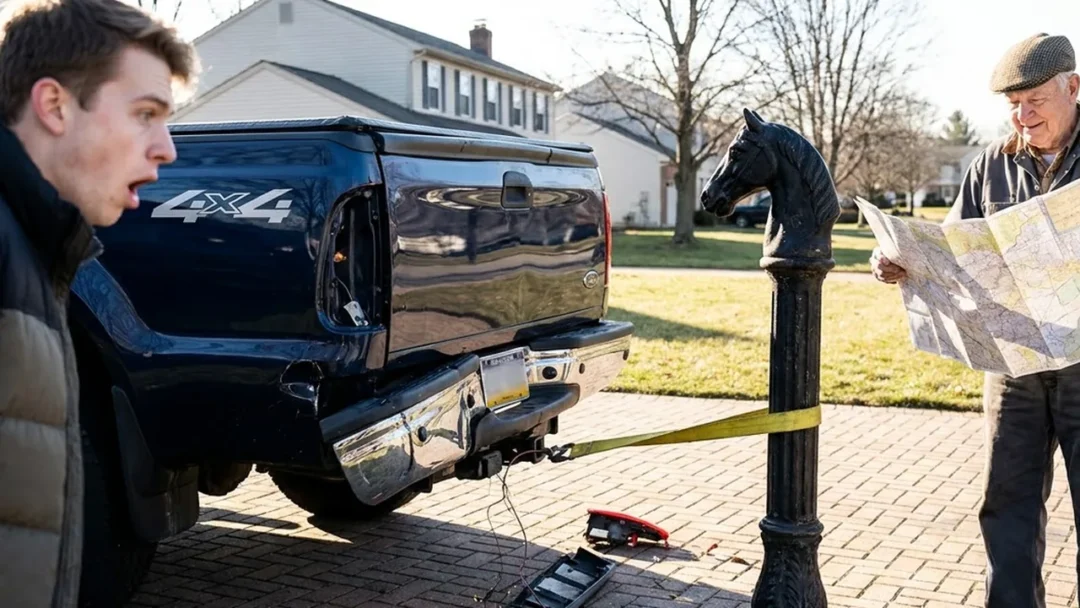
At the exact midpoint of the shared driveway, marking the surveyed boundary between the two parcels, stood an antique cast-iron horse-head post. Cast in 1928 by the Columbus Machine and Foundry Works, the heavy iron pillar stood three feet above the brick grade, its surface oxidized into a deep, handsome patina of dark gunmetal gray. The top of the post was modeled into the classical head of a draft horse with an iron ring in its mouth, while its hexagonal base was adorned with an official municipal bronze medallion that read: “CITY OF COLUMBUS SURVEY MONUMENT — EST. 1928.”
The quiet morning calm of the cobblestone alley was brutally shattered by the throaty, unbaffled roar of an eight-cylinder engine accelerating down the narrow street.
A brand-new, midnight-black GMC Sierra Denali crew-cab pickup truck turned sharply into the carriageway, its wide tires bouncing violently over the uneven brick pavement. The truck was an imposing seventy-thousand-dollar piece of modern Detroit engineering, fitted with a gleaming chrome front grille, polished chrome mirror caps, and a massive, sculpted chrome rear bumper loaded with ultrasonic parking sensors and integrated corner steps. The truck squeaked as its oversized tires brushed within inches of Walter’s pristine limestone foundation stones before the driver slammed on the brakes.
The driver’s door swung open with a heavy thud, and Chad Bradford hopped down onto the brick driveway. At thirty-eight, Chad was an aggressive corporate rental landlord who owned nineteen scattered properties throughout Columbus. He was dressed in high-end athleisure wear, expensive white running shoes, and polarized sunglasses, clutching an iced latte in one hand and an iPhone in the other. Chad had purchased the adjacent brick duplex six months earlier, turned it into a high-density short-term rental, and had spent every week since complaining that the historic carriageway was too narrow to park two modern full-size pickup trucks side-by-side.
Chad took a sip of his coffee, threw the plastic cup into the bed of his truck, and marched over to where Walter stood sweeping.
“Krause,” Chad snapped, pointing an impatient finger directly at the iron horse-head post. “I’m having a luxury paving crew come out here on Monday to lay down commercial blacktop and stripe this alley for four parking spots. This rusty iron hitching post sits six inches over my easement line. It’s blocking my tenants’ passenger doors. I’m taking it out this morning.”
Walter stopped sweeping, resting both hands on the smooth ash handle of his broom. His gray eyes met Chad’s hidden gaze behind the sunglasses with the steady, calm patience of granite.
“Good morning, Chad,” Walter replied, his voice deep, gravelly, and unhurried. “You will not be paving this carriageway, because the historic district code prohibits asphalt over nineteenth-century vitrified paving bricks. And you will certainly not be removing this post. That is not a decorative garden ornament. It is an official 1928 municipal civil survey benchmark, established under City Ordinance seventy-four.”
Chad scoffed loudly, throwing his head back in arrogant laughter. “City Ordinance from nineteen twenty-eight? Give me a break, Walter! This is twenty-twenty-six. I don’t care about a piece of junk iron that people tied horses to before the Great Depression. My property line extends to the center of this drive, and anything that restricts my commercial parking pad is an actionable nuisance.”
Chad turned, walked to the open tailgate of his Denali, and pulled out a heavy, thirty-foot industrial yellow kinetic recovery tow strap rated for thirty-five thousand pounds of break strength. The heavy nylon webbing had forged steel safety snap-hooks on both ends.
With an arrogant, mocking grin, Chad walked back to the boundary post, looped the yellow strap twice around the cast-iron horse’s neck, and snapped the forged hook tightly onto the heavy metal collar.
The preservation of German Village was born from a fierce grassroots movement in the early nineteen-sixties, when a coalition of local craftsmen, historians, and working families fought to prevent urban renewal bulldozers from leveling the historic brick cottages. Established by German immigrants in the mid-nineteenth century, the neighborhood was an architectural treasure of Italianate and Queen Anne cottages constructed with vitrified paving bricks fired from local Hocking Valley clay. The streets were laid out with narrow carriageways designed for horse-drawn dray wagons delivering coal and beer barrels. To maintain the district’s authentic historical integrity, the City of Columbus had enacted some of the most comprehensive municipal preservation codes in the Midwest, strictly regulating exterior paint colors, masonry pointing, and historic street furniture.
Chad Bradford represented a new and destructive breed of urban speculator. Having made quick profits flipping suburban residential properties in Delaware County, he had turned his attention to historic urban cores, purchasing properties under a dozen different limited liability companies and converting historic homes into high-turnover bachelor party pads and unpermitted Airbnb rentals. To maximize his rental yield, Chad sought to squeeze as many vehicles into the shared driveways as possible, disregarding the centuries-old easements that gave neighboring homeowners shared access. For six months, he had harassed Walter Krause with threatening text messages, claiming that the historic carriage post was an illegal barrier to commerce that lowered his rental revenues. But Walter had stood his ground with the quiet fortitude of an old stonemason who understood that real property rights are anchored in historical deeds, not temporary rental trends.
The morning air in the valley was crisp with the scent of fallen leaves and distant woodsmoke from historic fireplaces. Walter Krause adjusted his flat wool cap, looking down the red brick alleyway. Every brick in this carriageway had been laid by hand in 1894 by German immigrants who had fled European turmoil to build an honest life with their trowels and plumb bobs. They had carved drainage swales, built limestone retaining ledges, and anchored hitching posts so that their horses would have a secure resting place while wagons unloaded winter provisions. To treat this heritage as an inconvenient parking nuisance was to desecrate the sacrifices of the men and women who had built the city.