The Hundred Kilo Harvest Walk And The Counterfeit Fertilizer Scandal
CHAPTER 1: THE BOUNCING PLANK
The morning sun rose over the vast, black-loam horizons of Black Hawk County, burning the river mist off the metal grain silos of the Cedar Valley Agricultural Cooperative. It was seven-thirty on a crisp Thursday in early May. Across fifty square miles of eastern Iowa, the spring planting window was narrowing to an urgent, high-stakes deadline. The soil temperature had finally reached fifty-five degrees, corn seeders were lined up along every county blacktop, and three hundred family farms were locked in a desperate race against oncoming weekend thunderstorms to dress their fields with potassium and nitrogen.
At the cooperative’s loading dock, the air was thick with the chalky scent of raw agricultural limestone and diesel exhaust.
A heavy, sixteen-foot-long, eight-inch-wide oak plank bridged the two-foot gap between the high concrete dock edge and the wooden stake-bed of a nineteen-seventy-four Chevrolet C60 farm truck. The timber was weathered, stained with decades of spilled motor oil, and flexed dangerously over a four-foot drop into the crushed limestone drainage ditch below.
Standing in the center of the concrete dock, two young seasonal farmhands—Luke Bradley, twenty-four, and Seth Miller, twenty-five—were struggling with a single fifty-kilogram burlap sack of dense, granular potash. Both young men were broad-shouldered, over six feet tall, and possessed of modern gym-sculpted physiques, their biceps bulging beneath sleeveless shirts. Yet between them, the shifting, dense one-hundred-and-ten-pound burlap mass was an unwieldy, exhausting dead weight.
“Drop it, Luke! Drop it!” Seth gasped, his face turning an alarming shade of mottled scarlet as sweat stung his eyes. “The burlap’s slipping through my gloves! It’s cutting my fingers to pieces!”
With a dull, heavy thud that puffed a cloud of white dust into the morning air, the sack crashed onto the concrete floorboards. Both young men dropped to their haunches, gasping for breath, their forearms shaking from isometric fatigue.
“How the hell does anybody load five tons of this by hand?” Luke groaned, rubbing his lower back where the lumbosacral joints burned. “My spine feels like it’s compressed two inches. We need the forklift, Seth. Nobody can carry these bags across that bouncing board without breaking their neck.”
From behind a row of wooden grain flats, a quiet, rhythmic footstep approached.
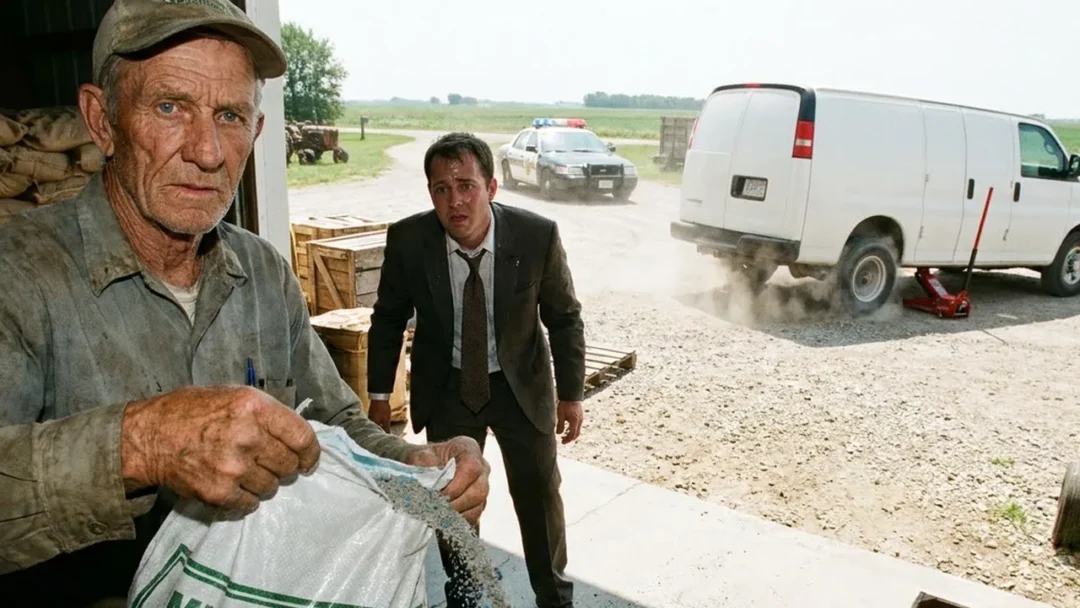
Caleb Thorne stepped onto the dock. Caleb was seventy-two years old, standing just five feet six inches tall and weighing a lean, wiry one hundred and forty-five pounds. He wore washed-out denim work overalls over a faded blue cotton work shirt, his silver hair tucked under a grease-stained seed cap. His face was weathered like dried cedar by fifty years of relentless prairie sun, biting winter blizzards, and summer hail. His frame was spare, lacking the swollen muscle bellies of the young gym lifters, but his shoulders were broad, sloping with the dense, functional sinew that only decades of uninterrupted manual labor can forge.
Caleb did not ask for a hydraulic hand-truck, nor did he wait for the cooperative’s forklift to warm its hydraulic lines.
He walked up to the pallet of fifty-kilogram sacks. With a fluid, practiced motion that looked completely casual, Caleb bent his knees into a disciplined quarter-squat, hooked his bare, leathery palms beneath the ears of two burlap bags, and drove upward through his heels.
In a single, unbroken arc, Caleb swung one fifty-kilogram sack onto his left shoulder, followed instantaneously by a second fifty-kilogram sack onto his right.
One hundred kilograms—two hundred and twenty pounds of dense, shifting mineral dead weight—rested balanced across the seventy-two-year-old farmer’s trapezius muscles. His spine did not buckle. His knees did not waver. His breathing remained as calm and steady as an idling tractor engine.
Without breaking stride, Caleb stepped directly onto the eight-inch oak plank.
The sixteen-foot timber bowed deeply beneath the combined three-hundred-and-sixty-pound load of man and mineral, dipping four inches in the center like a springboard. Luke and Seth watched in stunned silence, their mouths hanging open, fully expecting the elderly farmer to lose his footing and pitch headfirst into the ditch.
Caleb did not even glance down at his boots.
He walked the bouncing, flexing plank with the relaxed, rolling cadence of a veteran sailor crossing a rolling deck. He utilized the timber’s upward rebound to carry his momentum, his core absorbing the vertical vibration with micro-adjustments of his hips, his balance absolute. He stepped smoothly off the plank onto the truck bed, lowered his shoulders, and eased both fifty-kilogram bags onto the wooden floorboards with a soft, controlled rustle of burlap.
“If you fight the sack with your arms, boys, you’ll be broken by noon,” Caleb said softly, turning back toward the dock without a single drop of sweat on his brow. “You have to carry the weight on your skeleton, not your meat. The bones don’t get tired.”
Before the young men could answer, the aggressive honk of an electric horn cut through the cooperative yard.
A sleek, white commercial cargo van with tinted windows and out-of-state plates pulled onto the gravel apron, kicking up dust as it braked inches from Caleb’s truck bumper. The side panels bore a freshly decaled, high-gloss logo: APEX AGRO-CHEMICAL WHOLESALERS – DIRECT GERMAN IMPORTS.
The driver’s door swung open, and Julian Vance stepped out onto the gravel.
The biomechanics of carrying hundred-kilogram loads across narrow surfaces represents a specialized branch of rural physiology. When an individual attempts to lift an unwieldy, flexible sack using predominantly bicep and lumbar flexion, the shear stress exerted upon the L4-L5 and L5-S1 intervertebral discs exceeds eight hundred pounds of compressive force. Without a locked posterior kinetic chain, the erector spinae muscles rapidly deplete their cellular adenosine triphosphate reserves, triggering acute muscular tremors and catastrophic spinal misalignment. However, veteran agricultural laborers like Caleb utilize an ancient method known as axial skeletal balancing: the sack is positioned so that seventy percent of the weight rests directly over the cervical-thoracic junction, allowing the vertical compressive force to travel straight through the thoracic cage, pelvis, and femurs into the ground. By maintaining a constant, low center of gravity and utilizing micro-flexions of the ankles, an experienced farmer transforms an eight-inch flexible timber into an extension of his own nervous system, moving with dynamic equilibrium where younger, gym-trained athletes collapse under static strain.