The One Arm Weighted Pull Up And The Fake Welder Fraud
CHAPTER 1: THE CHAINS ON THE RAFTER
The late-afternoon sun cut through the high clerestory windows of Elihu Miller’s historic Pennsylvania bank-barn, casting long, golden shafts of dust-mote light across forty feet of cathedral-like timber framing. Built in eighteen-seventy-two from solid hand-hewn white oak, the massive structure had sheltered four generations of dairy cattle, cured hundreds of tons of clover hay, and withstood century-long Susquehanna gales without shifting a fraction of an inch on its limestone foundations.
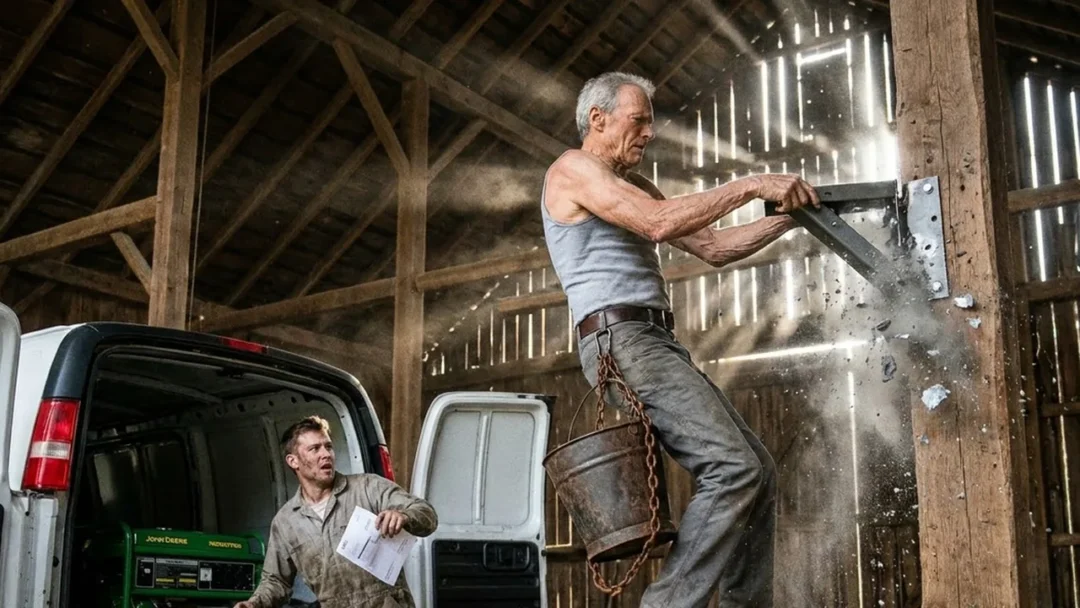
High above the threshing floor, suspended nine feet in the air from a massive twelve-inch-square oak purlin tie-beam, hung Elihu Miller.
Elihu was seventy-three years old, standing five feet nine inches tall, with a broad, compact torso, shoulders like carved granite blocks, and a close-cropped silver beard that outlined a jaw of unyielding iron. He wore a faded grey sleeveless cotton undershirt and heavy canvas work trousers tucked into grease-stained oilskin work boots. His skin was cross-hatched with pale, silvery lines—the indelible badge of forty-five years spent inside the roaring fireboxes of commercial steamships and high-pressure power generation stations as a master union boilermaker.
Clipped to the heavy forged D-ring of his four-inch wide leather rigger’s belt was an antique five-gallon galvanized steel bucket.
The bucket was filled to the brim with three-eighths-inch high-test grade-seventy transport logging chains, coiled tight and weighing exactly forty-two pounds on the grain scale. The rusty iron links clinked softly in the stillness of the barn, swinging gently between Elihu’s boots.
Elihu did not have two hands on the overhead timber.
His left arm was tucked casually behind the small of his back, his fingers resting motionless against his belt. His entire body weight—one hundred and sixty-eight pounds of lean, dense sinew plus forty-two pounds of cold iron chains, totaling two hundred and ten pounds of dead suspended mass—hung entirely from the four bare fingers of his right hand, clamped over the squared top edge of the rough-sawn white-oak beam.
There was no preliminary swinging, no desperate kicking of his boots, and no frantic momentum.
With the terrifying, effortless mechanical control of an industrial electric hoist, Elihu drew a measured breath through his nose, engaged the unilateral latissimus dorsi and brachialis of his right side, and pulled.
His right elbow tracked smoothly downward toward his ribcage. The muscle fibers across his back bunched into thick, undulating cables of biological steel, his scapula retracting with clockwork precision. In two seconds of pure, unbroken concentric contraction, Elihu pulled his chin cleanly over the top edge of the twelve-inch timber beam.
He paused at the apex of the hold for two full seconds, his eyes level with the swallow nests in the high rafters, before lowering his body back to a dead hang with the same smooth, decelerating control.
Thirty feet below on the threshing floor, leaning against the polished fender of an idling commercial white work van, Tyler Riggs stood watching with his jaw slack and his paper invoice fluttering in his hand.
Tyler was twenty-eight years old, thick-set, with slicked-back dark hair, wearing brand-new commercial coveralls with embroidered patches reading: RIGGS PRECISION STRUCTURAL WELDING & FABRICATION – CERTIFIED INDUSTRIAL RATINGS. In his right hand, Tyler held a clipboard bearing a handwritten invoice for three thousand two hundred dollars, while his welding mask hung loosely from his left elbow.
For the past three hours, Tyler had been supposedly installing an industrial steel hoist bracket on the barn’s central load-bearing oak post—a heavy cantilevered assembly intended to hang a motorized electric block-and-tackle for lifting tractor engines and silage wagons.
Tyler had taken the job with aggressive, fast-talking confidence, demanding cash upfront and boasting of his elite aerospace certifications. But seeing an elderly pensioner performing weighted one-arm pull-ups with a bucket of chains from a raw ceiling beam had momentarily derailed his sales pitch.
Then, the modern scammer’s defense mechanism clicked back into gear. Tyler sneered, shaking his head with an arrogant chuckle as he stepped across the floorboards.
“Cute party trick, pops,” Tyler scoffed, tapping the paper invoice against the clipboard with theatrical impatience. “I guess that’s what guys did for exercise before people had gym memberships and real jobs. But I’m on a commercial clock here. The bracket is fully welded and certified. That’ll be thirty-two hundred in cash or certified bank draft. Pay up so I can get to my next contract.”
Elihu Miller did not immediately answer.
With a smooth, silent movement, he released his right hand from the oak beam, dropped nine feet to the threshing floor, and landed in a soft, spring-loaded squat that absorbed the two-hundred-and-ten-pound impact with zero sound. He unclipped the chain bucket from his belt, set it against the timber post, and turned his pale grey eyes upon the young contractor.
“Three thousand two hundred dollars,” Elihu said softly, his voice carrying the deep, quiet hum of an industrial steam turbine. “You said on the telephone this bracket weld would hold five tons.”
Tyler puffed out his chest, waving his hand toward the freshly painted bracket mounted on the oak post.
“Five tons guaranteed, old man! Double-pass continuous fillet weld using heavy-duty structural electrodes! Solid industrial steel! That bracket will outlive this wooden barn by fifty years!”
Elihu walked slowly across the sawdust floorboards until he stood twelve inches from the newly installed bracket. He tilted his head, squinted his eyes, and began to inspect the metal.
The physiological conditioning of high-angle boilermaking and industrial rigging produces neuromuscular recruitment patterns that are practically nonexistent in commercial fitness environments. In the enclosed boiler shells of maritime transport vessels, where temperatures routinely exceed one hundred and twenty degrees and workspace clearances are restricted to thirty-inch crawlways, a boilermaker cannot rely on conventional bilateral barbell movements. Every weld, rivet, and pipe section must be positioned, aligned, and clamped using unilateral isometric tension while suspended from safety lanyards or hanging from temporary staging brackets. Over decades of such unyielding labor, the neuromuscular pathways governing unilateral scapular retraction, brachialis engagement, and forearm flexor endurance become extraordinarily dense, creating an unyielding biological framework capable of generating hundreds of pounds of explosive single-arm pulling torque.
The architecture of a Pennsylvania bank-barn is an engineering marvel designed to harness gravity and topography for maximum agricultural efficiency. Built directly into the natural slope of a hillside or ‘bank,’ the structure features a ground-level lower floor constructed of massive limestone masonry walls up to three feet thick, housing dairy cattle and horses where the thermal mass of the earth provides natural winter warmth and summer cooling. Above this stone basement, the cavernous upper threshing floor is accessed directly from the high side of the hill by heavy farm wagons, allowing tons of loose hay and grain to be unloaded at wagon height and dropped downward into storage mows via gravitational chutes. The structural framework relies on mortise-and-tenon joinery secured with hand-carved locust wood trunnels or ‘tree-nails,’ creating an interlocking timber skeleton that can flex under severe wind loads without loosening.