The Eighty Kilogram Millstone And The Imperial Jade Discovery
CHAPTER 3: THE LEVER AT CEDAR CREEK
The heavy oak double doors of the mill’s grinding room were thrown open, and Julian Vance stepped across the threshold, flanked by two burly men wearing private security badges and tactical utility vests. Behind them stood two commercial freight handlers wheeling a heavy-duty hydraulic lifting dolly.
“Evening again, Arthur,” Julian said, his voice now stripped of all charm, replaced by cold, legalistic venom. “I told you we had business to conclude.”
Deputy Marcus Bell stepped into the center of the grinding room floor, his hand resting firmly on the grip of his service weapon. “Step back out into the courtyard, Mr. Vance. You’re trespassing on private property after sunset.”
Julian smirked, pulling an embossed legal document from his leather portfolio and holding it out toward the deputy. “Not according to the Circuit Court of Fairfax County, Officer Bell. This is an Emergency Writ of Repossession and Cultural Asset Seizure issued at four-fifteen this afternoon. Black Ridge Antiquities Trust holds a certified UCC-1 lien on all architectural and mineral assets salvaged from the historical Shenandoah mill district, pursuant to an outstanding judgment against the former Cedar Creek Waterway Authority.”
Marcus took the document, scanning the lines under his flashlight. “The Cedar Creek Waterway Authority was dissolved in nineteen-sixty-eight. This lien was purchased from a defunct shell company three days ago. This isn’t a valid county attachment.”
“It has a judge’s stamp, Deputy,” Julian replied coldly, gesturing to his security guards. “Which gives my recovery team full legal authority to secure the asset. Take the stone.”
The two security guards—both former collegiate powerlifters weighing over two hundred and twenty pounds—stepped toward the heavy walnut drafting table, reaching for the edges of the eighty-kilogram wheel.
Arthur did not shout, nor did he reach for a weapon. He stood up from his workbench, walking slowly across the timber floorboards with the unhurried grace of an old sailor who knew every rolling wave of his ship.
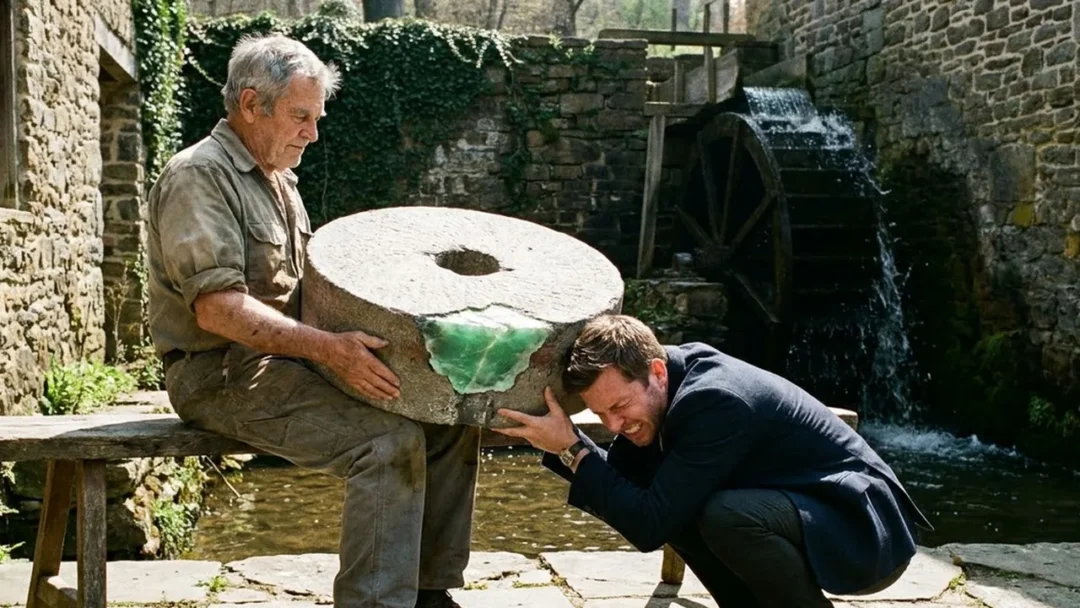
“Gentlemen,” Arthur said softly, placing his bare palm on the top rim of the upright stone. “You’re trying to move an eighty-kilo millstone with your lower backs. That’s a very fast way to end up in the regional orthopedic clinic.”
The lead guard sneered, ignoring the warning. He stepped beside the table, planted his steel-toed boots, and wrapped both gloved hands around the stone’s rough rim, heaving upward with a deep, guttural grunt of maximum effort.
The stone did not rise. The heavy walnut table groaned under the friction, but the dense eighty-kilogram dead weight remained anchored to the wood as if bolted to the center of the earth.
“Get on the other side, Frank!” the guard gasped, his face turning crimson as his biceps trembled under the futile load. “Lover it onto the dolly!”
The second guard stepped up, jamming the flat blade of a five-foot steel crowbar beneath the edge of the stone, preparing to lever the weight upward by force.
Arthur moved with blinding, effortless efficiency.
He didn’t fight the crowbar. Instead, he reached out with his left hand, caught the round balance rim of the stone, and applied a subtle, five-pound downward torque to the opposite edge—using the stone’s own eighty-kilogram rotational inertia as a crushing counterweight.
CLAAANG!
The heavy steel crowbar snapped violently downward out of the guard’s grip, its tempered steel handle striking the timber floor with concussive force, numbing the man’s hands up to his elbows. Before the guard could react, Arthur nudged the upright stone forward half an inch on its rounded rim, rolling the massive mass directly onto the blade of the pry bar, pinning the steel tool to the floorboards under eighty kilograms of immovable granite and jade.
“One man with balance can hold twenty tons on a fulcrum,” Arthur murmured, looking down at the two winded guards with calm, unblinking authority. “A master millwright learns that before he cuts his first tooth on a waterwheel.”
Julian’s face twisted in rage. “Enough of this backwoods parlor trick! Frank, pull your sidearm and cuff this old man for obstructing a judicial order!”
“Nobody is drawing a weapon in this mill, Julian,” Deputy Marcus Bell’s voice cut through the room like an icy whip. Marcus had drawn his Glock 17, holding it at low-ready, his police radio keyed to dispatch. “Drop your hands to your sides, both of you. I just ran the docket number on your emergency writ. The Fairfax County clerk’s office shows that docket belongs to a commercial zoning dispute in Reston. This signature is an electronic forgery.”
Julian took a step back toward the open courtyard doors, his arrogance beginning to fray at the edges. “You’re interfering with a federal consignment, Bell! Do you have any idea who purchased this piece?!”
“I don’t care if the President of the World Bank purchased it,” Marcus said, stepping forward with his handcuffs. “You forged a judicial seal in the Commonwealth of Virginia. Turn around and face the wall.”
Suddenly, from the darkness of the courtyard outside, the high-pitched wail of state police sirens echoed through the valley, accompanied by the flashing blue-and-red strobes of three Virginia State Police cruisers racing across the Cedar Creek bridge.
The architectural layout of Cedar Creek Mill had been engineered specifically to manipulate heavy gravitational loads with minimal human exertion. Throughout the eighteen-hundreds, millwrights had incorporated an intricate system of wooden overhead crane beams, cast-iron wall pulleys, and forged counterweight hooks that allowed a single operator to lift, flip, and redress four-thousand-pound runner stones without fracturing the delicate cutting furrows. The floorboards beneath Arthur’s boots were two-inch-thick tongue-and-groove virgin white oak, supported by twelve-by-twelve hand-hewn chestnut joists anchored directly into the limestone foundation bluffs. Every timber joint had been secured with seasoned hickory trunnels—wooden pegs that expanded with ambient humidity, creating an immovable structural frame that absorbed the continuous, low-frequency mechanical vibrations of the twelve-foot waterwheel turning outside in the tailrace. When Julian’s private security guards attempted to bully their way across the threshold with five-foot commercial pry bars, they were not merely challenging an elderly miller; they were attempting to leverage their modern muscular aggression against two centuries of integrated mechanical architecture.
Arthur’s naval salvage background had trained him in the brutal realities of underwater kinetic friction and mass displacement during the post-war cleanup of damaged harbor facilities in the Western Pacific. Working in zero-visibility conditions sixty feet beneath the surface of Subic Bay, clad in two-hundred-pound canvas diving suits and heavy lead-soled boots, Arthur had learned that brute force was a fatal flaw in the presence of heavy, unstable machinery. A diver who attempted to fight a swinging five-ton steel anchor cable or a slipping hoist chain was invariably crushed against the harbor bed. The only method of survival was to master the fulcrum, to recognize the precise center of gravity of an submerged object, and to utilize rotational shear to redirect kinetic momentum with minimal physical expenditure. As he stood across from the two burly corporate guards in the grinding room, his hands rested on the rough outer rim of the millstone with the absolute, relaxed certainty of a veteran diver holding a mooring line in a gale.