The Eighty Kilogram Millstone And The Imperial Jade Discovery
CHAPTER 2: THE SHANGHAI MANIFEST
The twilight had deepened into indigo over the Shenandoah Valley, and the cool night air off the Blue Ridge mountains smelled of pine resin and cold limestone springs. Inside the timber-framed office of Cedar Creek Mill, Arthur sat at his broad walnut drafting table beneath the warm yellow cone of a green glass banker’s lamp.
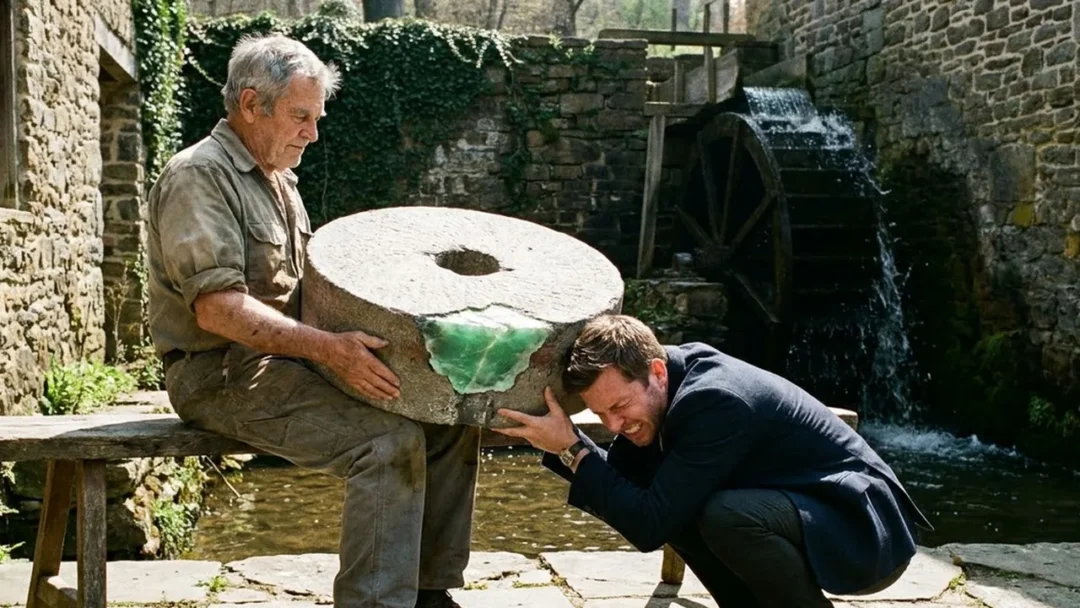
On the table before him lay the eighty-kilogram wheel, tilted at an angle against a heavy timber chock. Using a brass dental pick and a magnifying loupe clamped to his temple, Arthur was carefully cleaning away the hairline fracture where the cement crust had separated from the underlying gemstone.
Beside the stone lay a faded, oilcloth-wrapped dispatch case bearing the brass insignia of the United States Asiatic Fleet. From inside the case, Arthur had unrolled a fragile, rice-paper customs manifest dated November twelfth, nineteen-hundred and forty, stamped with the red vermilion seal of the Shanghai Maritime Customs Office.
The document was signed by his grandfather, Captain Edward Pendelton, a decorated naval officer and maritime courier who had served on the Yangtze River Patrol. Beneath the formal bureaucratic tariff headers was a hand-written addendum penned in iron-gall ink:
To my son Thomas: The Qianlong Imperial Jade Millstone, salvaged from the ancestral estate of the Chen lineage outside Suzhou ahead of the advancing forces. Sealed within eight centimeters of structural Portland cement to resemble ordinary ballast stone aboard the USS Luzon. This wheel represents the moral honor and legacy of three centuries. It must remain in the stewardship of our bloodline until it can be returned to public honor.
The door to the office opened with a soft creak, and Deputy Marcus Bell stepped inside, his uniform jacket zipped against the mountain chill, his hand resting casually on his gunbelt. Marcus was forty-two, a lifelong valley resident whose family had farmed corn along the creek for four generations.
“Evening, Arthur,” Marcus said, pulling off his campaign hat and glancing at the massive stone on the table. “I caught Julian Vance’s Mercedes tearing through the covered bridge at sixty miles an hour twenty minutes ago. The man looked like he’d seen an archangel. What did he try to pull this afternoon?”
Arthur looked up through his loupe, gesturing toward the chipped section of the stone. “Julian thought he was buying sixty dollars worth of garden cement, Marcus. He found out the cement was only an envelope.”
Marcus walked over, leaning over the table. As his flashlight beam struck the exposed corner, the deputy inhaled sharply, his hand instinctively dropping from his belt. The emerald-green mineral seemed to drink the light, reflecting a deep, watery translucence that illuminated the dust motes in the room with a pale green glow.
“Sweet Lord Almighty, Arthur,” Marcus breathed softly. “I’ve seen jade carvings in the Richmond museums, but I’ve never seen a solid boulder of this color. What is that, sixty pounds of solid gem-grade jadeite?”
“Over one hundred and twenty pounds of pure Burmese Imperial jadeite inside a fifty-pound cement shell,” Arthur explained, pointing with his pick to a series of microscopic intaglio characters carved beneath the mineral skin. “Carved in the middle of the eighteenth century for the Qianlong Emperor’s private palace gardens. In nineteen-forty, my grandfather cast the cement shell around it so foreign military looters wouldn’t break it into jewelry beads. When the USS Luzon was scuttled in Manila Bay in forty-one, this stone was already safe in a cargo crate in Norfolk.”
Marcus shook his head in awe, but his expression quickly shifted to professional gravity. “Arthur, Julian Vance isn’t just an antique dealer. The state police financial crimes division has had him on a surveillance watch for eighteen months. He brokers private, off-the-books transactions for an international antiquities syndicate based out of Geneva and Hong Kong. If he knows what’s inside this stone, he won’t stop at waving a hundred-dollar bill.”
Before Arthur could reply, the calm silence of the mill valley was shattered by the screech of heavy tires on gravel outside.
Through the window, two pairs of blinding halogen headlights cut through the darkness. A black cargo van and an unmarked dark SUV pulled into the mill courtyard, parking in a defensive V-formation that blocked the narrow wooden bridge across Cedar Creek.
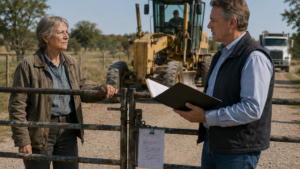
Five men stepped out of the vehicles, dressed in dark tactical jackets and carrying heavy steel pry-bars, pneumatic lifting jacks, and a commercial equipment dolly. Walking at the head of the group, clutching an embossed legal document in a leather portfolio, was Julian Vance.
Marcus stepped to the window, his hand unclipping the retention strap of his sidearm. “They didn’t waste any time, Arthur. And they didn’t bring an appraiser.”
The mineralogical composition of the Imperial Jade millstone represented a geological rarity that occurs only under the most extreme conditions of tectonic subduction. Genuine jadeite—chemically classified as a pyroxene mineral consisting of high-purity sodium aluminum silicate—crystallizes exclusively within high-pressure, low-temperature metamorphic zones where ocean floor crust is driven deep beneath continental plates. The vibrant, translucent emerald hue characterizing the highest grade of ‘Imperial’ jadeite is produced by the substitution of microscopic chromium ions within the aluminum crystalline lattice. Unlike modern commercial nephrite, which exhibits a fibrous, splintery fracture and a soapy, dull luster, high-grade Burmese jadeite displays an interlocking granular crystal structure that reflects light with an oily, glass-like brilliance and possesses a compressive strength exceeding that of structural alloy steel. For centuries, Chinese lapidary masters had reserved this specific material for royal ceremonial regalia, carving the stone with slow, water-slurried abrasive powders made of crushed garnet and quartz, a process requiring months of patient manual polishing to achieve a mirror finish.
Captain Edward Pendelton’s naval journals, preserved in the brass dispatch box on Arthur’s desk, detailed the chaotic final days of the International Settlement in Shanghai during the late autumn of nineteen-forty. Ahead of the imperial forces occupying the historic port cities of the Yangtze delta, prominent merchant families and scholars sought desperately to protect their ancestral cultural treasures from state-sponsored confiscation and black-market liquidation. The Chen family of Suzhou, renowned scholars and silk patrons whose lineage traced back to the Southern Song Dynasty, had entrusted the imperial garden wheel to Captain Pendelton during a covert midnight rendezvous along the Whangpoo River wharves. Pendelton, utilizing his authority as an American naval logistics officer, procured eight bags of high-early-strength Portland cement from the naval supply depot, constructing an ingenious wooden casting mold in the ship’s machine shop. By encasing the priceless jadeite disk within three inches of aggregate concrete, he transformed an imperial treasure into an unremarkable, oil-stained piece of marine engine ballast that passed undetected through military customs checkpoints aboard the gunboat USS Luzon.