The Eighty Kilogram Millstone And The Imperial Jade Discovery
CHAPTER 4: THE CORE OF EMPEROR QIANLONG
The grinding room of Cedar Creek Mill was flooded with bright white illumination as the state police forensic unit set up their portable halogen light arrays. Outside in the courtyard, Julian Vance and his two private security operatives sat handcuffed in the back of two separate patrol vehicles, their cell phones and documents seized by state investigators.
Standing beside Arthur at the walnut drafting table was Dr. Eleanor Vance-Chen.
Dr. Chen was fifty-one years old, distinguished, wearing a navy wool trench coat and wire-rimmed glasses, carrying a specialized Pelican case containing a portable Raman spectrometer and an X-ray fluorescence mineral analyzer. She was the senior curator of Asian antiquities at the Smithsonian Institution and the foremost authority on imperial jade diaspora artifacts in the Western Hemisphere.
“When Deputy Bell sent high-resolution macro imagery of the exposed fracture to our laboratory in Washington at eight o’clock tonight, I ordered a state police escort immediately, Mr. Pendelton,” Dr. Chen said, her hands trembling slightly with professional awe as she calibrated her handheld spectroscopic laser. “For seventy years, the international museum registry has listed the Qianlong Garden Disc as lost during the maritime evacuations of nineteen-forty.”
She placed the optical sensor of the spectrometer against the exposed green mineral vein, pressing the analysis trigger.
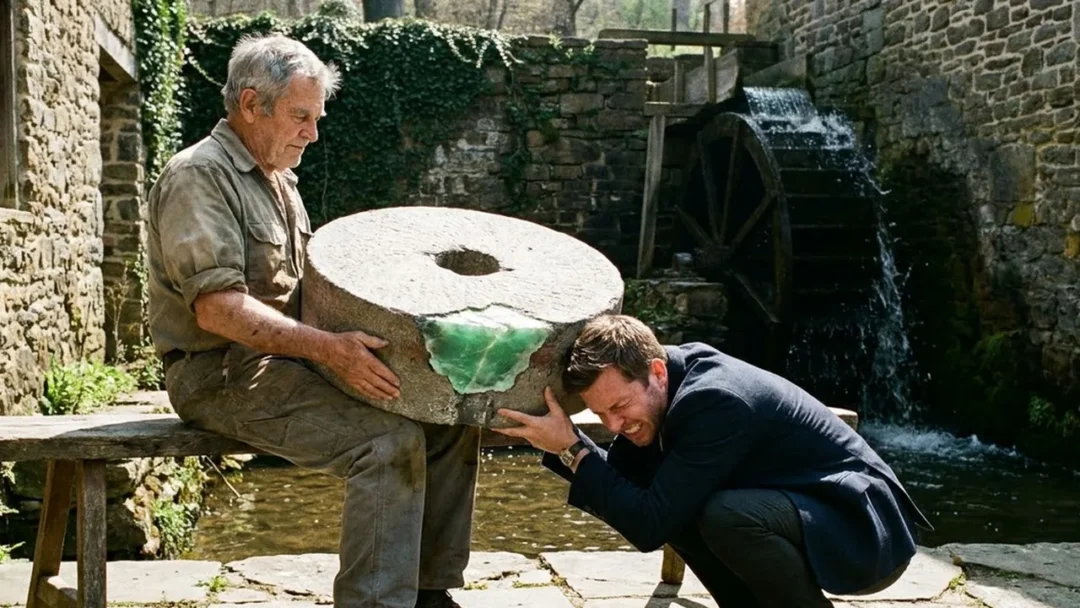
A sharp, diagnostic green laser beam pulsed through the translucent gemstone, illuminating the interior crystalline lattice with a deep, emerald-green brilliance that made the entire room glow like the canopy of an ancient rainforest. On Dr. Chen’s portable tablet monitor, spectral peaks formed instantly, tracing the chemical signature of pure sodium aluminum silicate with trace chromium concentrations exceeding three percent.
“Look at that spectrum,” Dr. Chen whispered, looking up at Arthur with tears of historical reverence in her eyes. “This is not ordinary ornamental nephrite. This is Old Mine jadeite from the historic Phakant deposits of northern Burma—the exact imperial tribute stone reserved exclusively for the private court of Emperor Qianlong in the mid-eighteenth century.”
She turned the stone slightly on its wooden chock, examining the inner border where the cement had cracked away from the rim. Using an ultraviolet wand, she revealed a microscopic engraving cut into the jade: four classical Chinese seal-script characters, framed by an imperial dragon motif.
“Bao Tian Di Zhi De,” Dr. Chen translated softly. “‘Treasure of the Virtue of Heaven and Earth.’ This was the cornerstone of the Emperor’s summer garden pavilion in the Old Summer Palace. The historical and cultural value of this single disc is completely incalculable. At private auction in Geneva, an unscrupulous buyer would have paid upwards of twenty million dollars.”
Arthur nodded slowly, his hand resting gently on the cool, smooth surface of the ancient stone. “My grandfather didn’t care about the millions, Dr. Chen. He promised the Chen family in Suzhou that he would keep it safe from looters and bomb craters. He poured the best Portland cement he could find around it, set it in the mill race, and used it to grind corn for the families of Shenandoah County for sixty years. He believed that stone belongs to the earth and the people, not to private vaults.”
“It seems Julian Vance had other plans,” Deputy Marcus Bell said, walking into the room carrying a seized manifest from Julian’s laptop. “State police cyber investigators just cracked Vance’s encrypted email server. Julian wasn’t taking this stone to a client in Great Falls. He had already secured an export container aboard an international air-freight transport departing Dulles International Airport at six o’clock tomorrow morning, bound for a private offshore holding company in Zurich.”
Dr. Chen’s expression hardened. “That export crate was registered under a forged diplomatic cultural-exchange waiver. Julian Vance’s syndicate was preparing to smuggle this national treasure out of the country before the sun came up.”
Arthur looked at the ancient green stone, then looked out the window toward the dark valley road. “A millstone that has turned for eighty years on Cedar Creek isn’t going to Zurich tonight, Marcus.”
“We need to transport this artifact immediately to the Smithsonian high-security depository in Washington,” Dr. Chen said urgently. “With Julian in custody, his syndicate partners will realize the operation has been compromised. They may attempt to intercept the transport before we reach Interstate Eighty-One.”
Arthur smiled a quiet, iron smile, reaching down to unhook a heavy forged-steel chain from the mill wall. “Let them try, Doctor. The Shenandoah Valley has held its ground against far worse than antique thieves.”
The spectroscopic verification of historical jadeite relies upon the non-destructive analysis of vibrational molecular modes through inelastic light scattering. When Dr. Eleanor Chen deployed her portable Raman spectrometer against the unpolished mineral fracture, the monochromatic laser excitation induced distinct optical phonon shifts at three hundred and seventy-five and seven hundred wavenumbers—a diagnostic spectral signature that distinguishes genuine jadeite from simulant minerals such as serpentinite, chrysoprase, and grossular garnet. Furthermore, the presence of localized luminescence bands at six hundred and ninety-one nanometers confirmed that the intense emerald green coloration was produced by chromium substitution within the octahedral sites of the pyroxene crystal structure, an unambiguous indicator of genuine Burmese jadeite of the highest imperial quality. In the clandestine antiquities markets of Geneva and London, private collectors and auction houses often utilized fraudulent chemical dyes and polymer impregnations—known in the trade as ‘B-grade’ and ‘C-grade’ treatments—to artificially enhance low-grade mineral specimens. But the stone resting upon Arthur’s timber table exhibited complete crystalline integrity, free of organic polymers or acid bleaching, possessing a natural refractive index of one point six six and a specific gravity of three point three four that placed its authenticity beyond legal or scientific doubt.