The Eighty Kilogram Millstone And The Imperial Jade Discovery
CHAPTER 5: THE AMBUSH ON THE BRIDGE
At midnight, a convoy of three vehicles departed Cedar Creek Mill, moving slowly down the narrow gravel road beneath the towering shadows of the Blue Ridge foothills. In the lead was Deputy Marcus Bell’s marked patrol cruiser, its low beams cutting through the mountain mist. In the center was the state police forensic van carrying Dr. Eleanor Chen and the eighty-kilogram imperial jade millstone, secured in a padded steel transit cradle. Bringing up the rear was Arthur Pendelton, driving his heavy-duty 1978 flatbed Ford truck, its eight-foot oak bed carrying four hundred pounds of heavy timber-clearing chains and an iron millwright’s timber-jack.
As the convoy approached the historic Cedar Creek Covered Bridge—a two-hundred-foot single-lane timber truss structure spanning a forty-foot rocky ravine—the night suddenly erupted into violence.
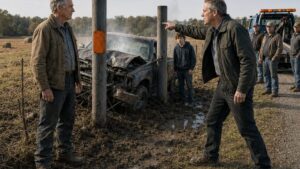
From the wooded turnout on the far side of the bridge, a customized, heavy-duty commercial timber transport truck shot forward without headlights, its massive steel bull-bar smashing directly into the front quarter-panel of Marcus Bell’s patrol cruiser.
CRASH-ROAAR!
The impact spun the cruiser sideways across the bridge approach, wedging the police vehicle against the timber guardrail and blocking the forward lane in a shower of sparks and shattered safety glass.
Before the forensic van could reverse, a second unmarked heavy pickup truck surged out of the creek bed behind them, ramming the rear of the van and boxing the transport vehicle onto the narrow wooden deck of the covered bridge.
Four masked men in tactical gear jumped from the trucks, armed with commercial pry-bars and tactical batons, led by a tall man shouting urgent commands over an open radio frequency.
“Blow the rear doors of the van!” the leader shouted, his voice echoing off the bridge timbers. “Grab the steel transport crate and drop it into the bed of the pickup! We have three minutes before the state police helicopter scrambles!”
Inside the crushed patrol cruiser, Deputy Marcus Bell was struggling to kick open his jammed driver’s door, dazed from the airbag deployment. In the passenger seat of the forensic van, Dr. Chen was desperately attempting to engage the internal security deadbolts.
Arthur Pendelton did not hesitate.
He slammed the transmission of his 1978 Ford into low-range four-wheel drive, stomped the accelerator, and drove the heavy front cattle-guard of his flatbed straight into the rear bumper of the ambush pickup, shoving the vehicle five feet forward and crushing its exhaust assembly against the bridge abutment.
Arthur kicked open his door, stepping onto the wooden bridge deck with the heavy, unhurried stride of an old master who had spent seventy years mastering immovable mass.
In his right hand, swinging with fluid, effortless momentum, he carried a four-foot, sixty-pound solid forged-steel millwright’s timber-jack—a massive lever tool used to lift and pivot five-ton waterwheel shafts.
“You boys picked the wrong bridge to block tonight,” Arthur said, his voice cutting through the mist with the chilling weight of an iron anchor.
The lead operative turned, raising a heavy steel pry-bar to strike Arthur across the head. “Out of the way, old man, or you go over the railing!”
Arthur didn’t flinch. As the pry-bar descended, Arthur took a single, fluid half-step inside the man’s arc. His left hand rose like an uncoiling steel cable, parrying the operative’s wrist in mid-air. With his right arm, he drove the blunt steel heel of the sixty-pound timber-jack downward into the bridge deck between the operative’s boots.
THUUUMP!
The concussive shockwave of solid steel striking the massive white-oak bridge timbers vibrated through the operative’s legs, shattering his balance. Before the man could recover, Arthur hooked the curved steel claw of the timber-jack behind the operative’s knee, gave a sharp, effortless lever pull, and dumped the two-hundred-pound attacker flat onto his back.
The second operative lunged with a tactical baton.
Arthur pivoted on his heel, using the heavy timber-jack as a vertical balance pole. He caught the baton blow on the iron shaft, rotated his wrists in a smooth, circular sweep honed from decades of turning millstone gearing, and ripped the weapon cleanly from the man’s grip.
With a single, explosive push of his palm, Arthur drove the operative backward into the side of the transport truck, knocking the wind from the man’s lungs with a sickening gasp.
From the far side of the bridge, the rumbling roar of diesel engines echoed through the trees.
Appearing through the mist came four massive farm tractors and two livestock haulers from the neighboring Shenandoah farms, led by Arthur’s nephew Thomas and three veteran valley cattlemen who had monitored the police radio frequency. The massive tractors blocked the far exit of the bridge, boxing the syndicate’s transport truck into an inescapable mechanical vise.
The remaining two operatives threw their weapons onto the wooden bridge deck, raising their hands in surrender as Deputy Marcus Bell kicked his way out of the cruiser with his service weapon drawn.
Arthur set the heavy iron timber-jack upright on the bridge timbers, resting his calloused hands on the handle as the morning mist began to glow with the first light of dawn.
“A wooden bridge built on Shenandoah oak has held forty tons of harvest every autumn for two centuries,” Arthur said softly, looking at the trapped syndicate operatives with quiet, unshakeable pride. “Did you really think a few city trucks could shake it?”
The structural engineering of nineteenth-century covered timber bridges in the Shenandoah Valley was predicated upon the Burr arch-truss system, a brilliant American synthesis of arch action and multiple king-post trusses patented by Theodore Burr in eighteen-hundred and four. Built in eighteen-fifty-eight to carry heavy freight wagons laden with flour, whiskey, and iron ore between Winchester and Staunton, the Cedar Creek Covered Bridge featured massive, curved white-pine arch ribs bolted directly to vertical king posts and bottom tension cords of seasoned white oak. When the syndicate’s transport trucks attempted to establish a high-speed roadblock upon the bridge approach, their drivers failed to recognize the structural dynamics of the timber deck. Unlike modern reinforced concrete highway spans, which possess rigid mass and high thermal expansion tolerances, a historic timber Burr arch bridge is a dynamic, load-sharing composite structure that deflects elastic energy through hundreds of interlocking mortise-and-tenon joints. By driving his heavy-duty flatbed truck into the rear bumper of the ambush vehicle, Arthur did not merely displace the syndicate pickup; he utilized the unyielding horizontal compression of the bridge’s timber abutments to trap the vehicle’s chassis against the bedrock wing-walls, converting thirty tons of static architectural mass into an immovable mechanical barricade.