The River View That Swallowed Rourke’s Last Lie
CHAPTER 1: AN UNOBSTRUCTED VIEW
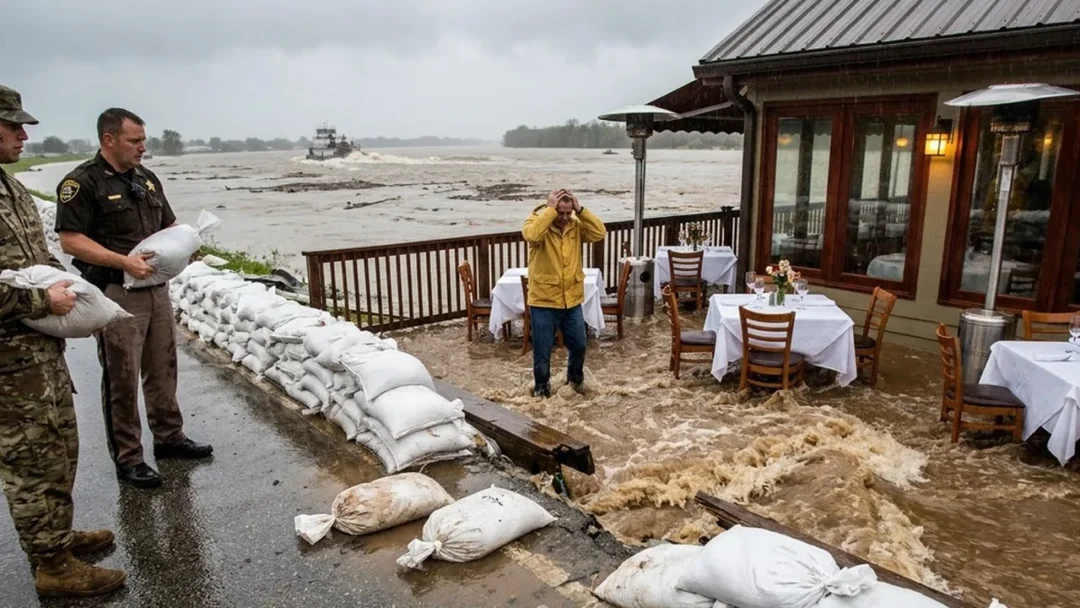
The Osage River had climbed eleven inches since dawn when Vincent Rourke walked onto the levee road in a yellow raincoat clean enough for a catalog. Around him, Missouri National Guard soldiers passed white sandbags along a line from the county dump truck to the temporary wall protecting Morrow Bend’s only evacuation route. Mud covered their boots, gloves, and faces. Rourke carried a folding utility knife.
Sergeant Naomi Bell stood on the crown of the road, reading the river by marks painted on an old cottonwood. The current moved whole branches now. A barge waited upstream for permission to clear the bend before navigation closed.
“Tear this down,” Rourke shouted. “My dinner guests pay for a river view, not a wall of dirt bags.”
Naomi stepped between him and the barrier. “County emergency order. Water reaches forecast crest in forty minutes. Stay behind the restaurant rail.”
Rourke pointed toward his lower dining deck, where white tablecloths and wine glasses had been set despite the evacuation advisory. “That is private commercial frontage.”
Deputy Caleb Dunn lifted another bag into place. “The road is public. So is the drainage easement.”
Rourke kicked the top tier. One bag dropped into the river, then two more. Brown water threaded through the gap. He cut the black tarp ties with his knife and pulled the plastic sheeting away from his deck ramp.
Naomi raised one hand to stop her soldiers from confronting him. A physical struggle on a wet levee could injure three people and weaken the wall further. She studied the gap, the road slope, and the side wing they had built that morning.
“Seal the road flank,” she ordered. “Let his opening drain to his parcel.”
Her engineers placed bags perpendicular to the wall, creating a short return that isolated the public road. Dunn switched on his body camera and told Rourke he was documenting intentional interference with flood control. Rourke laughed and demanded the deputy arrest the river.
Upstream, the waiting towboat throttled just enough to hold its barges against the current. The maneuver rolled a broad wake around the bend. Naomi saw the dark ridge travel across the swollen surface.
“Everybody high side,” she called.
The wake struck the missing bags. A two-foot surge burst through the opening Rourke had made and crossed his lower deck. Tables overturned. White cloth snapped around chair legs. Floral centerpieces vanished into brown water. A patio heater leaned, struck the rail, and went over with a splash.
Rourke stood ankle-deep, clutching his head. “Bring them back. Put the bags back now.”
Naomi kept her crew on the road wall. “We won’t block your view.”
The remark drew no laughter from the soldiers. They were watching a second wave of debris approach: a refrigerator, two fence rails, and a cottonwood limb thick as a man’s torso. Naomi assigned spotters with pike poles but forbade anyone from stepping onto the flooded deck. Moving water only knee-deep could sweep a person beneath its rail. The crew snagged a loose propane hose from dry ground and pinched its valve with a long-handled tool.
Rourke tried to direct them toward his wine cellar. Naomi told him life safety, public infrastructure, and hazardous materials came before inventory. He began listing bottle values. Dunn wrote each instruction and refusal into the incident log, including the fact that Rourke had ignored three county alerts delivered to his registered phone.
The restaurant’s kitchen crew gathered uphill. June Park counted them twice and reported one dishwasher missing until a cook remembered driving him home before the rain. Naomi required confirmation by phone. Assumptions became victims during floods. Five minutes later the young man answered, safe on the western ridge.
Only then did Naomi permit two soldiers to secure the restaurant’s exterior gas shutoff. They approached on lifelines, tested each board with a pole, and closed the valve while Dunn watched from the bank. Beneath them, water carried pale ribbons of insulation from somewhere under the deck. The material suggested the current had entered a cavity that should never have existed inside a regulated drainage path.
Dunn issued a citation for breaching an emergency barrier, but Naomi cared more about the water’s path. It should have drained through a swale beside the deck. Instead, it circled beneath the mahogany boards and boiled upward near the foundation. Something below was obstructing the public channel.
She ordered power cut to the lower restaurant and sent two engineers to secure floating propane cylinders. Rourke tried to descend after them. Dunn stopped him. “You created a moving-water rescue zone. Stay out.”
“I own every inch from the road to the river.”
“Your deed can argue with the flood after we survive it.”
Hydrologist Tessa Ward arrived in a county truck packed with gauges. Her forecast model showed the road should have six inches more freeboard than Naomi could measure. She checked the benchmark twice. “Either the river rose without three upstream sensors seeing it, or this wall is lower than the certified grade.”
Naomi sighted her laser level across the deck. The restaurant’s stone pilasters concealed the older embankment beneath imported fill. One section had been cut away for a grand stair to the water.
Soldiers pried loose a jammed chair. The current tore two deck boards free. Beneath them, set in a block of old concrete, a brass disk caught the storm light. Dunn washed mud from its face with bottled water.
UNITED STATES PUBLIC DRAINAGE SURVEY, it read. DO NOT DISTUR.
The monument stood six feet inside the restaurant’s claimed property line.